Artificial intelligence software may improve tuberculosis case detection through geographical targeting in Pakistan
Geographical targeting of active case finding for tuberculosis in Pakistan using hotspots identified by artificial intelligence software (SPOT-TB): study protocol for a pragmatic stepped wedge cluster randomised control trial
Pragmatic stepped wedge cluster randomised trialUnclear result
Does artificial intelligence software improve tuberculosis case finding yields in Pakistan?
Who
30
Mobile X-ray units and field teams in Pakistan · Pakistan
Compared
Intervention (MATCH-AI software)
Control (Existing approaches)
Main outcome
Difference in bacteriologically confirmed incident tuberculosis detected
Bottom line: This study protocol aims to investigate if artificial intelligence software improves tuberculosis case finding yields.
BMJ Open Respir Res · 2024-07-11Download image
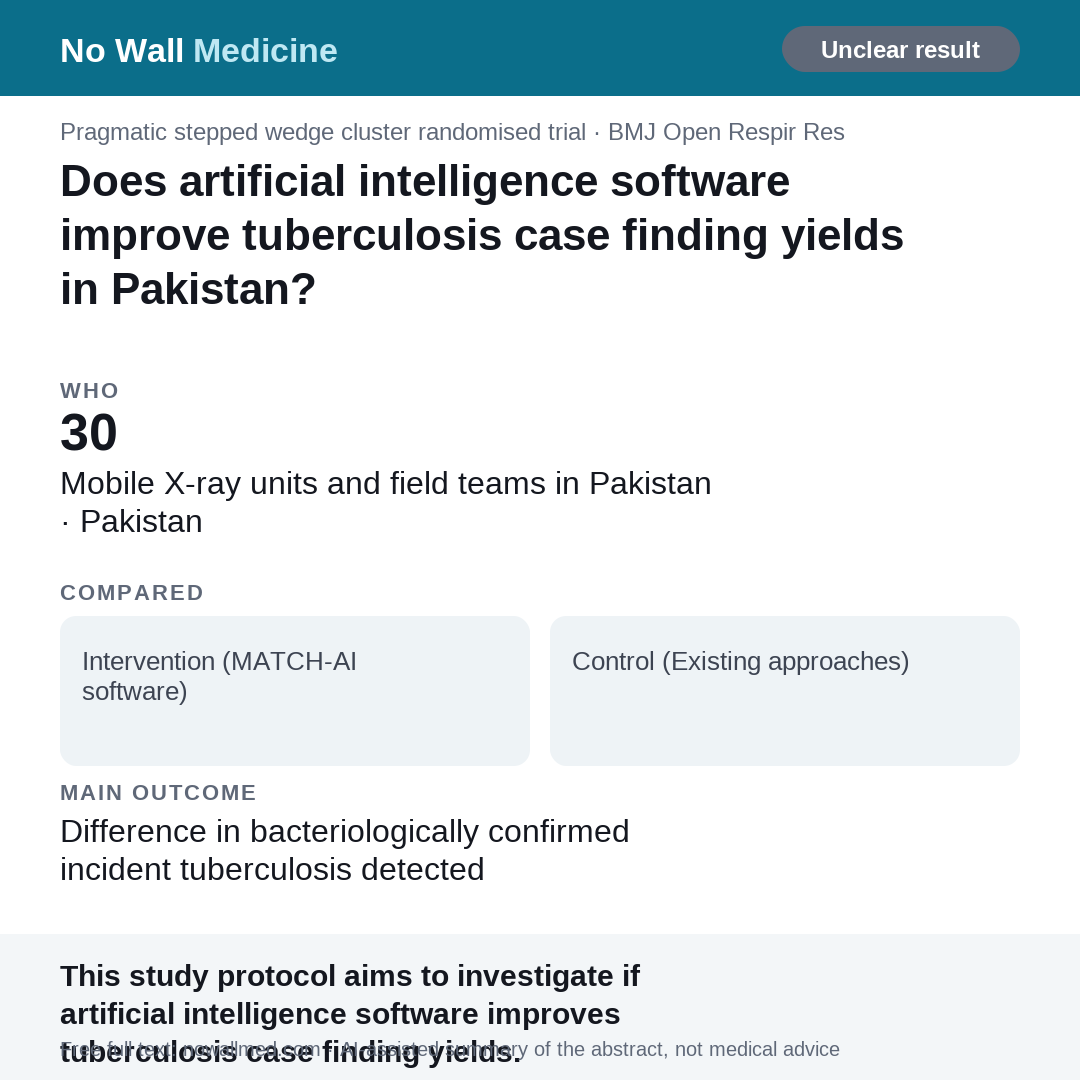
Clinical question: Does artificial intelligence software improve tuberculosis case finding yields in Pakistan?
Why it matters: Active case finding yields for tuberculosis have been lower than expected, and it is unknown if targeting high-prevalence areas using artificial intelligence can improve detection rates.
Key points
- The study will use a stepped wedge cluster randomised design to compare artificial intelligence software guidance against traditional site selection methods using 30 mobile X-ray units and field teams.
- The primary goal is to measure the difference in bacteriologically confirmed incident tuberculosis detected when using the MATCH-AI software to identify disease hotspots compared to existing approaches.
Headline and key points written with AI from the paper’s abstract, with every number checked against it. Read the paper before relying on them.
Abstract
Introduction
Pakistan has significantly strengthened its capacity for active case finding (ACF) for tuberculosis (TB) that is being implemented at scale in the country. However, yields of ACF have been lower than expected, raising concerns on its effectiveness in the programmatic setting. Distribution of TB in communities is likely to be spatially heterogeneous and targeting of ACF in areas with higher TB prevalence may help improve yields. The primary aim of SPOT-TB is to investigate whether a policy change to use a geographically targeted approach towards ACF supported by an artificial intelligence (AI) software, MATCH-AI, can improve yields in Pakistan. Methods and analysis
SPOT-TB will use a pragmatic, stepped wedge cluster randomised design. A total of 30 mobile X-ray units and their field teams will be randomised to receive the intervention. Site selection for ACF in the intervention areas will be guided primarily through the use of MATCH-AI software that models subdistrict TB prevalence and identifies potential disease hotspots. Control areas will use existing approaches towards site selection that are based on staff knowledge, experience and analysis of historical data. The primary outcome measure is the difference in bacteriologically confirmed incident TB detected in the intervention relative to control areas. All remaining ACF-related procedures and algorithms will remain unaffected by this trial. Ethics and dissemination
Ethical approval has been obtained from the Health Services Academy, Islamabad, Pakistan (7-82/IERC-HSA/2022-52) and from the Common Management Unit for TB, HIV and Malaria, Ministry of Health Services, Regulation and Coordination, Islamabad, Pakistan (26-IRB-CMU-2023). Findings from this study will be disseminated through publications in peer-reviewed journals and stakeholder meetings in Pakistan with the implementing partners and public-sector officials. Findings will also be presented at local and international medical and public health conferences. Trial registration number
NCT06017843.
Abstract reproduced under the article’s CC BY licence.
Topics
Cite this article
Zaidi SMA, Mahfooz A, Latif A, Nawaz N, Fatima R, Rehman FU. Geographical targeting of active case finding for tuberculosis in Pakistan using hotspots identified by artificial intelligence software (SPOT-TB): study protocol for a pragmatic stepped wedge cluster randomised control trial. BMJ Open Respir Res. 2024. doi:10.1136/bmjresp-2023-002079
Spotted a mistake? Suggest a correction
Top studies every Monday
The week’s key trials and guidelines in your specialties, plus any topics you follow. By email, free.
Get the weekly digest