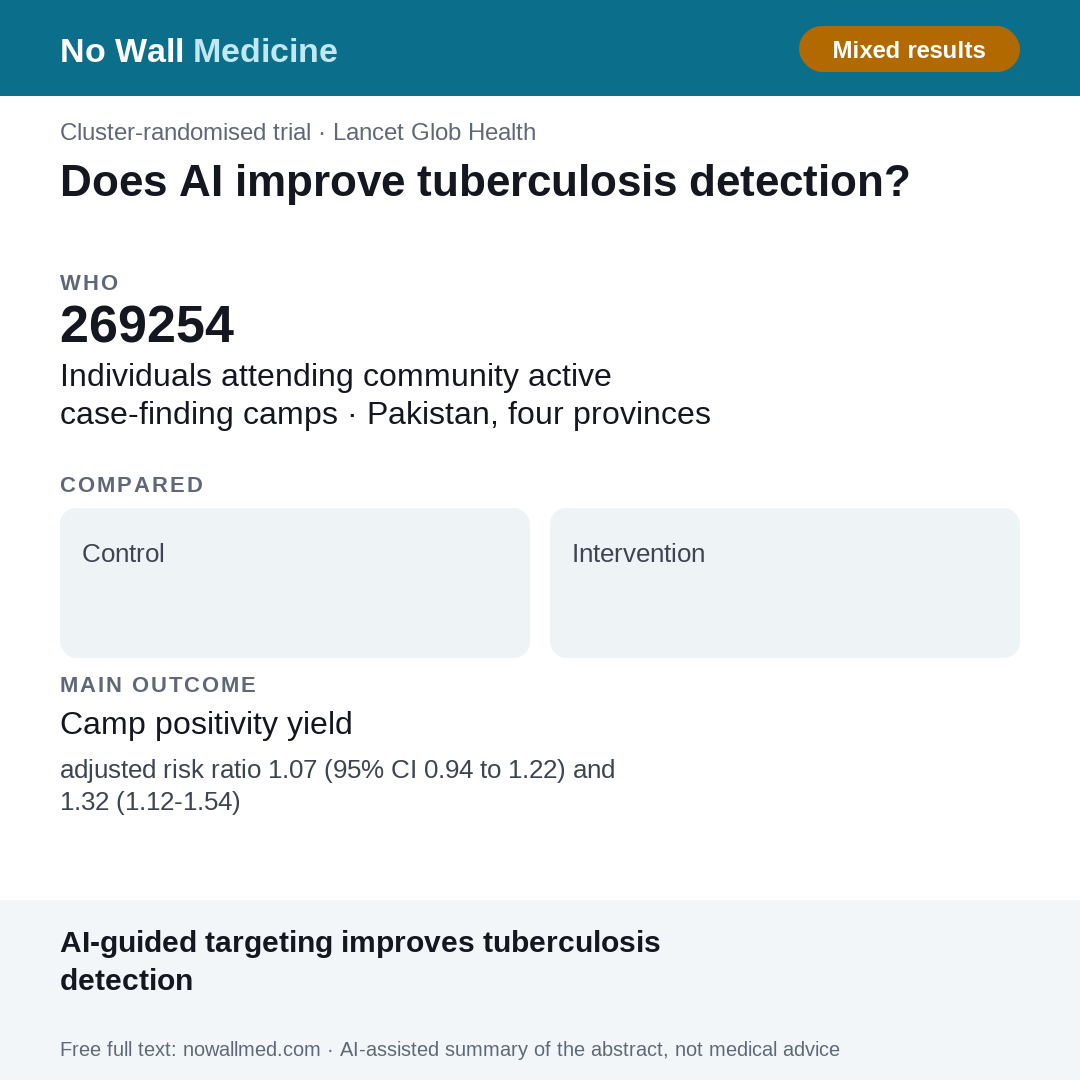
AI-guided targeting had 32% higher tuberculosis detection in validated analysis
Geographical targeting of active case-finding for tuberculosis in Pakistan using artificial intelligence software (SPOT-TB): a pragmatic, stepped wedge, cluster-randomised control trial
Cluster-randomised trialMixed results
Does AI improve tuberculosis detection?
Who
269254
Individuals attending community active case-finding camps · Pakistan, four provinces
Compared
Control
Intervention
Main outcome
Camp positivity yield
Result: adjusted risk ratio 1.07 (95% CI 0.94 to 1.22) and 1.32 (1.12-1.54)
Bottom line: AI-guided targeting improves tuberculosis detection
Limitation: Routine data did not capture implementation indicators
Funded by: Gates Foundation, Global Fund
Lancet Glob Health · 2026-11-12Download image
Clinical question: Does AI improve tuberculosis detection?
Key points
- 30 mobile x-ray van teams in 68 districts of Pakistan were randomised to AI-guided or conventional site selection.
- AI-guided targeting had a 32% higher camp positivity yield in validated per-protocol analysis.
- Intention-to-treat analysis showed a 7% higher yield, but this was not statistically significant.
Headline and key points written with AI from the paper’s abstract, with every number checked against it. Read the paper before relying on them.
Spotted a mistake? Suggest a correction