Gestational age at birth is associated with body mass index changes from infancy through adolescence
Gestational age at birth and body size from infancy through adolescence: An individual participant data meta-analysis on 253,810 singletons in 16 birth cohort studies
Individual participant data meta-analysisMixed results
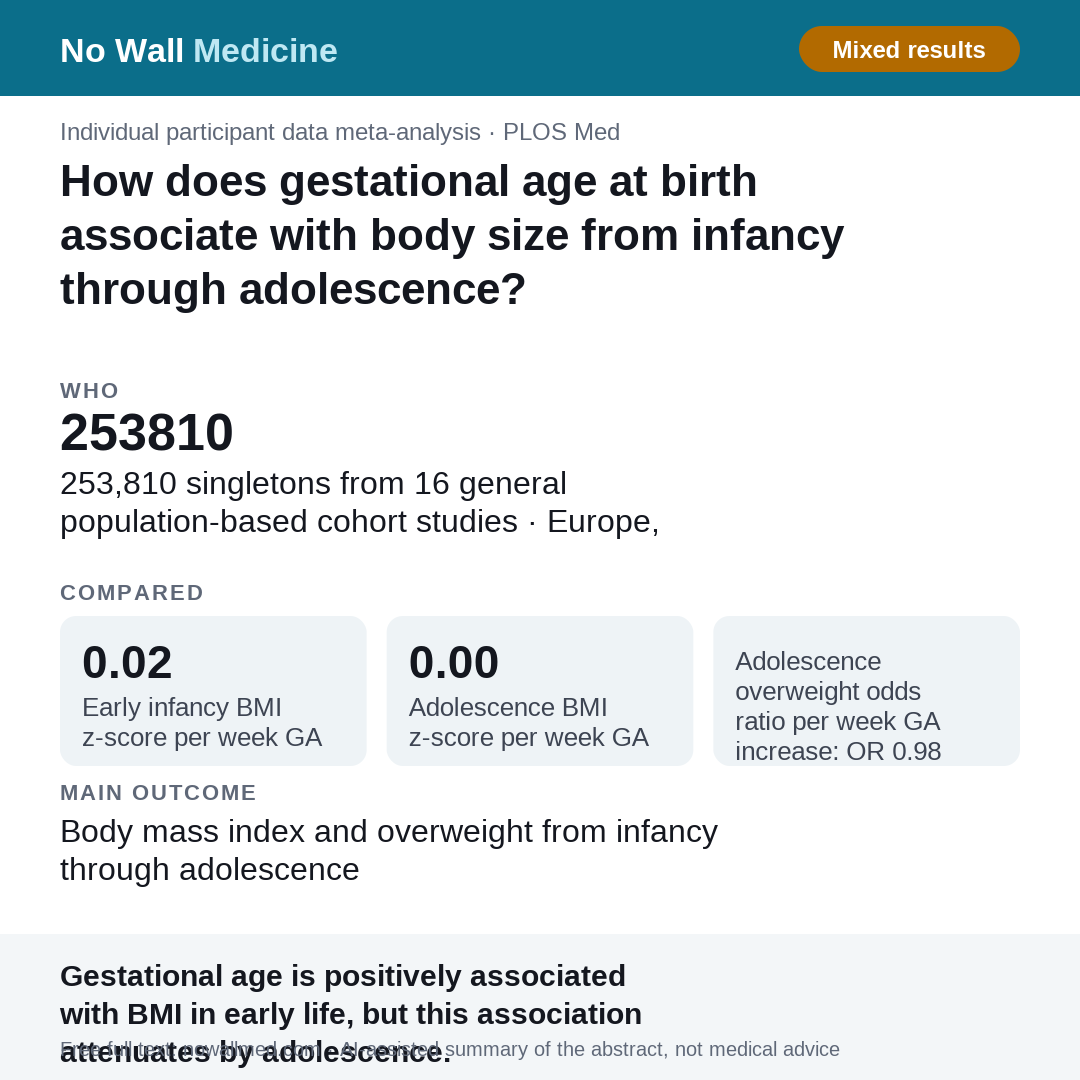
How does gestational age at birth associate with body size from infancy through adolescence?
Who
253810
253,810 singletons from 16 general population-based cohort studies · Europe, North America, and Australasia
Compared
0.02Early infancy BMI z-score per week GA increase (95% CI: 0.00; 0.05)
0.00Adolescence BMI z-score per week GA increase (95% CI: -0.01; 0.01)
Adolescence overweight odds ratio per week GA increase: OR 0.98 (95% CI: 0.97; 1.00)
Main outcome
Body mass index and overweight from infancy through adolescence
Bottom line: Gestational age is positively associated with BMI in early life, but this association attenuates by adolescence.
Limitation: Residual confounding may be a limitation and findings may be less generalisable to low- and middle-income countries.
PLOS Med · 2023-01-26Download image
Clinical question: How does gestational age at birth associate with body size from infancy through adolescence?
Why it matters: Evidence regarding the link between preterm birth and later body size has relied mostly on birth weight rather than the actual length of pregnancy.
Key points
- Researchers analyzed data from 253,810 mother-child dyads across 16 cohort studies to examine how gestational age relates to body mass index and overweight risk.
- Increased gestational age was associated with higher body mass index during the first decade of life, with the largest increase seen in early infancy.
- By adolescence, gestational age was not significantly associated with body mass index or the risk of being overweight.
Limitation the authors note: The authors state that residual confounding may be a limitation and findings may be less generalisable to settings in low- and middle-income countries.
Headline and key points written with AI from the paper’s abstract, with every number checked against it. Read the paper before relying on them.
Was this summary helpful?
Subject terms
Cite this article
Vinther JL, Cadman T, Avraam D, Ekstrøm CT, Sørensen TIA, Elhakeem A. Gestational age at birth and body size from infancy through adolescence: An individual participant data meta-analysis on 253,810 singletons in 16 birth cohort studies. PLOS Med. 2023. doi:10.1371/journal.pmed.1004036
Spotted a mistake? Suggest a correction
Top studies every Monday
The week’s key trials and guidelines in your specialties, plus any topics you follow. By email, free.
Get the weekly digest