Gestational diabetes mellitus and development of intergenerational non-alcoholic fatty liver disease (NAFLD) after delivery: a systematic review and meta-analysis
Systematic review and meta-analysisHarm found
Does gestational diabetes mellitus increase non-alcoholic fatty liver disease risk in mothers and offspring?
Who
Mothers and offspring from gestational diabetes mellitus pregnancies
Compared
Mothers with history of gestational diabetes: 50% increased risk
Mothers without history of gestational diabetes
Offspring from gestational diabetes pregnancies: 2.14; 1.57-2.92
Offspring from non-gestational diabetes pregnancies
Main outcome
Development of non-alcoholic fatty liver disease
Result: OR 1.50 (95% CI: 1.21-1.87) for mothers; 2.14 (95% CI 1.57-2.92) for offspring
Bottom line: Gestational diabetes mellitus increases the risk of non-alcoholic fatty liver disease in both mothers and their offspring.
eClinicalMedicine · 2024-04-29Download image
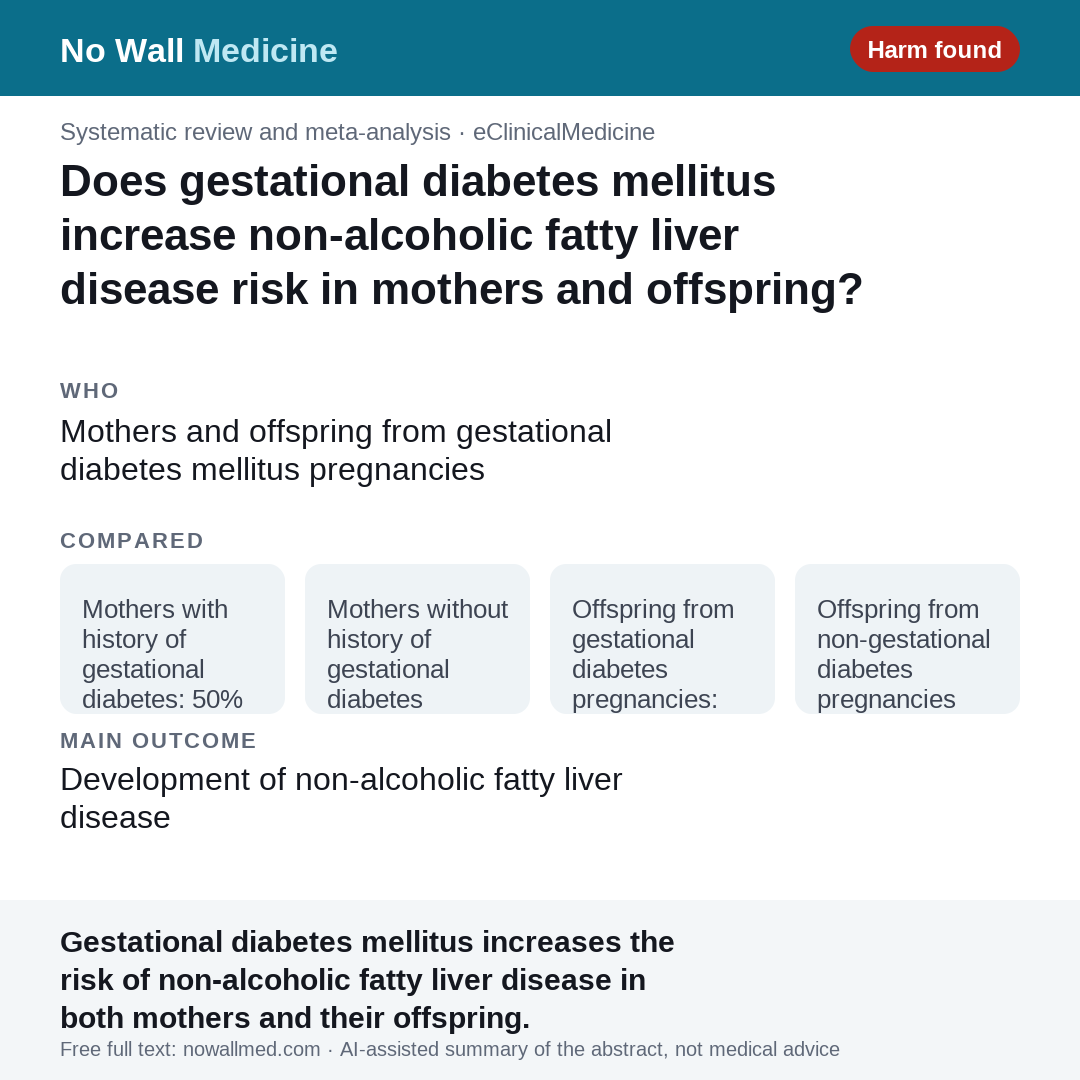
Clinical question: Does gestational diabetes mellitus increase non-alcoholic fatty liver disease risk in mothers and offspring?
Abstract
Background
It is known that gestational diabetes mellitus (GDM)-complicated pregnancies could affect maternal cardiometabolic health after delivery, resulting in hepatic dysfunction and a heightened risk of developing non-alcoholic fatty liver disease (NAFLD). Hence, this study aims to summarise existing literature on the impact of GDM on NAFLD in mothers and investigate the intergenerational impact on NAFLD in offspring. Methods
Using 4 databases (PubMed, Embase, Web of Science and Scopus) between January 1980 and December 2023, randomized controlled trials and observational studies that assessed the effect of maternal GDM on intergenerational liver outcomes were extracted and analysed using random-effects meta-analysis to investigate the effect of GDM on NAFLD in mothers and offspring. Pooled odds ratio (OR) was calculated using hazards ratio (HR), relative risk (RR), or OR reported from each study, with corresponding 95% confidence intervals (CI), and statistical heterogeneity was assessed with the Cochran Q-test and I2 statistic, with two-sided p values. The study protocol was pre-registered on PROSPERO (CRD42023392428). Findings
Twenty studies pertaining to mothers and offspring met the inclusion criteria and 12 papers were included further for meta-analysis on intergenerational NAFLD development. Compared with mothers without a history of GDM, mothers with a history of GDM had a 50% increased risk of developing NAFLD (OR 1.50; 95% CI: 1.21-1.87, over a follow-up period of 16 months-25 years. Similarly, compared with offspring born to non-GDM-complicated pregnancies, offspring born to GDM-complicated pregnancies displayed an approximately two-fold elevated risk of NAFLD development (2.14; 1.57-2.92), over a follow-up period of 1-17.8 years. Interpretation
This systematic review and meta-analysis suggests that both mothers and offspring from GDM-complicated pregnancies exhibit a greater risk to develop NAFLD. These findings underline the importance of early monitoring of liver function and prompt intervention of NAFLD in both generations from GDM-complicated pregnancies. Funding
No funding was available for this research.
Cite this article
Foo RX, Ma JJ, Du R, Goh GBB, Chong YS, Zhang C. Gestational diabetes mellitus and development of intergenerational non-alcoholic fatty liver disease (NAFLD) after delivery: a systematic review and meta-analysis. eClinicalMedicine. 2024. doi:10.1016/j.eclinm.2024.102609
Spotted a mistake? Suggest a correction
Top studies every Monday
The week’s key trials and guidelines in your specialties, plus any topics you follow. By email, free.
Get the weekly digest