Global childhood diarrhoea prevalence and its determinants: a systematic meta-analytic assessment, 1985-2024
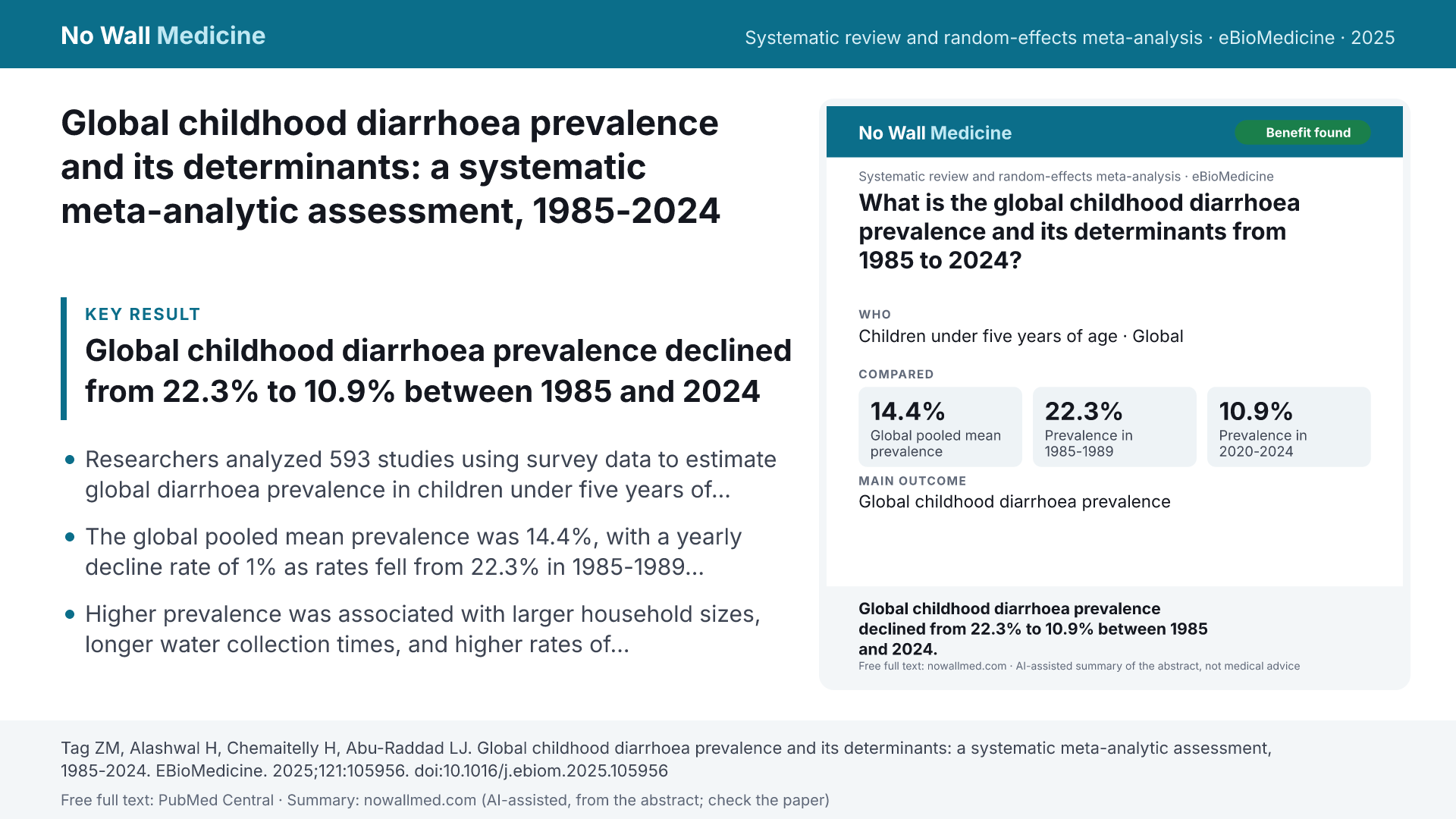
Key result: Global childhood diarrhoea prevalence declined from 22.3% to 10.9% between 1985 and 2024
Key points
- Researchers analyzed 593 studies using survey data to estimate global diarrhoea prevalence in children under five years of age from 1985 to 2024.
- The global pooled mean prevalence was 14.4%, with a yearly decline rate of 1% as rates fell from 22.3% in 1985-1989 to 10.9% in 2020-2024.
- Higher prevalence was associated with larger household sizes, longer water collection times, and higher rates of underweight, stunting, and wasting.
Why it matters: The global trends and specific socioeconomic, water, sanitation, hygiene, and nutrition determinants of childhood diarrhoea prevalence over the last four decades were not fully synthesized.
Discussion prompts
- Would these patients look like yours? Who was left out?
- Is the main outcome one that matters to patients?
- Is the difference large enough to change what you do?
Cite: Tag ZM, Alashwal H, Chemaitelly H, Abu-Raddad LJ. Global childhood diarrhoea prevalence and its determinants: a systematic meta-analytic assessment, 1985-2024. EBioMedicine. 2025;121:105956. doi:10.1016/j.ebiom.2025.105956
Free full text: PubMed Central · Summary and visual abstract: nowallmed.com/a/global-childhood-diarrhoea-prevalence-and-its-determinants-a-1vuwti8/ (AI-assisted from the abstract; check the paper before relying on it).