Global coverage of opioid agonist treatment and needle exchange programs remains low for most countries
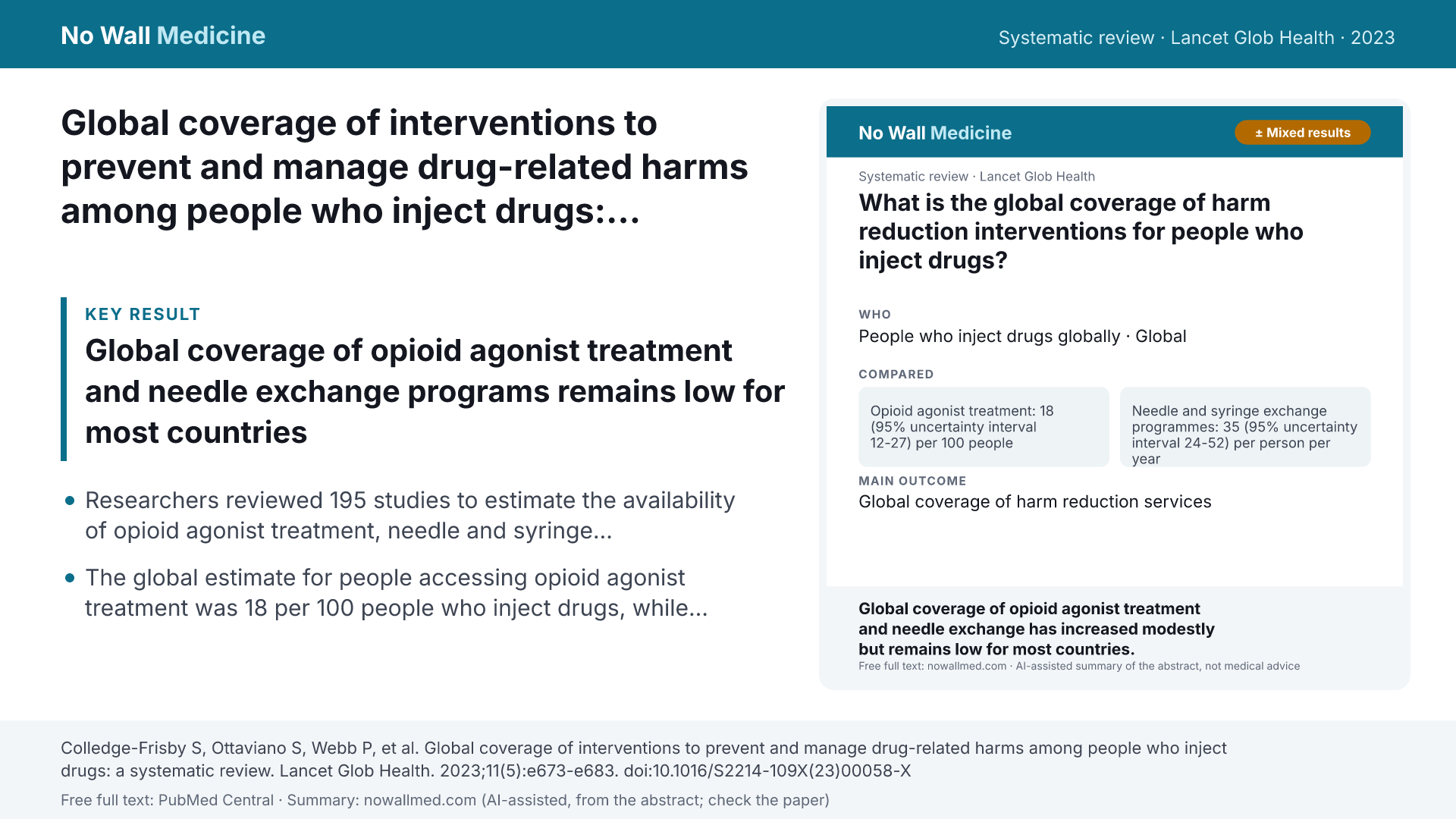
Global coverage of interventions to prevent and manage drug-related harms among people who inject drugs: a systematic review
Systematic reviewMixed results
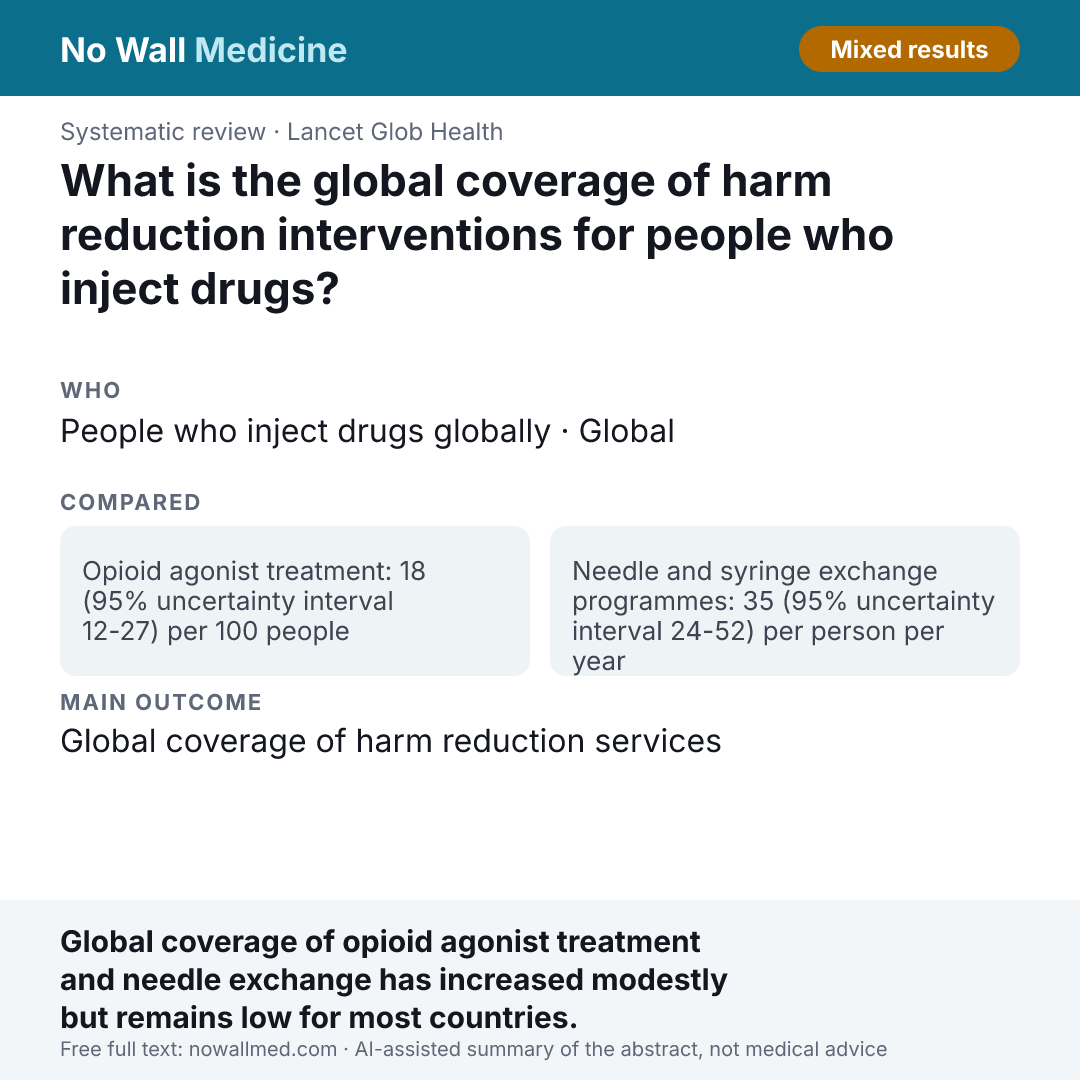
What is the global coverage of harm reduction interventions for people who inject drugs?
Who
People who inject drugs globally · Global
Compared
Opioid agonist treatment: 18 (95% uncertainty interval 12-27) per 100 people
Needle and syringe exchange programmes: 35 (95% uncertainty interval 24-52) per person per year
Main outcome
Global coverage of harm reduction services
Bottom line: Global coverage of opioid agonist treatment and needle exchange has increased modestly but remains low for most countries.
Funded by: Australian National Health and Medical Research Council
Lancet Glob Health · 2023-03-27 · Save PNG
Clinical question: What is the global coverage of harm reduction interventions for people who inject drugs?
Key points
- Researchers reviewed 195 studies to estimate the availability of opioid agonist treatment, needle and syringe exchange programs, and other harm reduction services for people who inject drugs.
- The global estimate for people accessing opioid agonist treatment was 18 per 100 people who inject drugs, while 35 needles and syringes were distributed per person per year.
- While 90 countries implement opioid agonist treatment and 94 countries implement needle and syringe exchange programs, only five countries provide high coverage of both services.
Headline and key points written with AI from the paper’s abstract, with every number checked against it. Read the paper before relying on them.
Was this summary helpful?
Abstract
Background
Harm reduction and treatment programmes are essential for reducing harms for people who inject drugs (PWID). We aimed to update estimates from a 2017 review of global coverage of needle and syringe exchange programmes (NSPs), opioid agonist treatment (OAT), and other harm reduction services that target PWID (eg, take-home naloxone [THN] programmes, supervised consumption facilities, and drug checking services). Methods
We did a systematic review of available evidence from peer-reviewed and grey literature databases for studies published between Jan 1, 2017, and May 31, 2022. Programmatic data were collected on the availability of services, the number of sites, people accessing services, and equipment distributed in countries where there is evidence of injecting drug use. National estimates of coverage of OAT (ie, number of people accessing OAT per 100 PWID) and NSPs (ie, number of needles and syringes distributed per PWID per year) were generated where available using the most recent data. Regional and global estimates were derived and compared with WHO indicators. The study was registered with PROSPERO (CRD42020173974). Findings
We included 195 studies and found there were 90 countries implementing OAT (75% of the PWID population) and 94 countries implementing NSPs (88% of the global PWID population). Only five countries (2% of the global PWID population) are providing high coverage of both services. Far fewer countries were implementing THN programmes (n=43), supervised consumption facilities (n=17), and drug checking services (n=26), with nine countries implementing all five services. Globally, we estimated there were 18 (95% uncertainty interval [UI] 12-27) people accessing OAT per 100 PWID, and 35 (95% UI 24-52) needles and syringes being distributed per person who injects drugs per year. More countries reported high (OAT 24; NSPs 10), moderate (OAT 8; NSPs 15), and low (OAT 38; NSPs 47) coverage of services compared with the previous review. Interpretation
Global coverage of OAT and NSPs has increased modestly in the past 5 years but remains low for most countries. Programmatic data on other key harm reduction interventions are scarce. Funding
Australian National Health and Medical Research Council.
Abstract reproduced under the article’s CC BY licence.
Subject terms
Headline, design, result, key points, caveat and citation as plain text.
Cite this article
Colledge-Frisby S, Ottaviano S, Webb P, et al. Global coverage of interventions to prevent and manage drug-related harms among people who inject drugs: a systematic review. Lancet Glob Health. 2023;11(5):e673-e683. doi:10.1016/S2214-109X(23)00058-X
Spotted a mistake? Suggest a correction