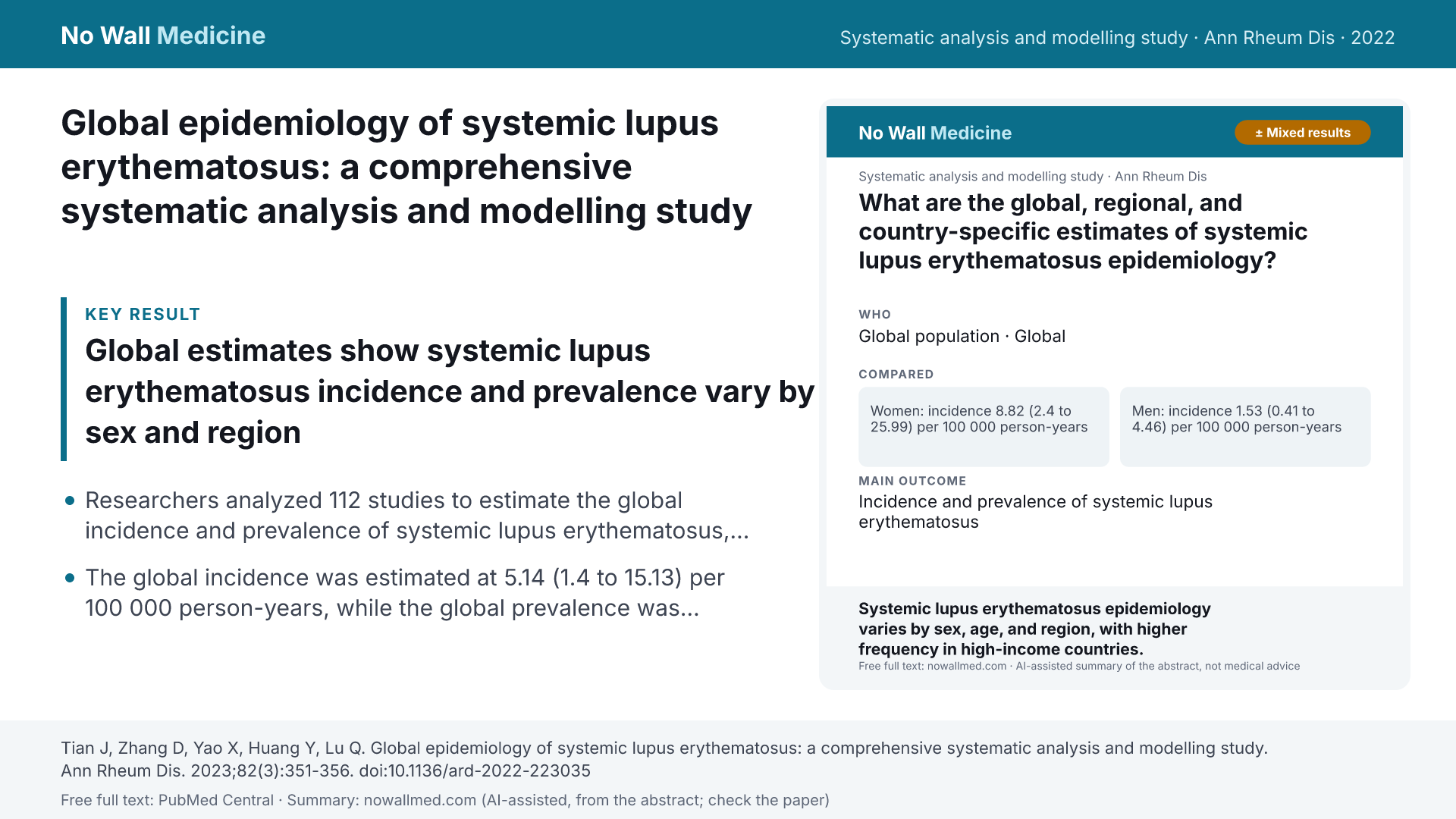
Global estimates show systemic lupus erythematosus incidence and prevalence vary by sex and region
Global epidemiology of systemic lupus erythematosus: a comprehensive systematic analysis and modelling study
Systematic analysis and modelling studyMixed results
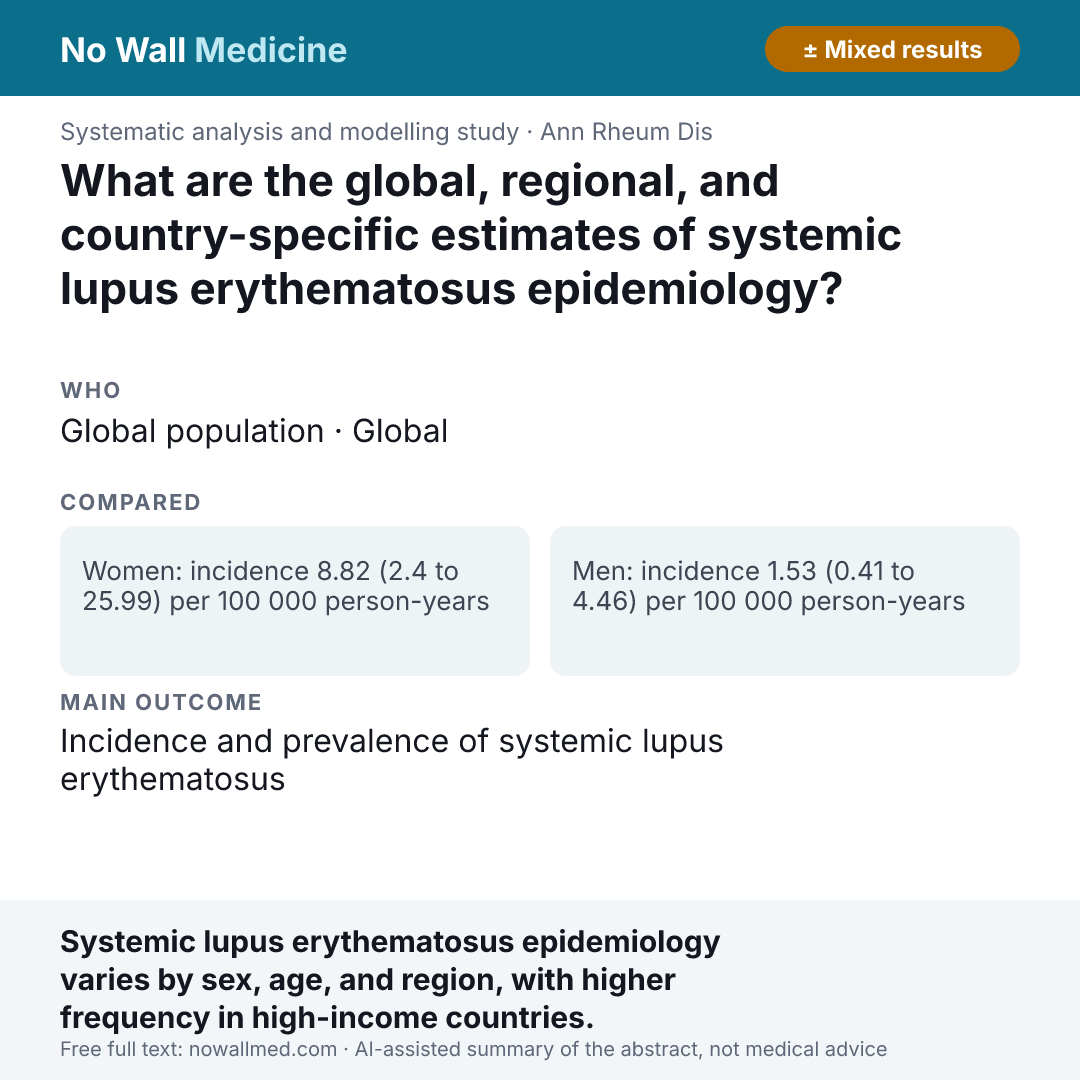
What are the global, regional, and country-specific estimates of systemic lupus erythematosus epidemiology?
Who
Global population · Global
Compared
Women: incidence 8.82 (2.4 to 25.99) per 100 000 person-years
Men: incidence 1.53 (0.41 to 4.46) per 100 000 person-years
Main outcome
Incidence and prevalence of systemic lupus erythematosus
Bottom line: Systemic lupus erythematosus epidemiology varies by sex, age, and region, with higher frequency in high-income countries.
Ann Rheum Dis · 2022-10-14 · Save PNG
Clinical question: What are the global, regional, and country-specific estimates of systemic lupus erythematosus epidemiology?
Why it matters: Epidemiological data for systemic lupus erythematosus is lacking for 79.8% of countries worldwide.
Key points
- Researchers analyzed 112 studies to estimate the global incidence and prevalence of systemic lupus erythematosus, an autoimmune disease.
- The global incidence was estimated at 5.14 (1.4 to 15.13) per 100 000 person-years, while the global prevalence was 43.7 (15.87 to 108.92) per 100 000 persons.
- In women, the prevalence was 78.73 (28.61 to 196.33) per 100 000 persons, compared to 9.26 (3.36 to 22.97) per 100 000 persons in men.
Headline and key points written with AI from the paper’s abstract, with every number checked against it. Read the paper before relying on them.
Was this summary helpful?
Abstract
Objectives
To quantify global, regional and country-specific estimates of epidemiology of systemic lupus erythematosus (SLE). Methods
Four databases were systematically searched, and a Bayesian hierarchical linear mixed model was constructed to estimate the global, regional, and country-specific incidence and prevalence of SLE. Results
112 studies met the inclusion criteria. The global SLE incidence and newly diagnosed population were estimated to be 5.14 (1.4 to 15.13) per 100 000 person-years and 0.40 million people annually, respectively. In women, the values were 8.82 (2.4 to 25.99) per 100 000 person-years and 0.34 million people annually, while in men, the estimates were 1.53 (0.41 to 4.46) per 100 000 person-years and 0.06 million people annually, respectively. Poland, the USA and Barbados had the highest estimates of SLE incidence. Regarding prevalence, the global SLE prevalence and affected population were estimated to be 43.7 (15.87 to 108.92) per 100 000 persons and 3.41 million people, respectively. In women, the values were 78.73 (28.61 to 196.33) per 100 000 persons and 3.04 million people, while in men the estimates were 9.26 (3.36 to 22.97) per 100 000 persons and 0.36 million people, respectively. The United Arab Emirates, Barbados and Brazil had the highest SLE prevalence. In addition to regional and sex differences, age and prevalence estimation method (period or point prevalence) differences could also lead to variations in epidemiological SLE findings. Conclusions
Epidemiological data on SLE are lacking for 79.8% of countries worldwide. The epidemiology of SLE varies substantially between different sex and age groups and is distributed unequally among geographical regions; specifically, SLE occurs more frequently in high-income countries.
Abstract reproduced under the article’s CC BY NC licence.
Subject terms
Headline, design, result, key points, caveat and citation as plain text.
Cite this article
Tian J, Zhang D, Yao X, Huang Y, Lu Q. Global epidemiology of systemic lupus erythematosus: a comprehensive systematic analysis and modelling study. Ann Rheum Dis. 2023;82(3):351-356. doi:10.1136/ard-2022-223035
Spotted a mistake? Suggest a correction