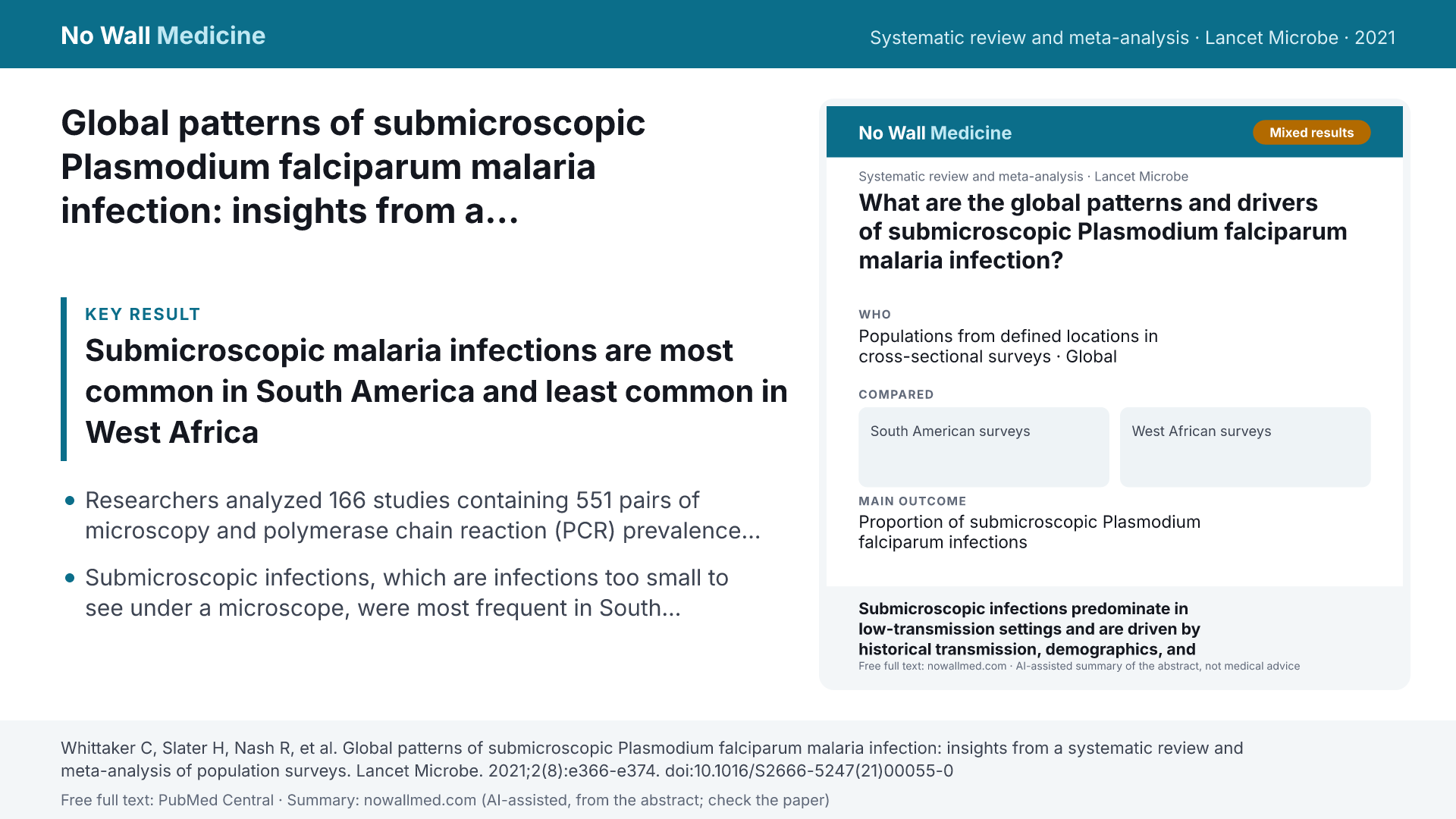
Submicroscopic malaria infections are most common in South America and least common in West Africa
Global patterns of submicroscopic Plasmodium falciparum malaria infection: insights from a systematic review and meta-analysis of population surveys
Infectious DiseaseAdult and pediatric
Systematic review and meta-analysisMixed results
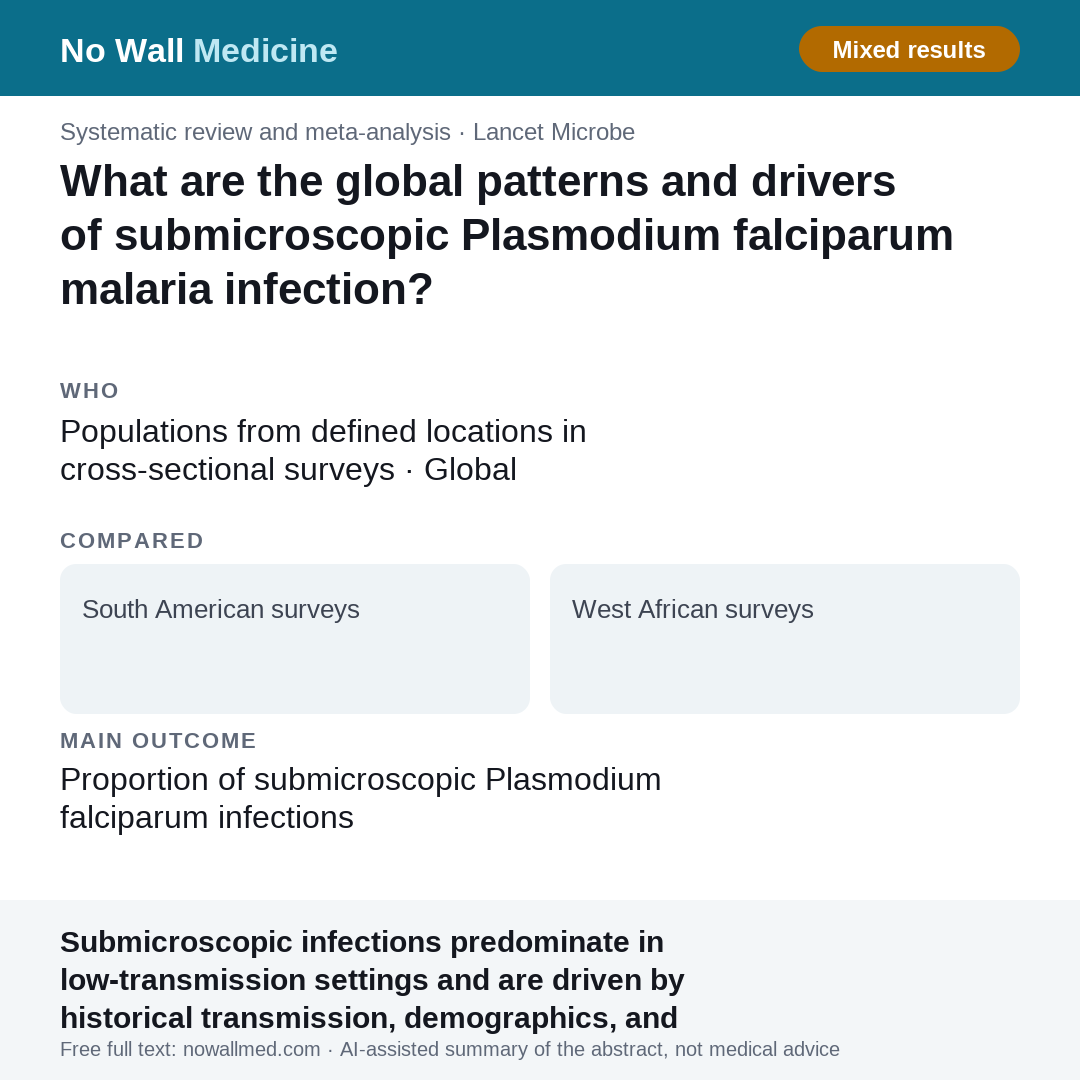
What are the global patterns and drivers of submicroscopic Plasmodium falciparum malaria infection?
Who
Populations from defined locations in cross-sectional surveys · Global
Compared
South American surveys
West African surveys
Main outcome
Proportion of submicroscopic Plasmodium falciparum infections
Bottom line: Submicroscopic infections predominate in low-transmission settings and are driven by historical transmission, demographics, and geography.
Funded by: Bill & Melinda Gates Foundation, Royal Society, UK Medical Research Council
Lancet Microbe · 2021-08-12Download image
Clinical question: What are the global patterns and drivers of submicroscopic Plasmodium falciparum malaria infection?
Why it matters: The drivers of submicroscopic Plasmodium falciparum infections and the specific locations where these undetected infections are most common remain unclear.
Key points
- Researchers analyzed 166 studies containing 551 pairs of microscopy and polymerase chain reaction (PCR) prevalence data from cross-sectional surveys.
- Submicroscopic infections, which are infections too small to see under a microscope, were most frequent in South American surveys and least frequent in West African surveys.
- The size of the submicroscopic reservoir was associated with historical transmission intensity, age, seasonality, and the specific testing methodology used.
Headline and key points written with AI from the paper’s abstract, with every number checked against it. Read the paper before relying on them.
Was this summary helpful?
Abstract
Background
Adoption of molecular techniques to detect Plasmodium falciparum infection has revealed many previously undetected (by microscopy) yet transmissible low-density infections. The proportion of these infections is typically highest in low transmission settings, but drivers of submicroscopic infection remain unclear. Here, we updated a previous systematic review of asexual P falciparum prevalence by microscopy PCR in the same population. We aimed to explore potential drivers of submicroscopic infection and to identify the locations where submicroscopic infections are most common. Methods
In this systematic review and meta-analysis we searched PubMed and Web of Science from Jan 1, 2010, until Oct 11, 2020, for cross-sectional studies reporting data on asexual P falciparum prevalence by both microscopy and PCR. Surveys of pregnant women, surveys in which participants had been chosen based on symptoms or treatment, or surveys that did not involve a population from a defined location were excluded. Both the number of individuals tested and the number of individuals who tested positive by microscopy or PCR, or both, for P falciparum infection were extracted. Bayesian regression modelling was used to explore determinants of the size of the submicroscopic reservoir including geographical location, seasonality, age, methodology, and current or historical patterns of transmission. Findings
Of 4893 identified studies, we retained 121 after screening and removal of duplicates. 45 studies from a previous systematic review were included giving 166 studies containing 551 cross-sectional survey microscopy and PCR prevalence pairs. Our results show that submicroscopic infections predominate in low-transmission settings across all regions, but also reveal marked geographical variation, with the proportion of infections that are submicroscopic being highest in South American surveys and lowest in west African surveys. Although current transmission levels partly explain these results, we find that historical transmission intensity also represents a crucial determinant of the size of the submicroscopic reservoir, as does the demographic structure of the infected population (with submicroscopic infection more likely to occur in adults than in children) and the PCR or microscopy methodology used. We also observed a small yet significant influence of seasonality, with fewer submicroscopic infections observed in the wet season than the dry season. Integrating these results with estimates of infectivity in relation to parasite density suggests the contribution of submicroscopic infections to transmission across different settings is likely to be highly variable. Interpretation
Significant variation in the prevalence of submicroscopic infection exists even across settings characterised by similar current levels of transmission. These differences in submicroscopic epidemiology potentially warrant different approaches to targeting this infected subgroup across different settings to eliminate malaria. Funding
Bill & Melinda Gates Foundation, The Royal Society, and the UK Medical Research Council.
Abstract reproduced under the article’s CC BY licence.
Subject terms
Cite this article
Whittaker C, Slater H, Nash R, Bousema T, Drakeley C, Ghani AC. Global patterns of submicroscopic Plasmodium falciparum malaria infection: insights from a systematic review and meta-analysis of population surveys. Lancet Microbe. 2021. doi:10.1016/S2666-5247(21)00055-0
Spotted a mistake? Suggest a correction
Top studies every Monday
The week’s key trials and guidelines in your specialties, plus any topics you follow. By email, free.
Get the weekly digest