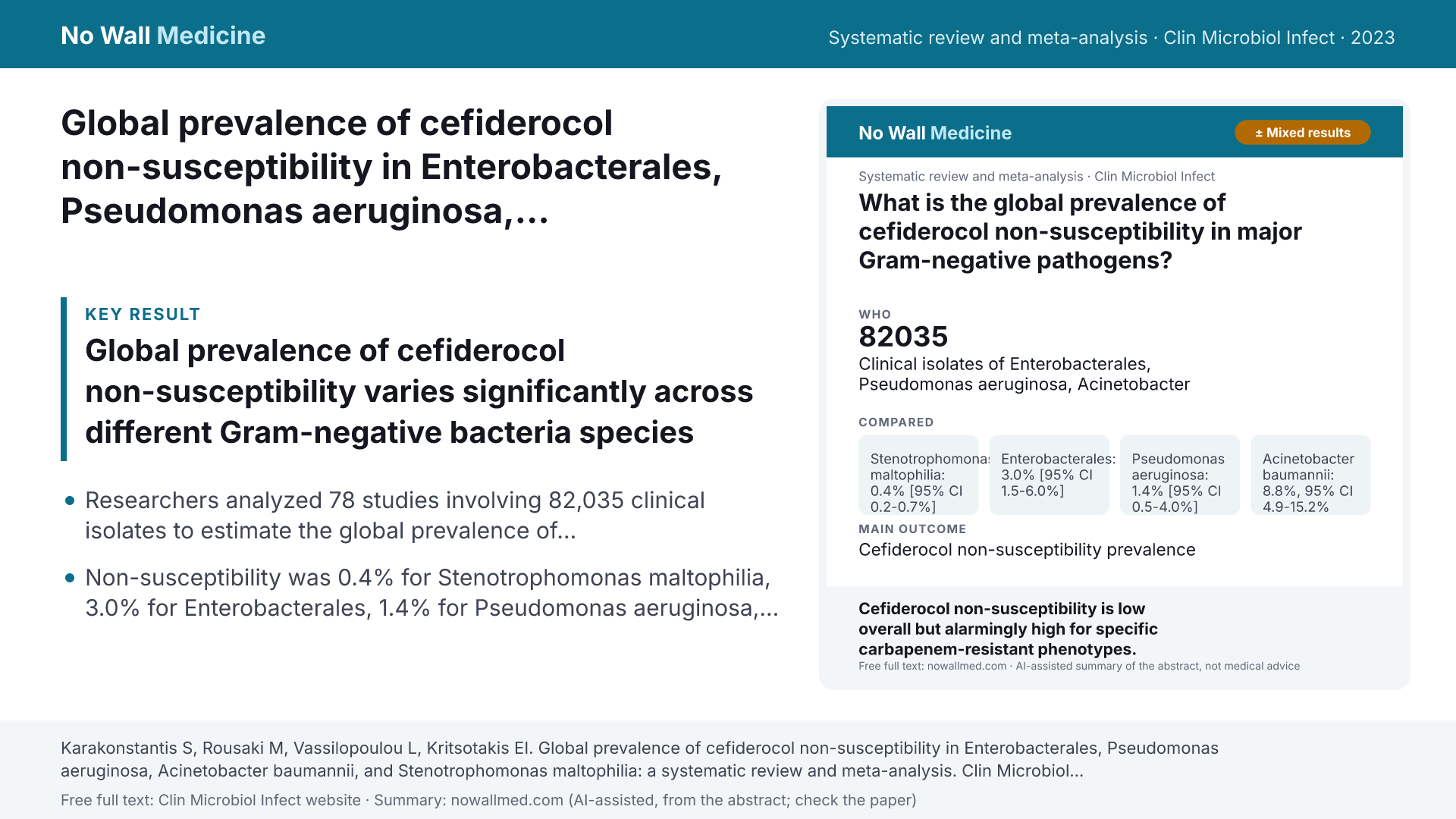
Global prevalence of cefiderocol non-susceptibility varies significantly across different Gram-negative bacteria species
Global prevalence of cefiderocol non-susceptibility in Enterobacterales, Pseudomonas aeruginosa, Acinetobacter baumannii, and Stenotrophomonas maltophilia: a systematic review and meta-analysis
Systematic review and meta-analysisMixed results
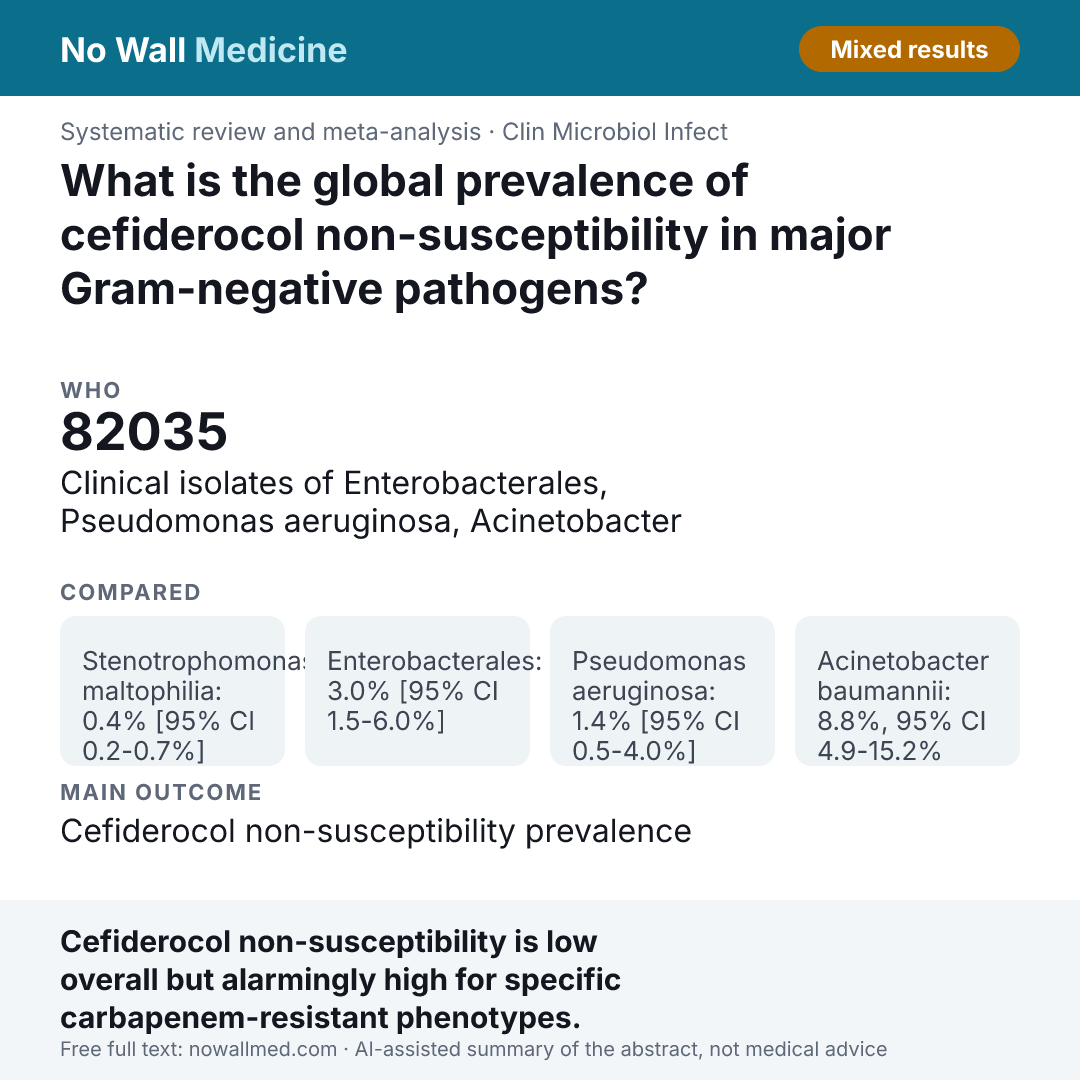
What is the global prevalence of cefiderocol non-susceptibility in major Gram-negative pathogens?
Who
82035
Clinical isolates of Enterobacterales, Pseudomonas aeruginosa, Acinetobacter baumannii, and Stenotrophomonas maltophilia · Global
Compared
Stenotrophomonas maltophilia: 0.4% [95% CI 0.2-0.7%]
Enterobacterales: 3.0% [95% CI 1.5-6.0%]
Pseudomonas aeruginosa: 1.4% [95% CI 0.5-4.0%]
Acinetobacter baumannii: 8.8%, 95% CI 4.9-15.2%
Main outcome
Cefiderocol non-susceptibility prevalence
Bottom line: Cefiderocol non-susceptibility is low overall but alarmingly high for specific carbapenem-resistant phenotypes.
Limitation: Heterogeneity was driven by single-centre investigations and geographical regions.
Clin Microbiol Infect · 2023-09-04 · Save PNG
Clinical question: What is the global prevalence of cefiderocol non-susceptibility in major Gram-negative pathogens?
Key points
- Researchers analyzed 78 studies involving 82,035 clinical isolates to estimate the global prevalence of cefiderocol non-susceptibility, which is when bacteria are not inhibited by the antibiotic.
- Non-susceptibility was 0.4% for Stenotrophomonas maltophilia, 3.0% for Enterobacterales, 1.4% for Pseudomonas aeruginosa, and 8.8% for Acinetobacter baumannii using EUCAST breakpoints.
- Non-susceptibility was associated with higher rates in carbapenem-resistant Enterobacterales at 12.4% and New Delhi metallo-β-lactamase-producing Acinetobacter baumannii at 44.7%.
Limitation the authors note: Additional sources of heterogeneity included single-centre investigations and geographical regions.
Headline and key points written with AI from the paper’s abstract, with every number checked against it. Read the paper before relying on them.
Was this summary helpful?
Subject terms
Headline, design, result, key points, caveat and citation as plain text.
Cite this article
Karakonstantis S, Rousaki M, Vassilopoulou L, Kritsotakis EI. Global prevalence of cefiderocol non-susceptibility in Enterobacterales, Pseudomonas aeruginosa, Acinetobacter baumannii, and Stenotrophomonas maltophilia: a systematic review and meta-analysis. Clin Microbiol Infect. 2023. doi:10.1016/j.cmi.2023.08.029
Spotted a mistake? Suggest a correction