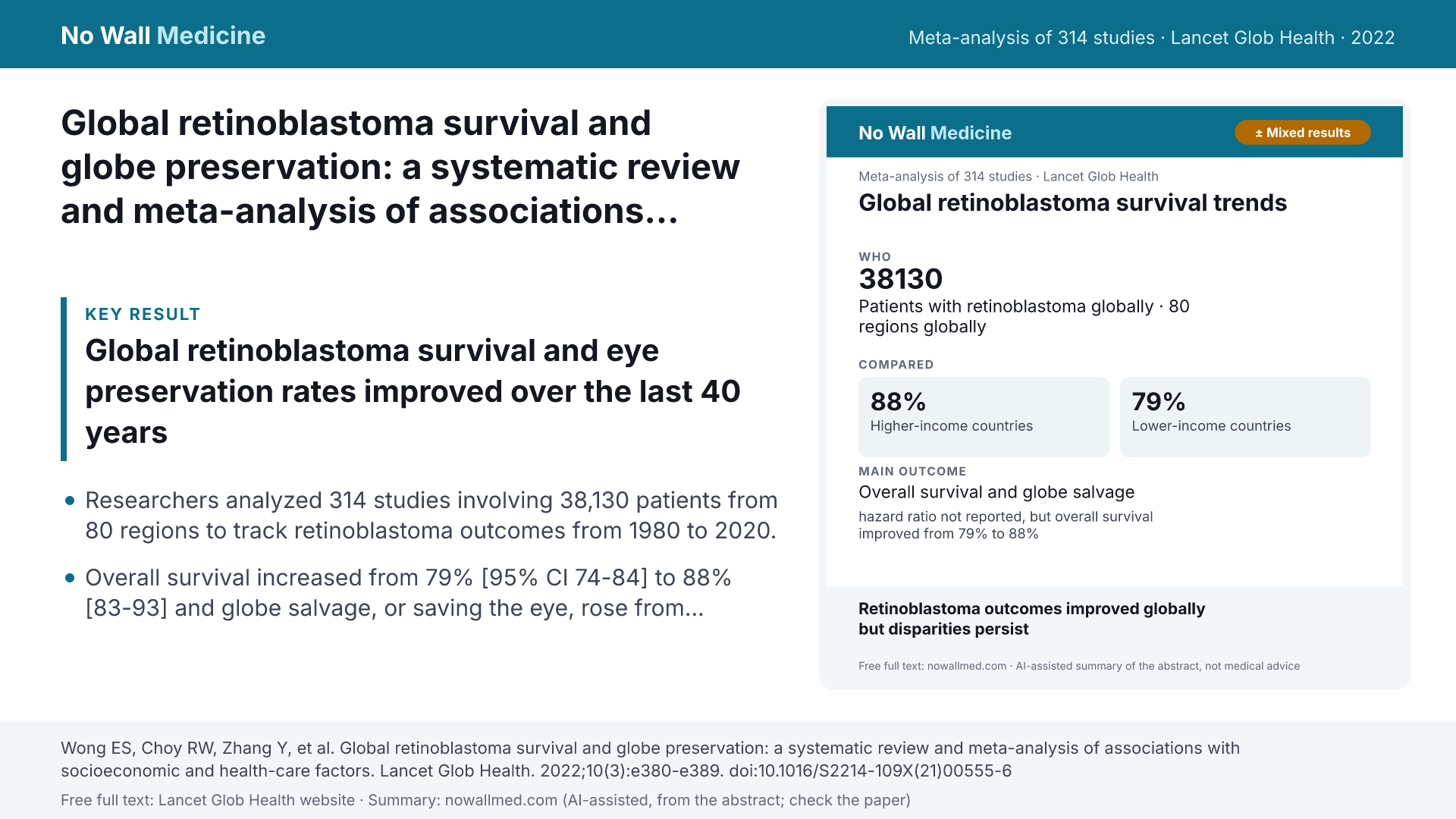
Global retinoblastoma survival and eye preservation rates improved over the last 40 years
Global retinoblastoma survival and globe preservation: a systematic review and meta-analysis of associations with socioeconomic and health-care factors
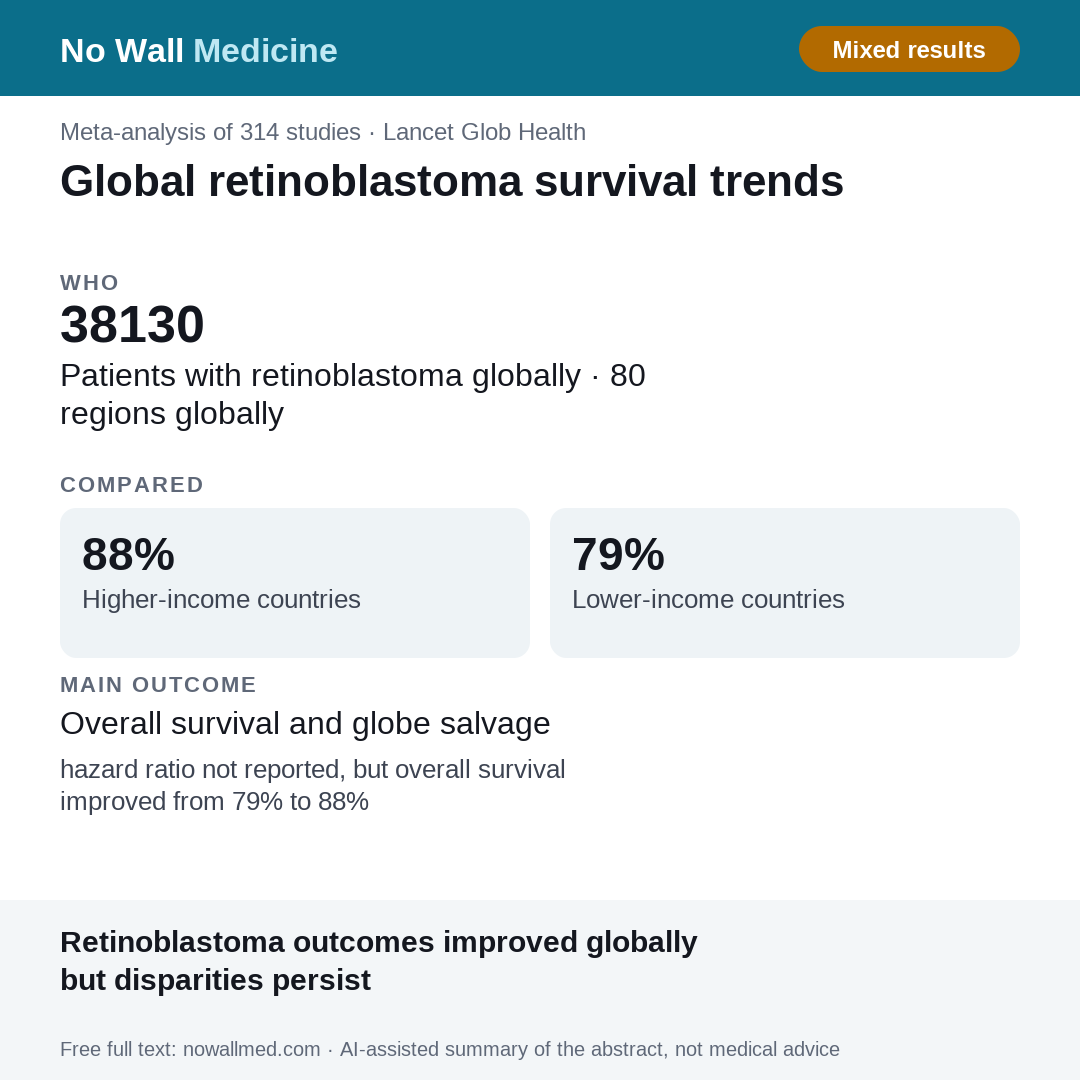
Meta-analysis of 314 studiesMixed results
Global retinoblastoma survival trends
Who
38130
Patients with retinoblastoma globally · 80 regions globally
Compared
88%Higher-income countries (83-93)
79%Lower-income countries (74-84)
Main outcome
Overall survival and globe salvage
Result: hazard ratio not reported, but overall survival improved from 79% to 88%
Bottom line: Retinoblastoma outcomes improved globally but disparities persist
Funded by: Health and Medical Research Fund
Lancet Glob Health · 2022-01-27Download image
Why it matters: Retinoblastoma outcomes have been inconsistent across different income levels and geographical locations over the past four decades.
Key points
- Researchers analyzed 314 studies involving 38,130 patients from 80 regions to track retinoblastoma outcomes from 1980 to 2020.
- Overall survival increased from 79% [95% CI 74-84] to 88% [83-93] and globe salvage, or saving the eye, rose from 22% [14-32] to 44% [36-52].
- Higher survival and eye preservation were associated with higher income levels, better education, and improved health-care financing and accessibility.
Headline and key points written with AI from the paper’s abstract, with every number checked against it. Read the paper before relying on them.
Was this summary helpful?
Abstract
Background
Despite advancements in globe-preserving treatments, improvements in retinoblastoma outcomes are inconsistent across income levels and geographical locations. We aimed to investigate trends in global retinoblastoma survival and globe preservation during the past 40 years. We also examined associated socioeconomic and health-care factors and global survival disparity. Methods
We did a systematic review and meta-analysis by screening articles in any language in nine databases (PubMed, Embase, ScienceDirect, Web of Science, OpenGrey, Global Burden of Disease, Global Health Data Exchange, Global Index Medicus, and International Agency for the Prevention of Blindness) published between Jan 1, 1981, and Oct 8, 2021. We screened for articles that described retinoblastoma overall survival or globe salvage, or both. All reported studies were subsequently stratified into four periods: 1980-89, 1990-99, 2000-09, and 2010-20. Indicators on socioeconomic and health-care factors were extracted from the World Bank and WHO. Ophthalmology-related indicators were further parsed from the International Agency for the Prevention of Blindness. Between-study heterogeneities by income level were assessed by mixed-effect meta-analysis. Associations of retinoblastoma outcome with socioeconomic and health-care factors and factors for survival prediction were investigated by multivariable linear regressions. This study is registered with PROSPERO, number CRD42020221556. Findings
Our search identified 14 621 articles, of which 314 studies were included for analysis after screening, including 38 130 patients from 80 regions globally presenting during 1980-2020. 255 articles were entered for time-trend meta-analysis, covering 29 106 patients from 73 countries. Both overall survival (from 79% [95% CI 74-84] to 88% [83-93]; p=0·017) and globe salvage rate (from 22% [14-32] to 44% [36-52]; p=0·0003) improved significantly over the four decades. Wide disparities were observed between higher-income and lower-income countries. Overall survival, globe salvage, and globe salvage for advanced intraocular disease correlated positively with income level. Higher overall survival was associated with lower Gini index (p=0·0001) and with populations that had smaller percentages living in rural areas (p=0·0005). Higher globe salvage was associated with better health-care financing and accessibility (p=0·030). Overall survival (p=0·0024) and globe salvage (p=0·022) were both associated positively with education level. Survival gaps were observed in sub-Saharan Africa and southeast and southwest Asia. Interpretation
Retinoblastoma treatment outcomes have improved globally over the past four decades but large disparities persist between higher-income and lower-income countries, with some areas having major survival gaps. Targeted health-care policy making with increased health-care financing and accessibility are needed in low-income and lower-middle-income countries to improve retinoblastoma outcomes worldwide. Funding
Health and Medical Research Fund (Hong Kong) and Children Cancer's Foundation (Hong Kong).
Abstract reproduced under the article’s CC BY licence.
Subject terms
Cite this article
Wong ES, Choy RW, Zhang Y, et al. Global retinoblastoma survival and globe preservation: a systematic review and meta-analysis of associations with socioeconomic and health-care factors. Lancet Glob Health. 2022. doi:10.1016/S2214-109X(21)00555-6
Spotted a mistake? Suggest a correction