Glofitamab plus chemotherapy improved survival for patients with relapsed diffuse large B-cell lymphoma
Glofitamab plus gemcitabine and oxaliplatin for relapsed/refractory DLBCL: 3-year follow-up of STARGLO
Phase 3 randomized trialBenefit found
Does glofitamab plus gemcitabine and oxaliplatin improve survival in relapsed/refractory diffuse large B-cell lymphoma?
Who
Autologous stem cell transplant ineligible relapsed/refractory diffuse large B-cell lymphoma patients
Compared
Glofitamab plus gemcitabine and oxaliplatin: median overall survival 25.5 months
Rituximab plus gemcitabine and oxaliplatin: median overall survival 12.5 months
Main outcome
overall survival
Result: hazard ratio 0.60 (95% CI 0.4-0.8)
Bottom line: Glofitamab plus gemcitabine and oxaliplatin demonstrated superior overall survival compared to rituximab plus gemcitabine and oxaliplatin.
Blood Adv · 2026-06-11Download image
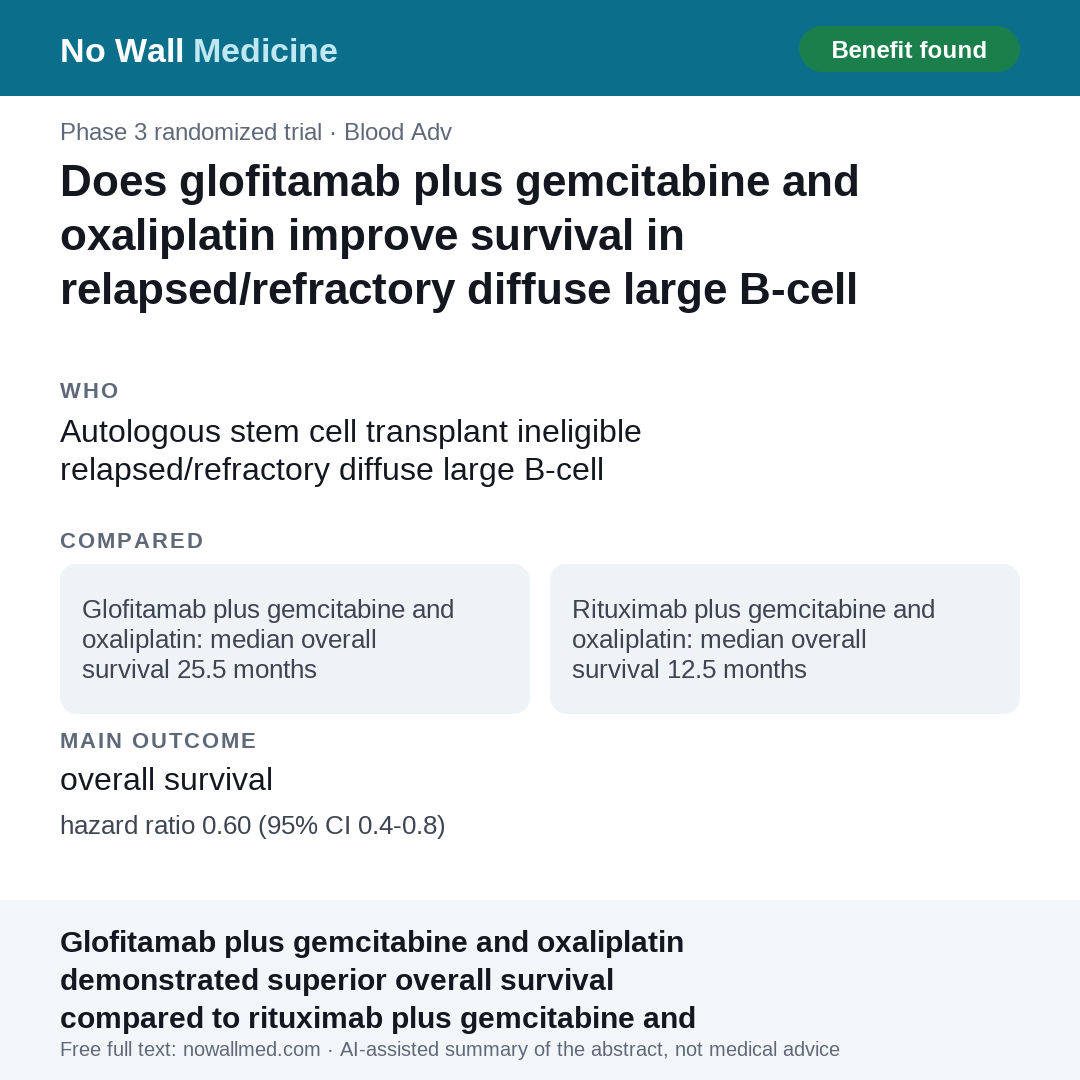
Clinical question: Does glofitamab plus gemcitabine and oxaliplatin improve survival in relapsed/refractory diffuse large B-cell lymphoma?
Why it matters: Patients with relapsed or refractory diffuse large B-cell lymphoma who cannot undergo stem cell transplant require effective treatment options.
Key points
- Researchers studied patients with relapsed or refractory diffuse large B-cell lymphoma who were ineligible for autologous stem cell transplant.
- Glofitamab plus gemcitabine and oxaliplatin resulted in a median overall survival of 25.5 months compared to 12.5 months for rituximab plus chemotherapy.
- The complete response rate was 58.5% for the glofitamab group compared to 25.3% for the rituximab group.
Headline and key points written with AI from the paper’s abstract, with every number checked against it. Read the paper before relying on them.
Abstract
In the phase 3 STARGLO trial, glofitamab plus gemcitabine-oxaliplatin (Glofit-GemOx) demonstrated superior overall survival (OS) vs rituximab plus GemOx (R-GemOx), in patients with autologous stem cell transplant (ASCT)-ineligible relapsed/refractory (R/R) diffuse large B-cell lymphoma (DLBCL). We present efficacy and safety from STARGLO, with 3 years of follow-up, including in clinically relevant subgroups. After a median OS follow-up of 35.1 months (data cutoff: 1 May 2025), Glofit-GemOx continued to demonstrate favorable outcomes vs R-GemOx, respectively: median OS, 25.5 vs 12.5 months (hazard ratio [HR], 0.60; 95% confidence interval [CI], 0.4-0.8); median progression-free survival, 14.4 vs 3.3 months (HR, 0.41; 95% CI, 0.3-0.6); complete response rate, 58.5% vs 25.3%. Glofit-GemOx was particularly efficacious in the second-line (2L) vs third-line or later setting (3-year OS rate, 54.6% [95% CI, 45.2-64.0] vs 33.2% [95% CI, 21.2-45.3]). In the 2L setting, among patients with primary refractory disease or early treatment failure, the 36-month OS rate was 46.1% (95% CI, 35.2-56.9) with Glofit-GemOx vs 16.5% (95% CI, 3.4-29.6) with R-GemOx. Glofit-GemOx was favorable over R-GemOx regardless of patient age, with consistent efficacy observed across age categories, including in older patients (aged ≥75 years). No new safety signals were identified. With extended follow-up, fixed-duration Glofit-GemOx continues to demonstrate superior survival vs R-GemOx in ASCT-ineligible patients with R/R DLBCL, with favorable outcomes pronounced in the 2L setting, and consistent across subgroups including older patients and those with early relapsing disease. These data support Glofit-GemOx as an effective off-the-shelf treatment with curative potential in R/R DLBCL. This trial was registered at www.clinicaltrials.gov as NCT04408638.
Abstract reproduced under the article’s CC BY NC ND licence.
Topics
Spotted a mistake? Suggest a correction