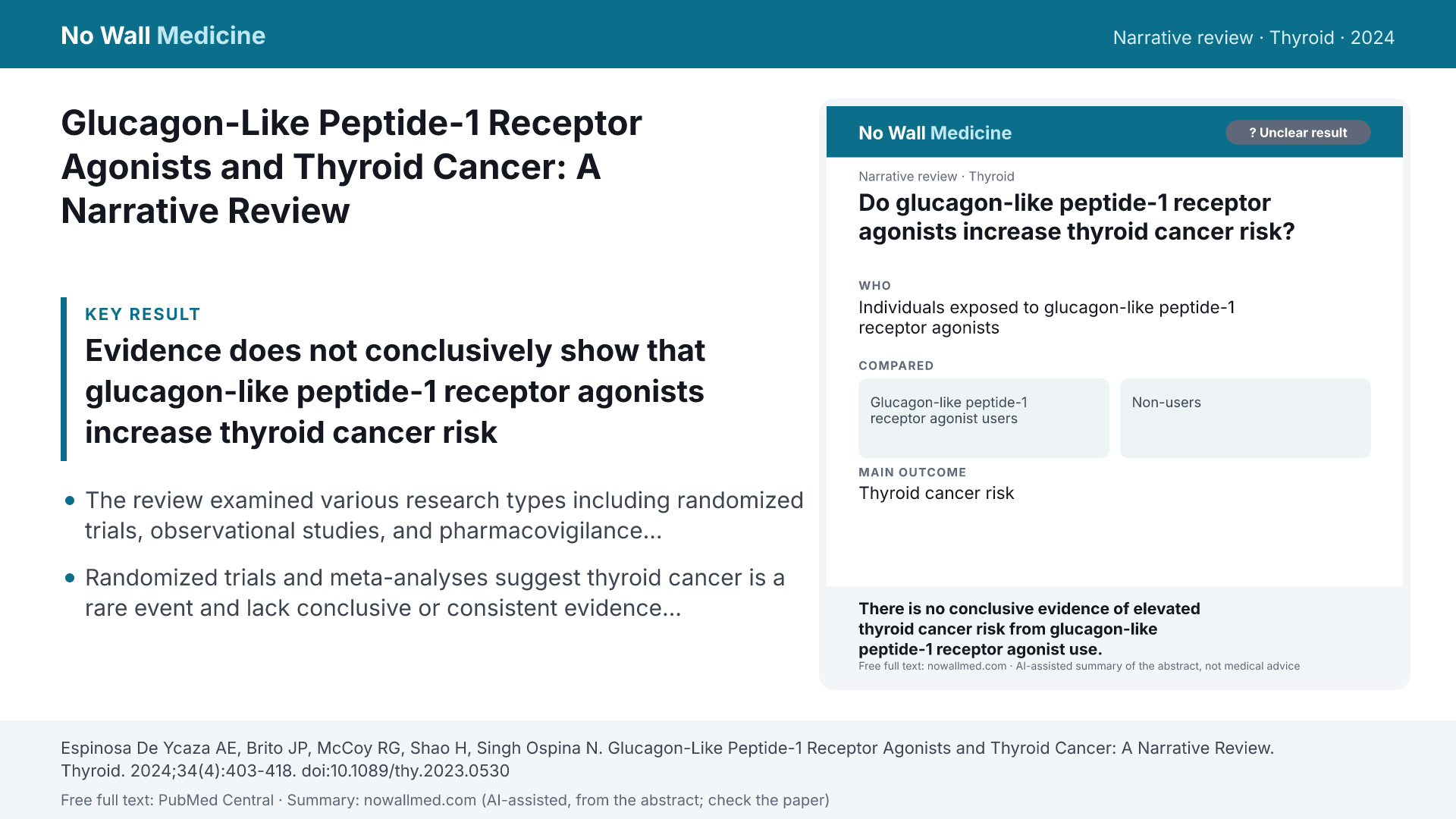
Evidence does not conclusively show that glucagon-like peptide-1 receptor agonists increase thyroid cancer risk
Glucagon-Like Peptide-1 Receptor Agonists and Thyroid Cancer: A Narrative Review
Narrative reviewUnclear result
Do glucagon-like peptide-1 receptor agonists increase thyroid cancer risk?
Who
Individuals exposed to glucagon-like peptide-1 receptor agonists
Compared
Glucagon-like peptide-1 receptor agonist users
Non-users
Main outcome
Thyroid cancer risk
Bottom line: There is no conclusive evidence of elevated thyroid cancer risk from glucagon-like peptide-1 receptor agonist use.
Limitation: Evidence spans various methodologies with inconsistent results from observational studies and imprecise effect estimates.
Thyroid · 2024-03-26Download image
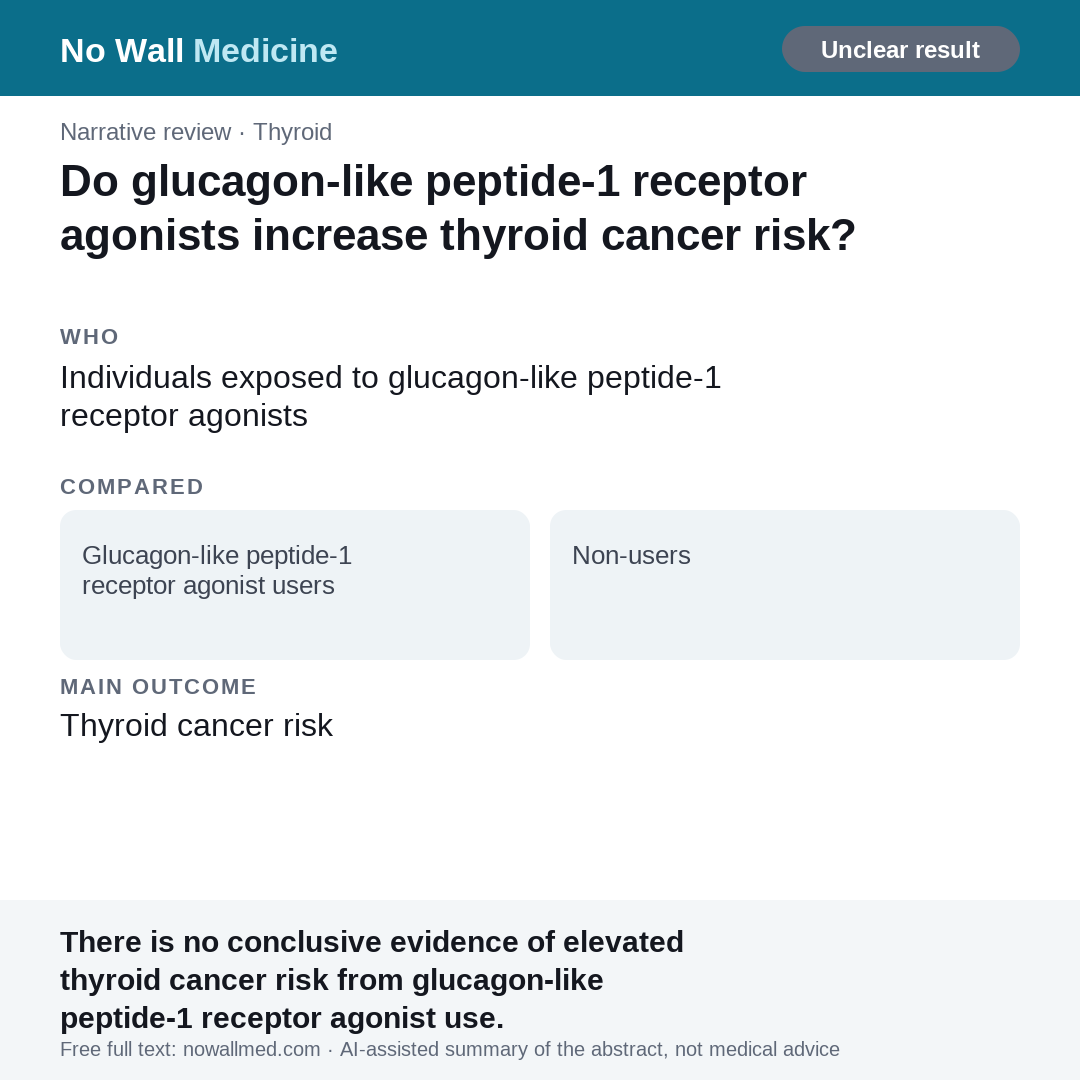
Clinical question: Do glucagon-like peptide-1 receptor agonists increase thyroid cancer risk?
Why it matters: It is unknown if the association between glucagon-like peptide-1 receptor agonists and non-medullary thyroid cancer seen in rodents exists in humans.
Key points
- The review examined various research types including randomized trials, observational studies, and pharmacovigilance reports regarding glucagon-like peptide-1 receptor agonists and thyroid cancer.
- Randomized trials and meta-analyses suggest thyroid cancer is a rare event and lack conclusive or consistent evidence of increased risk in patients using these medications.
- While pharmacovigilance studies show a signal of increased reporting for thyroid cancer, observational studies with higher risk of bias yielded inconsistent results.
Limitation the authors note: Observational studies used in the review were noted to have a higher risk of bias and limited evaluation of covariates or dependable outcome definitions.
Headline and key points written with AI from the paper’s abstract, with every number checked against it. Read the paper before relying on them.
Was this summary helpful?
Subject terms
Cite this article
Espinosa De Ycaza AE, Brito JP, McCoy RG, Shao H, Singh Ospina N. Glucagon-Like Peptide-1 Receptor Agonists and Thyroid Cancer: A Narrative Review. Thyroid. 2024. doi:10.1089/thy.2023.0530
Spotted a mistake? Suggest a correction