Glucagon-like peptide-1 receptor agonists showed no significant cardiovascular benefit for primary prevention in type 2 diabetes
Glucagon-like peptide-1 receptor agonists for primary cardiovascular disease prevention in type 2 diabetes, a systematic review
Systematic review of randomized controlled trialsNo clear difference
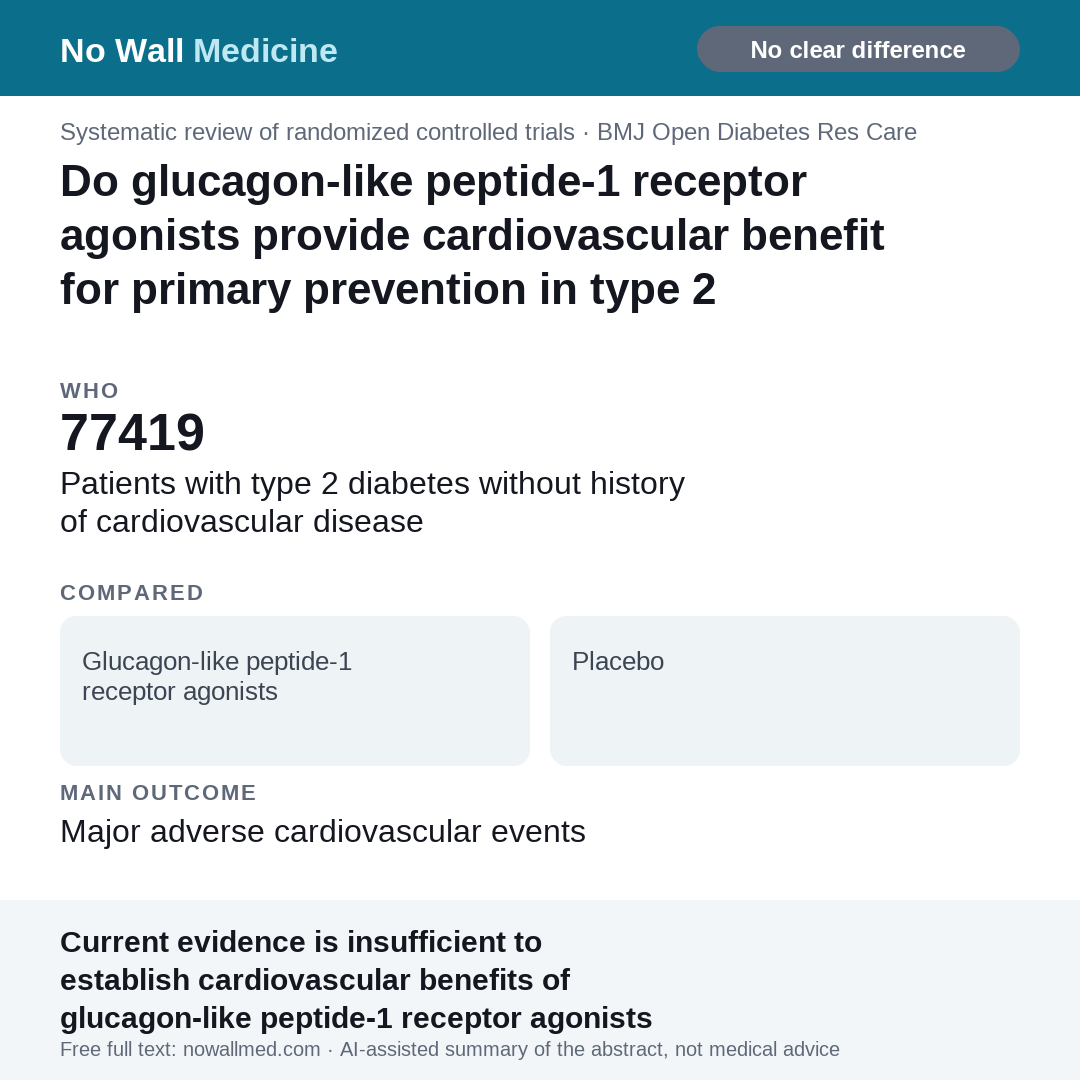
Do glucagon-like peptide-1 receptor agonists provide cardiovascular benefit for primary prevention in type 2 diabetes?
Who
77419
Patients with type 2 diabetes without history of cardiovascular disease
Compared
Glucagon-like peptide-1 receptor agonists
Placebo
Main outcome
Major adverse cardiovascular events
Result: hazard ratio 0.88 (95% CI 0.74 to 1.05)
Bottom line: Current evidence is insufficient to establish cardiovascular benefits of glucagon-like peptide-1 receptor agonists for primary prevention in type 2 diabetes.
Limitation: Subgroup analyses of aggregated data from studies not powered for primary prevention alone.
Funded by: Drug manufacturer-funded trials
BMJ Open Diabetes Res Care · 2026-08-19Download image
Clinical question: Do glucagon-like peptide-1 receptor agonists provide cardiovascular benefit for primary prevention in type 2 diabetes?
Why it matters: It is unclear if glucagon-like peptide-1 receptor agonists provide cardiovascular benefits for patients with type 2 diabetes who do not have a history of cardiovascular disease.
Key points
- Researchers analyzed 11 drug manufacturer-funded randomized controlled trials involving 77,419 participants with type 2 diabetes.
- The pooled estimate for major adverse cardiovascular events in primary prevention patients was not significant, with a hazard ratio of 0.88 (95% CI 0.74 to 1.05).
- No significant differences were found for all secondary outcomes, including all-cause mortality, cardiovascular mortality, heart attack, or stroke.
Limitation the authors note: The review was limited to subgroup analyses of aggregated data from studies that were not powered for primary prevention alone.
Headline and key points written with AI from the paper’s abstract, with every number checked against it. Read the paper before relying on them.
Abstract
We aimed to estimate the cardiovascular (CV) benefit of glucagon-like peptide-1 receptor agonists (GLP-1 RAs) in patients with type 2 diabetes (T2D) without a history of CV disease (CVD) (primary CVD prevention). We searched MEDLINE and the Cochrane Central Register of Controlled Trials for randomized controlled trials (RCTs) and Epistemonikos for systematic reviews (up to July 4, 2025). We included RCTs of patients with T2D comparing a GLP-1 RA to placebo using a CV or renal primary outcome. 11 drug manufacturer-funded trials (77 419 participants) were included. We used version 1 of the Cochrane risk of bias tool. Our primary analysis was the pooled estimate of the treatment effect in primary CVD prevention. Outcomes of interest were major adverse cardiovascular events (MACE, primary outcome), all-cause mortality, CV mortality, myocardial infarction, stroke, and serious adverse events (secondary outcomes). Only 26% of participants were primary CVD prevention patients. The pooled estimates of treatment effect for primary CVD prevention were not significant for the primary outcome, MACE (pooled HR 0.88, 95% CI 0.74 to 1.05, based on eight trials, n=16 672), and all secondary outcomes. The certainty of the evidence was rated as low due to trials' risk of bias and imprecision. Our review was limited to subgroup analyses of aggregated data from studies not powered for primary prevention alone. Current evidence is insufficient to establish CV benefits of GLP-1 RAs in T2D without a history of CVD, and dedicated primary prevention trials are needed.
Abstract reproduced under the article’s CC BY NC licence.
Topics
Cite this article
Grenet G, Eskandari R, Ko J, Adams SP, Salzwedel DM, Heran BS. Glucagon-like peptide-1 receptor agonists for primary cardiovascular disease prevention in type 2 diabetes, a systematic review. BMJ Open Diabetes Res Care. 2026. doi:10.1136/bmjdrc-2026-006225
Spotted a mistake? Suggest a correction