Goal-directed fluid therapy in emergency abdominal surgery: a randomised multicentre trial
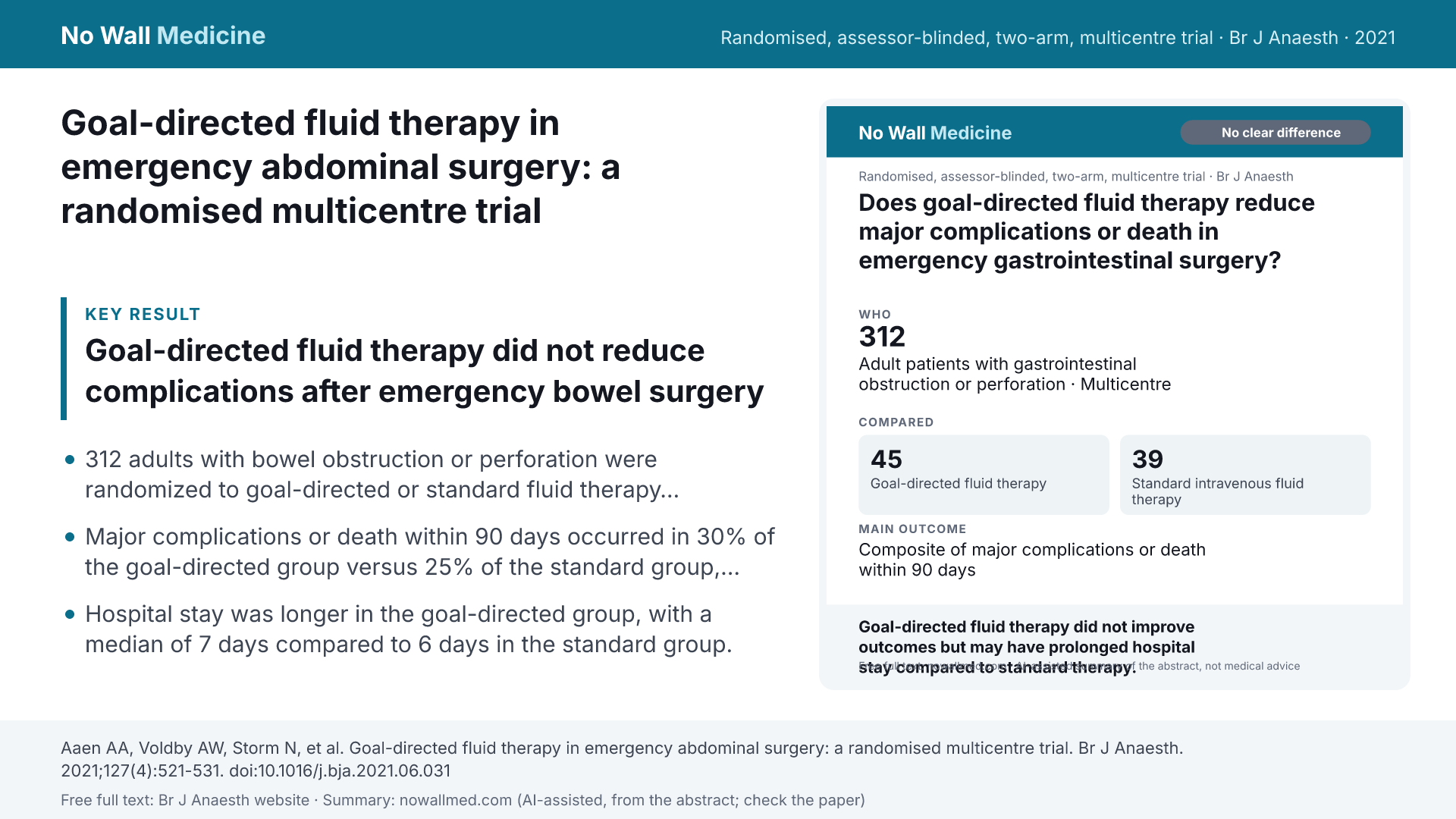
Key result: Goal-directed fluid therapy did not reduce complications after emergency bowel surgery
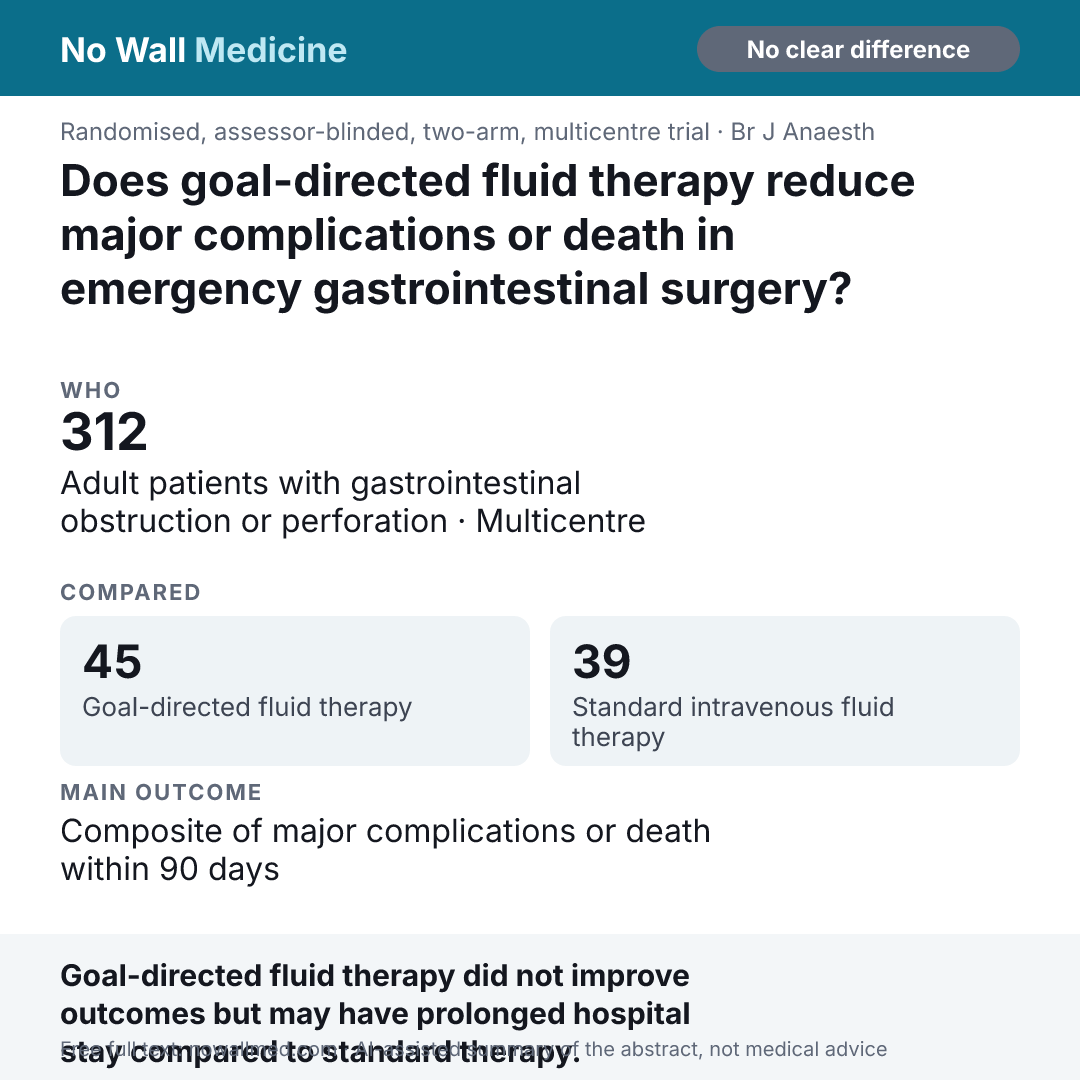
Randomised, assessor-blinded, two-arm, multicentre trialNo clear difference
Does goal-directed fluid therapy reduce major complications or death in emergency gastrointestinal surgery?
Who
312
Adult patients with gastrointestinal obstruction or perforation · Multicentre
Compared
45Goal-directed fluid therapy (30%)
39Standard intravenous fluid therapy (25%)
Main outcome
Composite of major complications or death within 90 days
Result: odds ratio=1.24; 95% confidence interval, 0.75-2.05
Bottom line: Goal-directed fluid therapy did not improve outcomes but may have prolonged hospital stay compared to standard therapy.
Br J Anaesth · 2021-08-11 · Save PNG
Key points
- 312 adults with bowel obstruction or perforation were randomized to goal-directed or standard fluid therapy during surgery.
- Major complications or death within 90 days occurred in 30% of the goal-directed group versus 25% of the standard group, a difference that was not statistically significant.
- Hospital stay was longer in the goal-directed group, with a median of 7 days compared to 6 days in the standard group.
Discussion prompts
- Would these patients look like yours? Who was left out?
- Is the main outcome one that matters to patients?
- Is the difference large enough to change what you do?
Cite: Aaen AA, Voldby AW, Storm N, et al. Goal-directed fluid therapy in emergency abdominal surgery: a randomised multicentre trial. Br J Anaesth. 2021;127(4):521-531. doi:10.1016/j.bja.2021.06.031
Free full text: Br J Anaesth website · Summary and visual abstract: nowallmed.com/a/goal-directed-fluid-therapy-in-emergency-abdominal-surgery-a-1oauz9l/ (AI-assisted from the abstract; check the paper before relying on it).