Gravity- vs Wall Suction-Driven Large-Volume Thoracentesis: A Randomized Controlled Study
Multicenter, single-blinded, randomized controlled trialNo clear difference
Does wall suction drainage result in more chest discomfort compared with gravity drainage?
Who
221
Patients with large free-flowing effusions of 500 mL or more · Multicenter
Compared
Wall suction
Gravity drainage
Main outcome
Postprocedural chest discomfort at 5 minutes
Bottom line: Wall suction and gravity drainage result in similar levels of procedural discomfort and dyspnea improvement.
Chest · 2024-07-18Download image
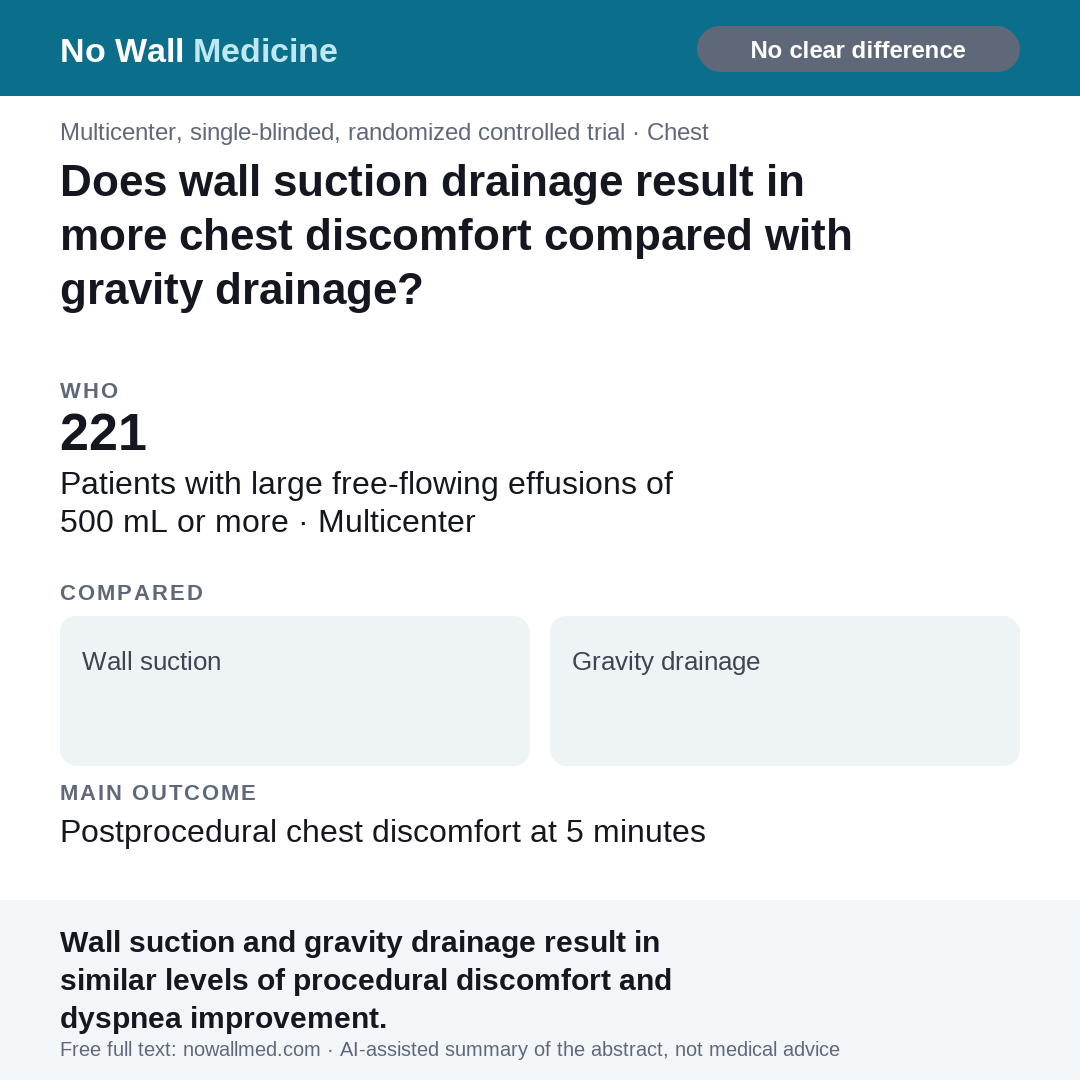
Clinical question: Does wall suction drainage result in more chest discomfort compared with gravity drainage?
Abstract
Background
Prior studies have found no differences in procedural chest discomfort for patients undergoing manual syringe aspiration or drainage with gravity after thoracentesis. However, whether gravity drainage could protect against chest pain due to the larger negative-pressure gradient generated by wall suction has not been investigated. Research question
Does wall suction drainage result in more chest discomfort compared with gravity drainage in patients undergoing large-volume thoracentesis? Study design and methods
In this multicenter, single-blinded, randomized controlled trial, patients with large free-flowing effusions of ≥ 500 mL were assigned at a 1:1 ratio to wall suction or gravity drainage. Wall suction was performed with a suction system attached to the suction tubing and with vacuum pressure adjusted to full vacuum. Gravity drainage was performed with a drainage bag placed 100 cm below the catheter insertion site and connected via straight tubing. Patients rated chest discomfort on a 100-mm visual analog scale before, during, and after drainage. The primary outcome was postprocedural chest discomfort at 5 minutes. Secondary outcomes included measures of postprocedure chest discomfort, breathlessness, procedure time, volume of fluid drained, and complication rates. Results
Of the 228 patients initially randomized, 221 were included in the final analysis. The primary outcome of procedural chest discomfort did not differ significantly between the groups (P = .08), nor did the secondary outcomes of postprocedural discomfort and dyspnea. Similar volumes were drained in both groups, but the procedure duration was longer in the gravity arm by approximately 3 minutes. No differences in rate of pneumothorax or reexpansion pulmonary edema were noted between the two groups. Interpretation
Thoracentesis via wall suction and gravity drainage results in similar levels of procedural discomfort and dyspnea improvement. Clinical trial registry
ClinicalTrials.gov; No.: NCT05131945; URL: www. Clinicaltrials
gov.
Topics
Cite this article
Shojaee S, Pannu J, Yarmus L, Fantin A, MacRosty C, Bassett R. Gravity- vs Wall Suction-Driven Large-Volume Thoracentesis: A Randomized Controlled Study. Chest. 2024. doi:10.1016/j.chest.2024.05.046
Spotted a mistake? Suggest a correction
Top studies every Monday
The week’s key trials and guidelines in your specialties, plus any topics you follow. By email, free.
Get the weekly digest