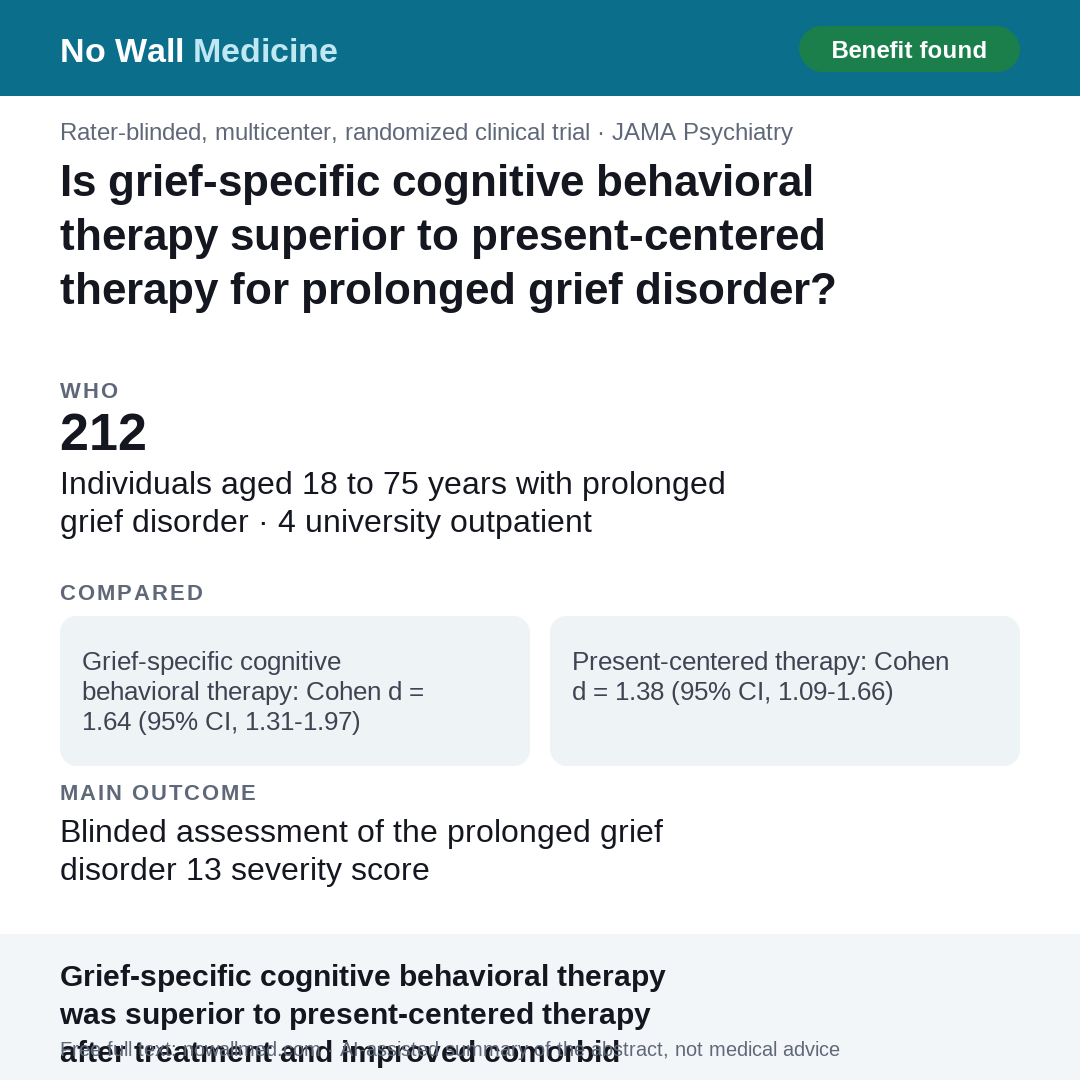
Cognitive behavioral therapy for prolonged grief disorder showed greater symptom reduction than present-centered therapy
Grief-Specific Cognitive Behavioral Therapy vs Present-Centered Therapy: A Randomized Clinical Trial
Rater-blinded, multicenter, randomized clinical trialBenefit found
Is grief-specific cognitive behavioral therapy superior to present-centered therapy for prolonged grief disorder?
Who
212
Individuals aged 18 to 75 years with prolonged grief disorder · 4 university outpatient clinics in Germany
Compared
Grief-specific cognitive behavioral therapy: Cohen d = 1.64 (95% CI, 1.31-1.97)
Present-centered therapy: Cohen d = 1.38 (95% CI, 1.09-1.66)
Main outcome
Blinded assessment of the prolonged grief disorder 13 severity score
Result: Cohen d = 0.31 (95% CI, 0.03-0.57) after treatment
Bottom line: Grief-specific cognitive behavioral therapy was superior to present-centered therapy after treatment and improved comorbid symptoms at follow-up.
JAMA Psychiatry · 2024-11-13Download image
Clinical question: Is grief-specific cognitive behavioral therapy superior to present-centered therapy for prolonged grief disorder?
Why it matters: It is unknown whether integrative cognitive behavioral therapy for prolonged grief is more effective than active control treatments like present-centered therapy.
Key points
- Researchers studied 212 participants with prolonged grief disorder who were randomized to receive either grief-specific cognitive behavioral therapy or present-centered therapy.
- After treatment, the cognitive behavioral group showed significantly greater reductions in grief severity compared to the present-centered group (Cohen d = 0.31; 95% CI, 0.03-0.57).
- At the 12-month follow-up, the difference in grief severity was only visible on a trend level (Cohen d = 0.28; 95% CI, -0.02 to 0.57).
Headline and key points written with AI from the paper’s abstract, with every number checked against it. Read the paper before relying on them.
Topics
Cite this article
Rosner R, Rau J, Kersting A, Rief W, Steil R, Rummel AM. Grief-Specific Cognitive Behavioral Therapy vs Present-Centered Therapy: A Randomized Clinical Trial. JAMA Psychiatry. 2024. doi:10.1001/jamapsychiatry.2024.3409
Spotted a mistake? Suggest a correction
Top studies every Monday
The week’s key trials and guidelines in your specialties, by email. Free.
Get the weekly digest