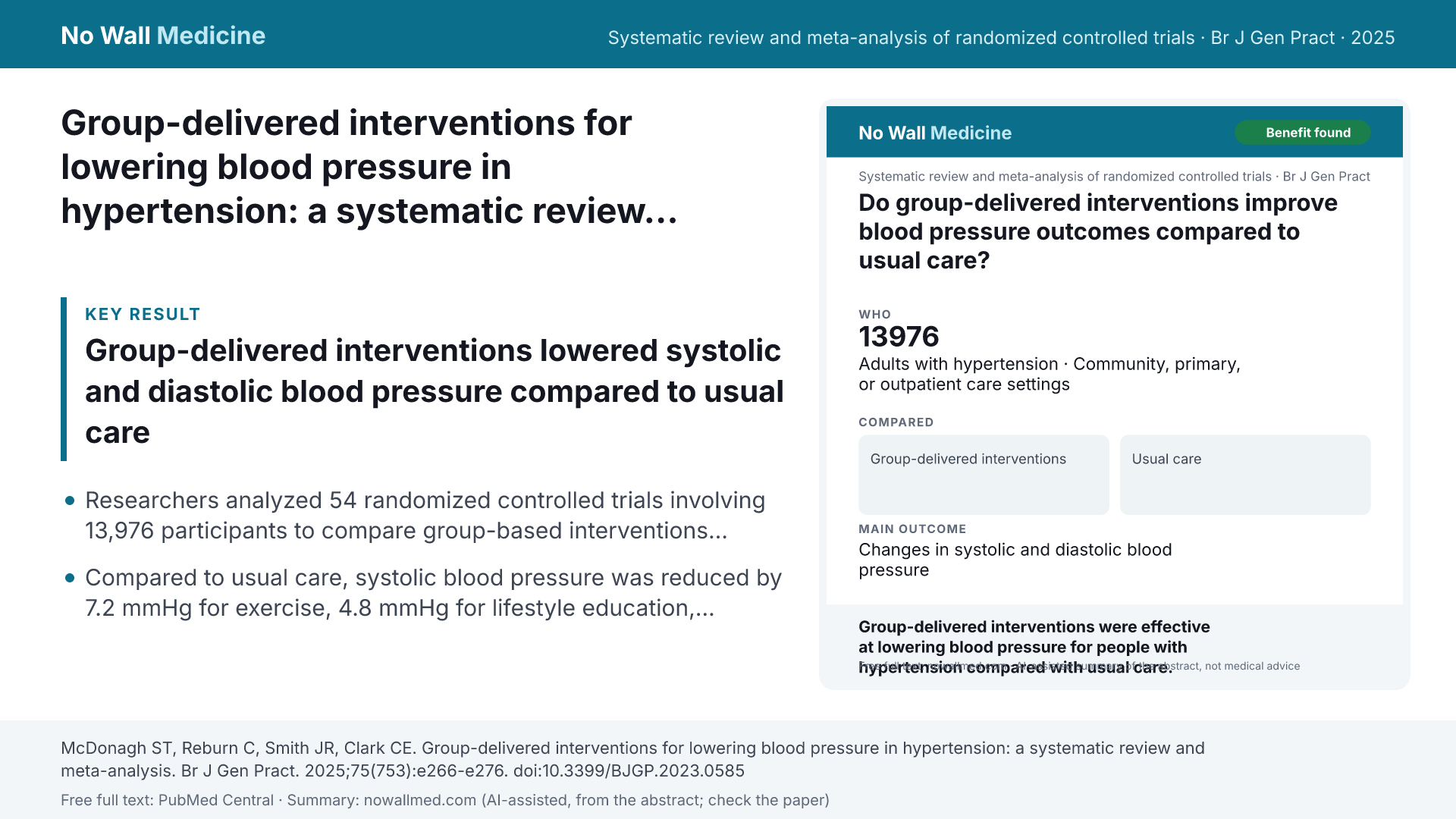
Group-delivered interventions lowered systolic and diastolic blood pressure compared to usual care
Group-delivered interventions for lowering blood pressure in hypertension: a systematic review and meta-analysis
Systematic review and meta-analysis of randomized controlled trialsBenefit found
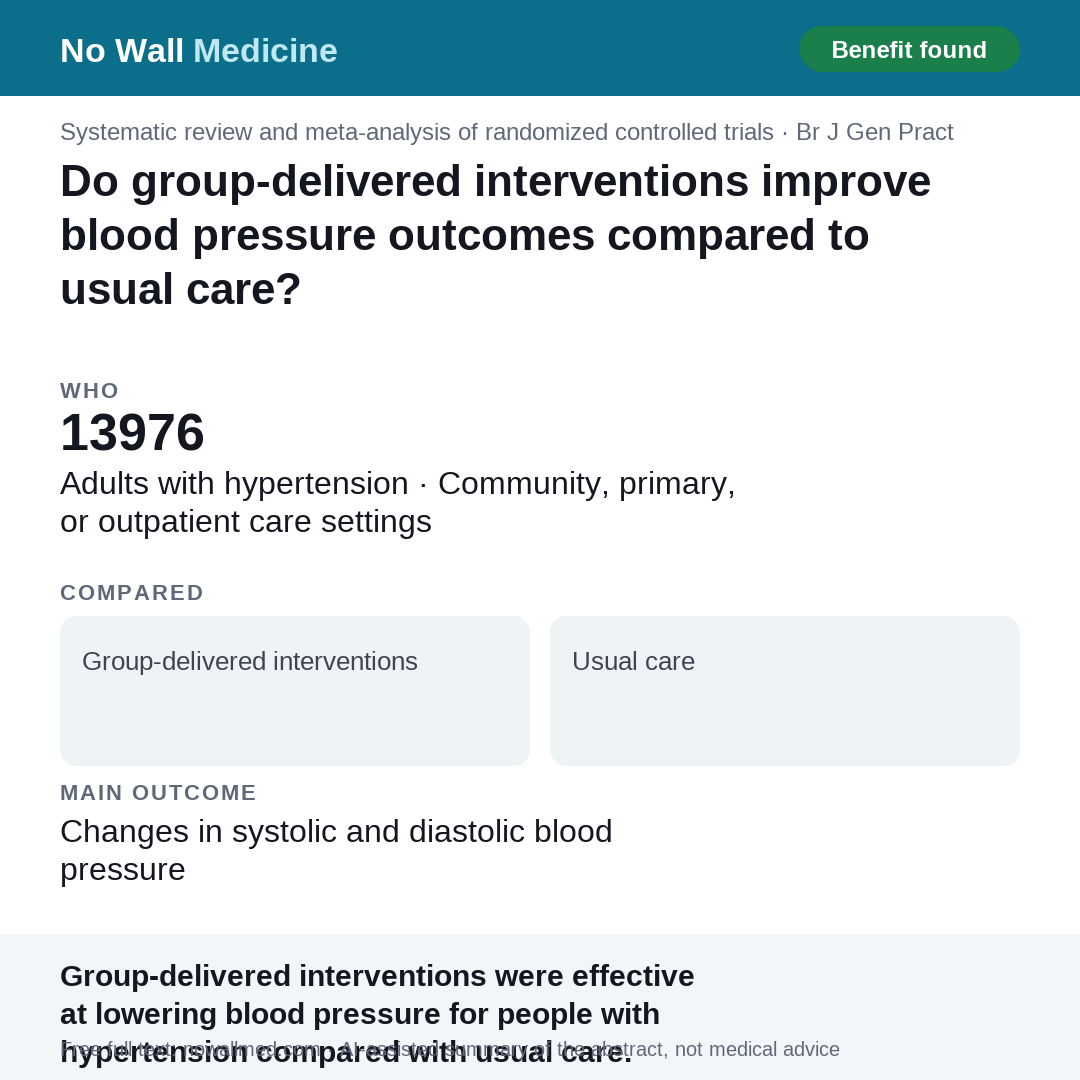
Do group-delivered interventions improve blood pressure outcomes compared to usual care?
Who
13976
Adults with hypertension · Community, primary, or outpatient care settings
Compared
Group-delivered interventions
Usual care
Main outcome
Changes in systolic and diastolic blood pressure
Result: systolic BP reduced by 7.2 mmHg (95% CI 4.7 to 9.6)
Bottom line: Group-delivered interventions were effective at lowering blood pressure for people with hypertension compared with usual care.
Limitation: Feasibility and cost-effectiveness in primary care require further study.
Br J Gen Pract · 2025-03-27Download image
Clinical question: Do group-delivered interventions improve blood pressure outcomes compared to usual care?
Why it matters: It was unclear if group-delivered interventions, which use peer support, provide benefits for blood pressure outcomes compared to standard individual care.
Key points
- Researchers analyzed 54 randomized controlled trials involving 13,976 participants to compare group-based interventions with usual care for hypertension.
- Compared to usual care, systolic blood pressure was reduced by 7.2 mmHg for exercise, 4.8 mmHg for lifestyle education, and 3.6 mmHg for psychotherapy.
- Diastolic blood pressure reductions were 3.9 mmHg for exercise, 2.9 mmHg for lifestyle education, and 1.2 mmHg for psychotherapy.
Limitation the authors note: The feasibility and cost-effectiveness of these interventions in primary care require further study.
Headline and key points written with AI from the paper’s abstract, with every number checked against it. Read the paper before relying on them.
Was this summary helpful?
Subject terms
Cite this article
McDonagh ST, Reburn C, Smith JR, Clark CE. Group-delivered interventions for lowering blood pressure in hypertension: a systematic review and meta-analysis. Br J Gen Pract. 2025. doi:10.3399/BJGP.2023.0585
Spotted a mistake? Suggest a correction
Top studies every Monday
The week’s key trials and guidelines in your specialties, plus any topics you follow. By email, free.
Get the weekly digest