Growth hormone administration reduced liver fat in adults with overweight or obesity and fatty liver disease
Growth Hormone Administration Improves Nonalcoholic Fatty Liver Disease in Overweight/Obesity: A Randomized Trial
Randomized, double-blind, placebo-controlled trialBenefit found
Does growth hormone administration reduce hepatic steatosis in overweight or obese adults with NAFLD?
Who
53
Adults aged 18 to 65 years with overweight/obesity and NAFLD without diabetes
Compared
Growth hormone: -5.2 ± 10.5%
Placebo: 3.8 ± 6.9%
Main outcome
intrahepatic lipid content by proton magnetic resonance spectroscopy
Result: -8.9% (95% CI, -14.5 to -3.3%)
Bottom line: Low-dose growth hormone administration reduces hepatic steatosis in adults with overweight/obesity and NAFLD without worsening glycemic measures.
J Clin Endocrinol Metab · 2023-06-28Download image
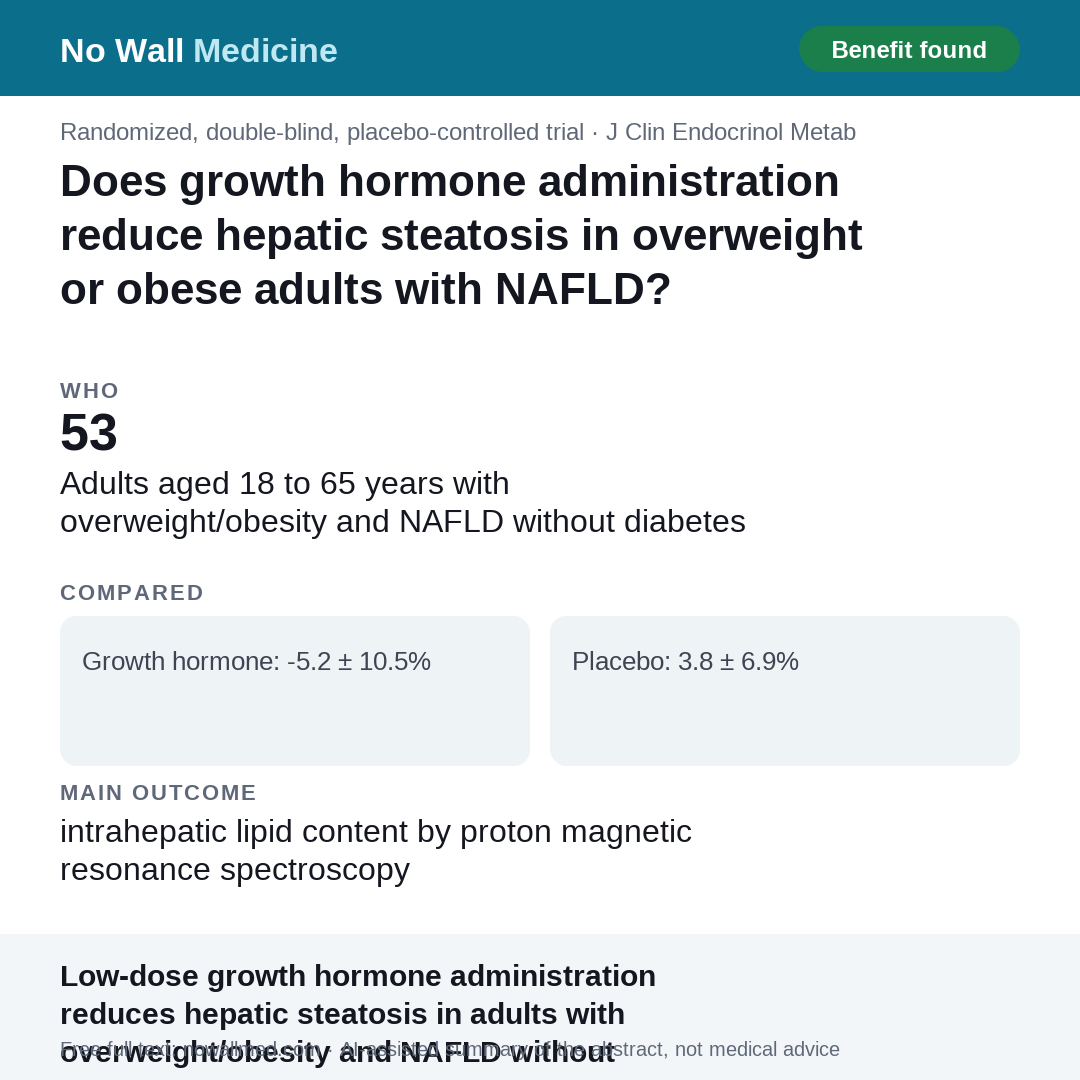
Clinical question: Does growth hormone administration reduce hepatic steatosis in overweight or obese adults with NAFLD?
Why it matters: Nonalcoholic fatty liver disease is a progressive condition that currently lacks effective treatments.
Key points
- Researchers conducted a 6-month randomized trial with 53 adults aged 18 to 65 years with a body mass index of 25 kg/m2 or higher and nonalcoholic fatty liver disease.
- Daily growth hormone administration resulted in a mean absolute reduction in intrahepatic lipid content of -5.2 ± 10.5% compared to 3.8 ± 6.9% for the placebo group.
- Lower extremity edema, or swelling in the legs, was more frequent in the growth hormone group at 21% compared to 0% in the placebo group.
Headline and key points written with AI from the paper’s abstract, with every number checked against it. Read the paper before relying on them.
Was this summary helpful?
Subject terms
Cite this article
Dichtel LE, Corey KE, Haines MS, Chicote ML, Lee H, Kimball A. Growth Hormone Administration Improves Nonalcoholic Fatty Liver Disease in Overweight/Obesity: A Randomized Trial. J Clin Endocrinol Metab. 2023. doi:10.1210/clinem/dgad375
Spotted a mistake? Suggest a correction
Top studies every Monday
The week’s key trials and guidelines in your specialties, plus any topics you follow. By email, free.
Get the weekly digest