Guadecitabine did not improve overall survival compared to standard treatments in relapsed acute myeloid leukemia
Guadecitabine vs TC in relapsed/refractory AML after intensive chemotherapy: a randomized phase 3 ASTRAL-2 trial
Randomized phase 3 trialNo clear difference
Is guadecitabine better than preselected treatment choice for relapsed or refractory acute myeloid leukemia?
Who
302
Patients with relapsed or refractory acute myeloid leukemia
Compared
6.4 monthsguadecitabine
5.4 monthspreselected treatment choice
Main outcome
overall survival
Result: hazard ratio 0.88 (95% confidence interval, 0.67-1.14)
Bottom line: Guadecitabine did not demonstrate an overall survival benefit compared to preselected treatment choice in relapsed or refractory acute myeloid leukemia.
Blood Adv · 2024-01-17Download image
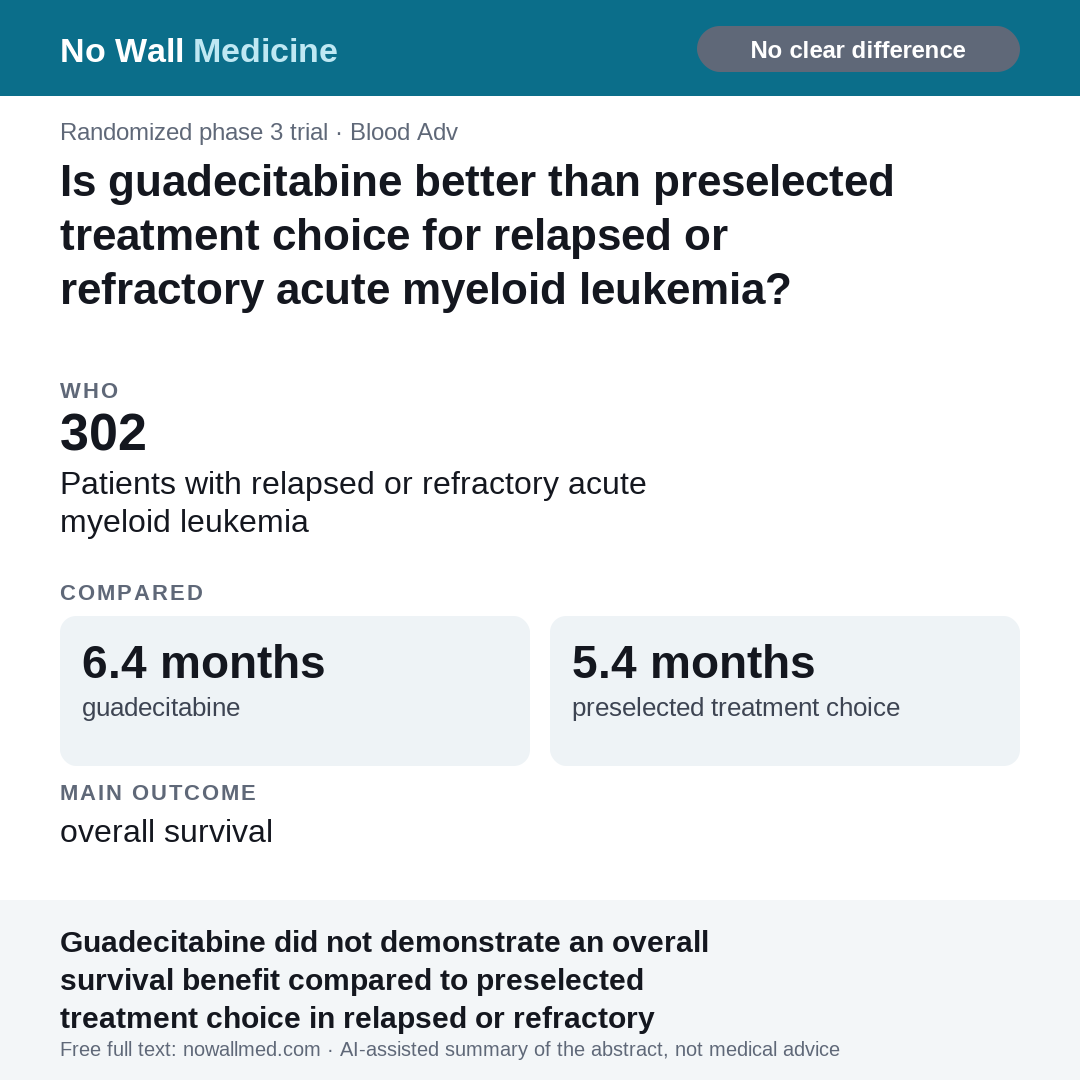
Clinical question: Is guadecitabine better than preselected treatment choice for relapsed or refractory acute myeloid leukemia?
Why it matters: It was unknown if guadecitabine improves overall survival for patients with acute myeloid leukemia who have relapsed or are resistant to intensive chemotherapy.
Key points
- Researchers studied 302 patients with relapsed or refractory acute myeloid leukemia, comparing guadecitabine to a choice of chemotherapy, low-intensity treatment, or best supportive care.
- The median overall survival was 6.4 months for guadecitabine and 5.4 months for the comparison group, which was not a statistically significant difference.
- Guadecitabine was associated with higher complete response rates of 17% compared to 8% for the comparison group, but also higher rates of severe neutropenia at 32% versus 17%.
Headline and key points written with AI from the paper’s abstract, with every number checked against it. Read the paper before relying on them.
Abstract
Guadecitabine is a novel hypomethylating agent (HMA) resistant to deamination by cytidine deaminase. Patients with relapsed/refractory acute myeloid leukemia (AML) were randomly assigned to guadecitabine or a preselected treatment choice (TC) of high-intensity chemotherapy, low-intensity treatment with HMAs or low-dose cytarabine, or best supportive care (BSC). The primary end point was overall survival (OS). A total of 302 patients were randomly assigned to guadecitabine (n = 148) or TC (n = 154). Preselected TCs were low-intensity treatment (n = 233 [77%; mainly HMAs]), high-intensity chemotherapy (n = 63 [21%]), and BSC (n = 6 [2%]). The median OS were 6.4 and 5.4 months for guadecitabine and TC, respectively (hazard ratio 0.88 [95% confidence interval, 0.67-1.14]; log-rank P = .33). Survival benefit for guadecitabine was suggested in several prospective subgroups, including age <65 years, Eastern Cooperative Oncology Group performance status 0 to 1, refractory AML, and lower peripheral blood blasts ≤30%. Complete response (CR) + CR with partial hematologic recovery rates were 17% for guadecitabine vs 8% for TC (P < .01); CR+CR with incomplete count recovery rates were 27% for guadecitabine vs 14% for TC (P < .01). Safety was comparable for the 2 arms, but guadecitabine had a higher rate of grade ≥3 neutropenia (32% vs 17%; P < .01). This study did not demonstrate an OS benefit for guadecitabine. Clinical response rates were higher for guadecitabine, with comparable safety to TC. There was an OS benefit for guadecitabine in several prespecified subgroups. This study was registered at www.clinicaltrials.gov as #NCT02920008.
Abstract reproduced under the article’s CC BY NC ND licence.
Topics
Cite this article
Roboz GJ, Sanz G, Griffiths EA, Yee K, Kantarjian H, Récher C. Guadecitabine vs TC in relapsed/refractory AML after intensive chemotherapy: a randomized phase 3 ASTRAL-2 trial. Blood Adv. 2024. doi:10.1182/bloodadvances.2023012062
Spotted a mistake? Suggest a correction
Top studies every Monday
The week’s key trials and guidelines in your specialties, plus any topics you follow. By email, free.
Get the weekly digest