Guided antipsychotic dose reduction was associated with similar relapse rates compared to maintaining stable doses
Guided antipsychotic reduction to reach minimum effective dose (GARMED) in patients with remitted psychosis: a 2-year randomized controlled trial with a naturalistic cohort
Open-label randomized prospective comparative cohort trialNo clear difference
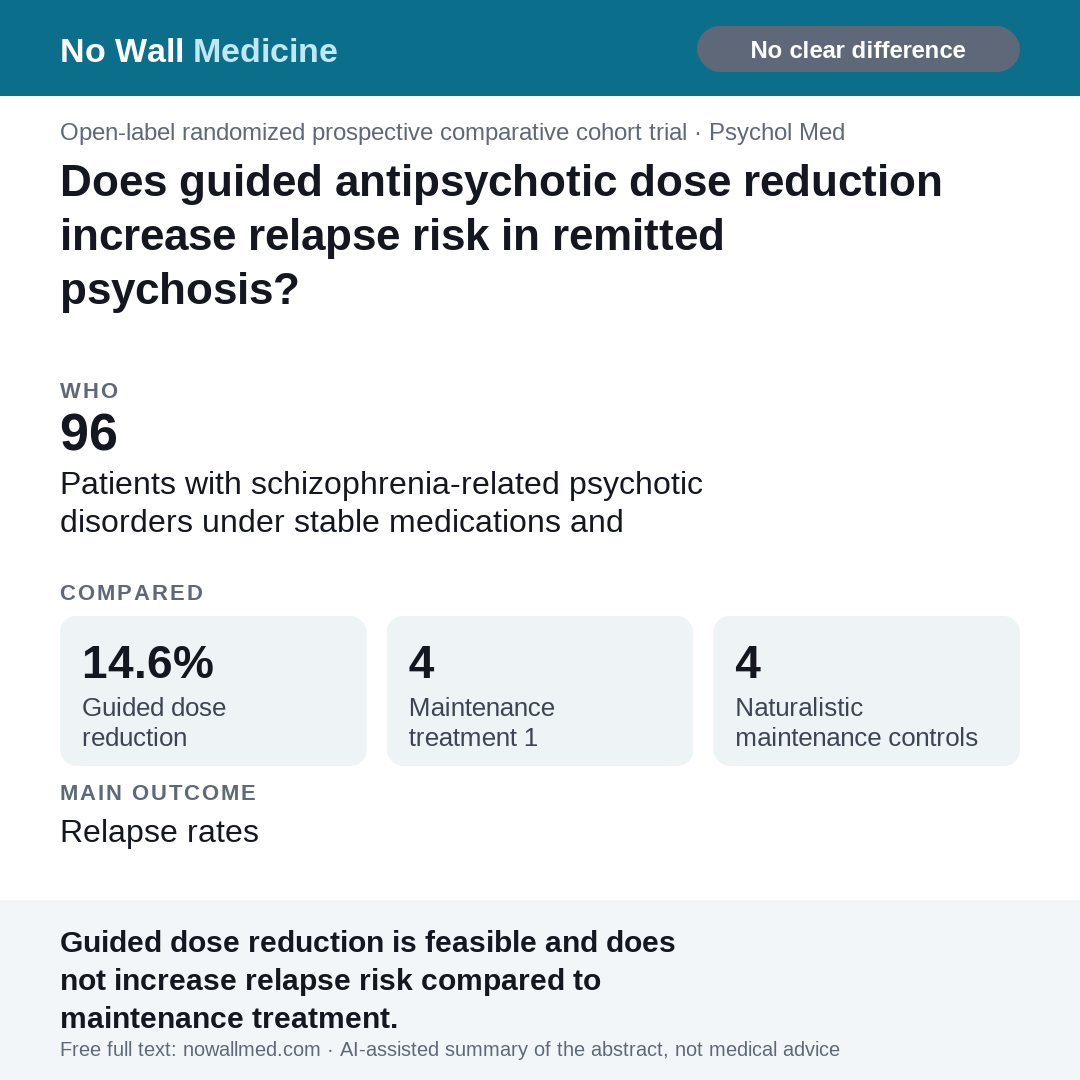
Does guided antipsychotic dose reduction increase relapse risk in remitted psychosis?
Who
96
Patients with schizophrenia-related psychotic disorders under stable medications and symptoms
Compared
14.6%Guided dose reduction
4Maintenance treatment 1
4Naturalistic maintenance controls
Main outcome
Relapse rates
Bottom line: Guided dose reduction is feasible and does not increase relapse risk compared to maintenance treatment.
Psychol Med · 2023-03-10Download image
Clinical question: Does guided antipsychotic dose reduction increase relapse risk in remitted psychosis?
Why it matters: Patients with stable psychotic symptoms face a dilemma between wanting to stop antipsychotic medication and the risk of experiencing a relapse.
Key points
- Researchers studied 96 patients with schizophrenia-related psychotic disorders, comparing guided dose reduction to two different maintenance treatment groups over 2 years.
- Relapse occurred in 14.6% of patients, with 6 in the guided reduction group, 4 in the first maintenance group, and 4 in the second maintenance group.
- While 74.5% of patients in the guided reduction group stayed well on lower doses, 25.5% could not successfully decrease any medication dose.
Headline and key points written with AI from the paper’s abstract, with every number checked against it. Read the paper before relying on them.
Was this summary helpful?
Subject terms
Cite this article
Liu CC, Hsieh MH, Chien YL, Liu CM, Lin YT, Hwang TJ. Guided antipsychotic reduction to reach minimum effective dose (GARMED) in patients with remitted psychosis: a 2-year randomized controlled trial with a naturalistic cohort. Psychol Med. 2023. doi:10.1017/S0033291723000429
Spotted a mistake? Suggest a correction
Top studies every Monday
The week’s key trials and guidelines in your specialties, plus any topics you follow. By email, free.
Get the weekly digest