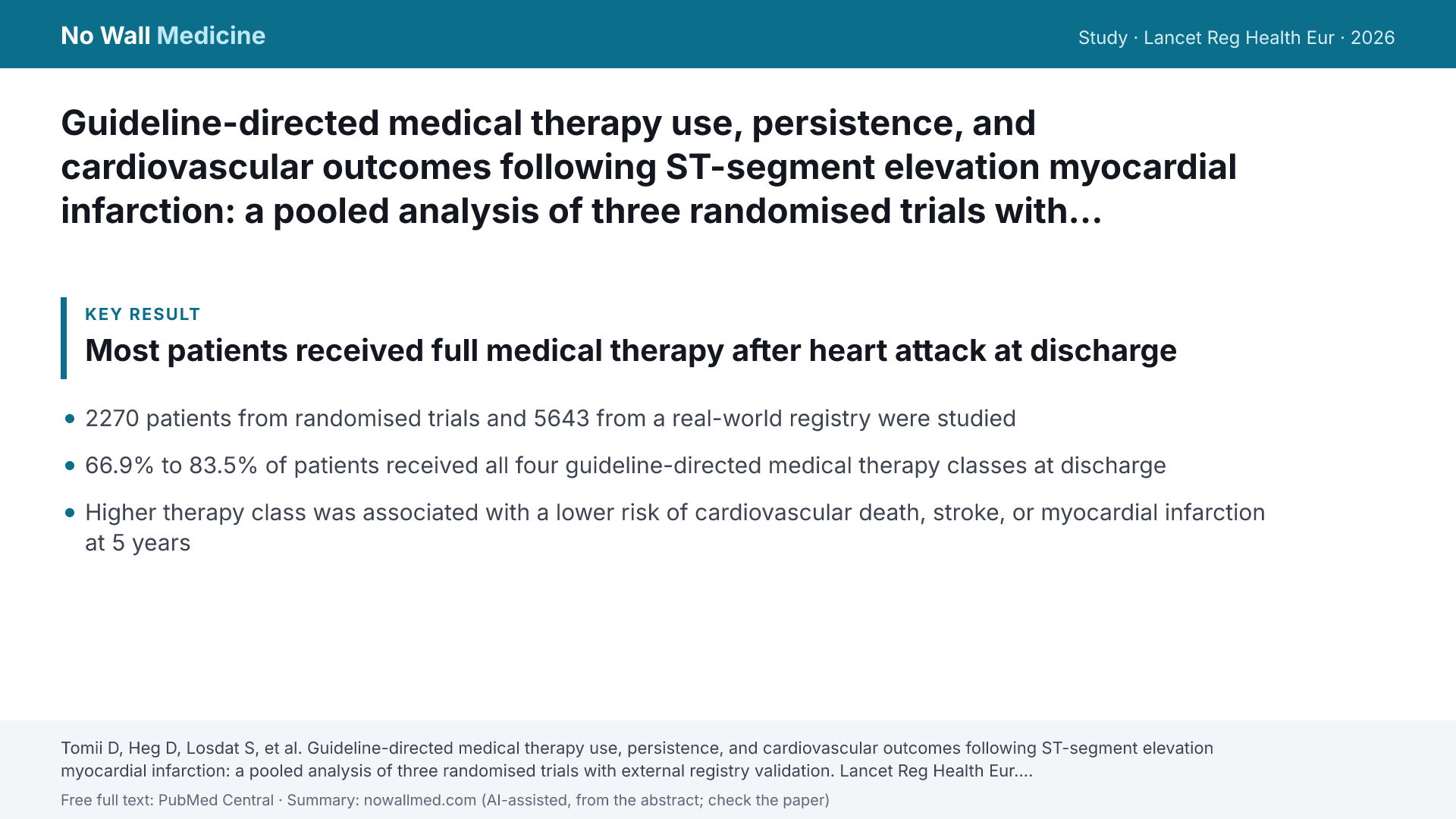
Most patients received full medical therapy after heart attack at discharge
Guideline-directed medical therapy use, persistence, and cardiovascular outcomes following ST-segment elevation myocardial infarction: a pooled analysis of three randomised trials with external registry validation
Why it matters: Implementation and long-term persistence of guideline-directed medical therapy after heart attack remain suboptimal
Key points
- 2270 patients from randomised trials and 5643 from a real-world registry were studied.
- 66.9% to 83.5% of patients received all four guideline-directed medical therapy classes at discharge.
- Higher therapy class was associated with a lower risk of cardiovascular death, stroke, or myocardial infarction at 5 years.
Study type: Observational study: it can show a link, but not prove that one thing causes another.
Headline and key points written with AI from the paper’s abstract, with every number checked against it. Read the paper before relying on them.
Was this summary helpful?
Headline, design, result, key points, caveat and citation as plain text.
Cite this article
Tomii D, Heg D, Losdat S, et al. Guideline-directed medical therapy use, persistence, and cardiovascular outcomes following ST-segment elevation myocardial infarction: a pooled analysis of three randomised trials with external registry validation. Lancet Reg Health Eur. 2027;72:101919. doi:10.1016/j.lanepe.2026.101919
Spotted a mistake? Suggest a correction