GuidelineClinical Journal of the American Society of Nephrology · Dec 20, 2021

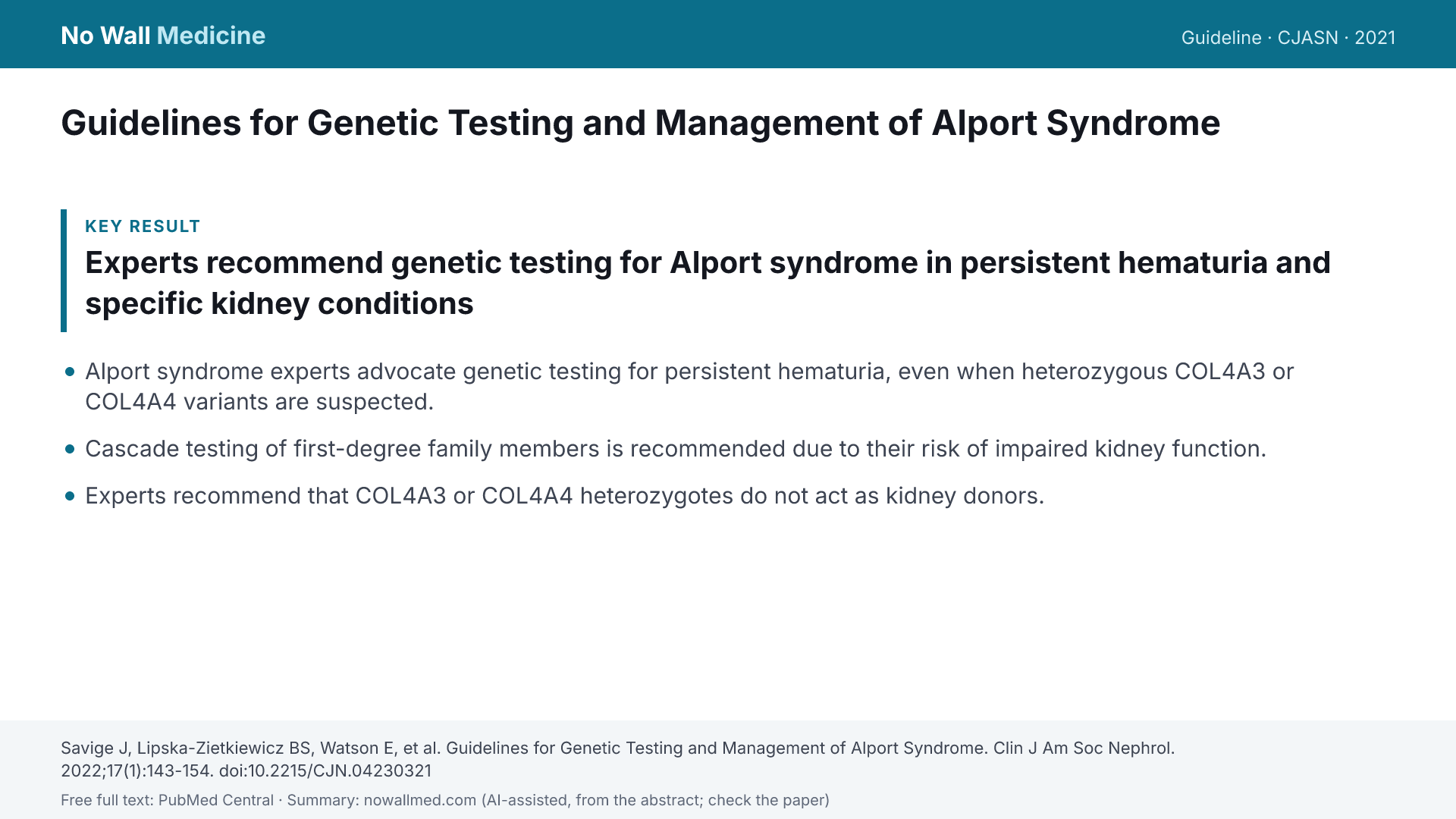
Experts recommend genetic testing for persistent hematuria and kidney disease to manage Alport syndrome

Guidelines for Genetic Testing and Management of Alport Syndrome

Savige J, Lipska-Zietkiewicz BS, Watson E, Hertz JM, Deltas C, Mari F, et al
NephrologyMedical Genetics & GenomicsAdult
Key points

Headline and key points written with AI from the paper’s abstract, with every number checked against it. Read the paper before relying on them.

Was this summary helpful?
Read the full paper free at PubMed Central ↗⬇ Slide🖨 Handout
Top Nephrology studies every Monday

The week’s key trials and guidelines, free to read, in one short email. No account; unsubscribe in one click.

Choose specialties and topics

Subject terms

Autoantigens; Collagen Type IV; Genetic Testing; Humans; Nephritis, Hereditary; Practice Guidelines as Topic

DOI: 10.2215/CJN.04230321 · PubMed: 34930753

Cite this article

Savige J, Lipska-Zietkiewicz BS, Watson E, Hertz JM, Deltas C, Mari F. Guidelines for Genetic Testing and Management of Alport Syndrome. CJASN. 2021. doi:10.2215/CJN.04230321

RIS (EndNote, Zotero, Mendeley)BibTeX

Spotted a mistake? Suggest a correction

Similar articles

Guideline · Eur J Hum Genet · Apr 15, 2021 · Medical Genetics & Genomics

Experts refine genetic testing standards for Alport syndrome to include more kidney disease symptoms

Research · Eur J Hum Genet · Mar 18, 2026 · Medical Genetics & Genomics

Systematic reassessment of reported variants in individuals with suspicion of Alport spectrum disorder reveals a high rate of ambiguous results

Review · JASN · May 22, 2026 · Nephrology

Autosomal Dominant Alport Syndrome

Guideline · Nephrol Dial Transplant · Dec 14, 2024 · Nephrology

Expert consensus guideline provides recommendations for diagnosing and managing Alport syndrome and related kidney diseases

Research · Kidney Int · Jul 24, 2026 · Nephrology

Noninvasive optical coherence tomography biomarker for Alport syndrome, COL4-related focal segmental glomerulosclerosis, and COL4 variant interpretation