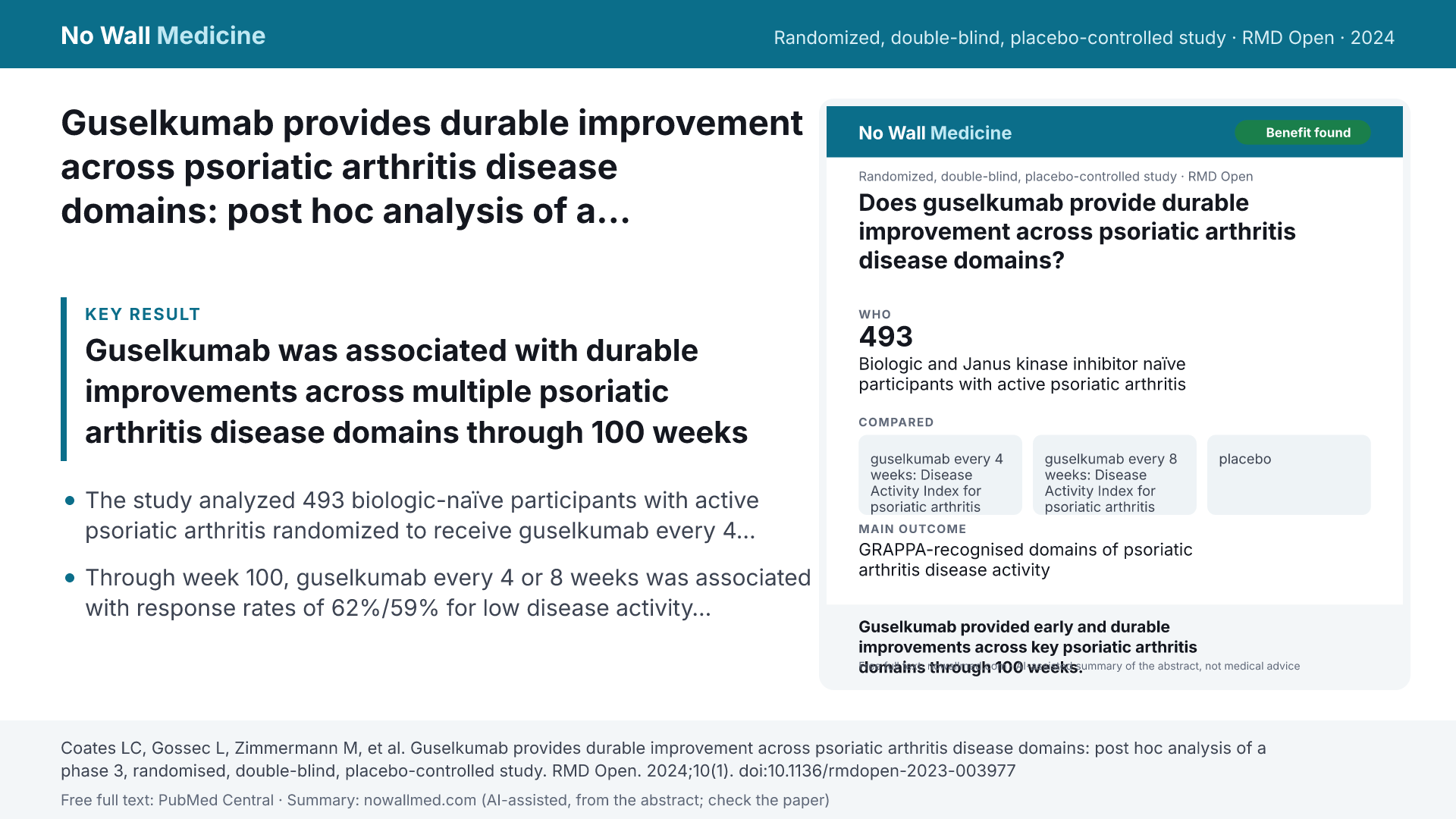
Guselkumab was associated with durable improvements across multiple psoriatic arthritis disease domains through 100 weeks
Guselkumab provides durable improvement across psoriatic arthritis disease domains: post hoc analysis of a phase 3, randomised, double-blind, placebo-controlled study
Randomized, double-blind, placebo-controlled studyBenefit found
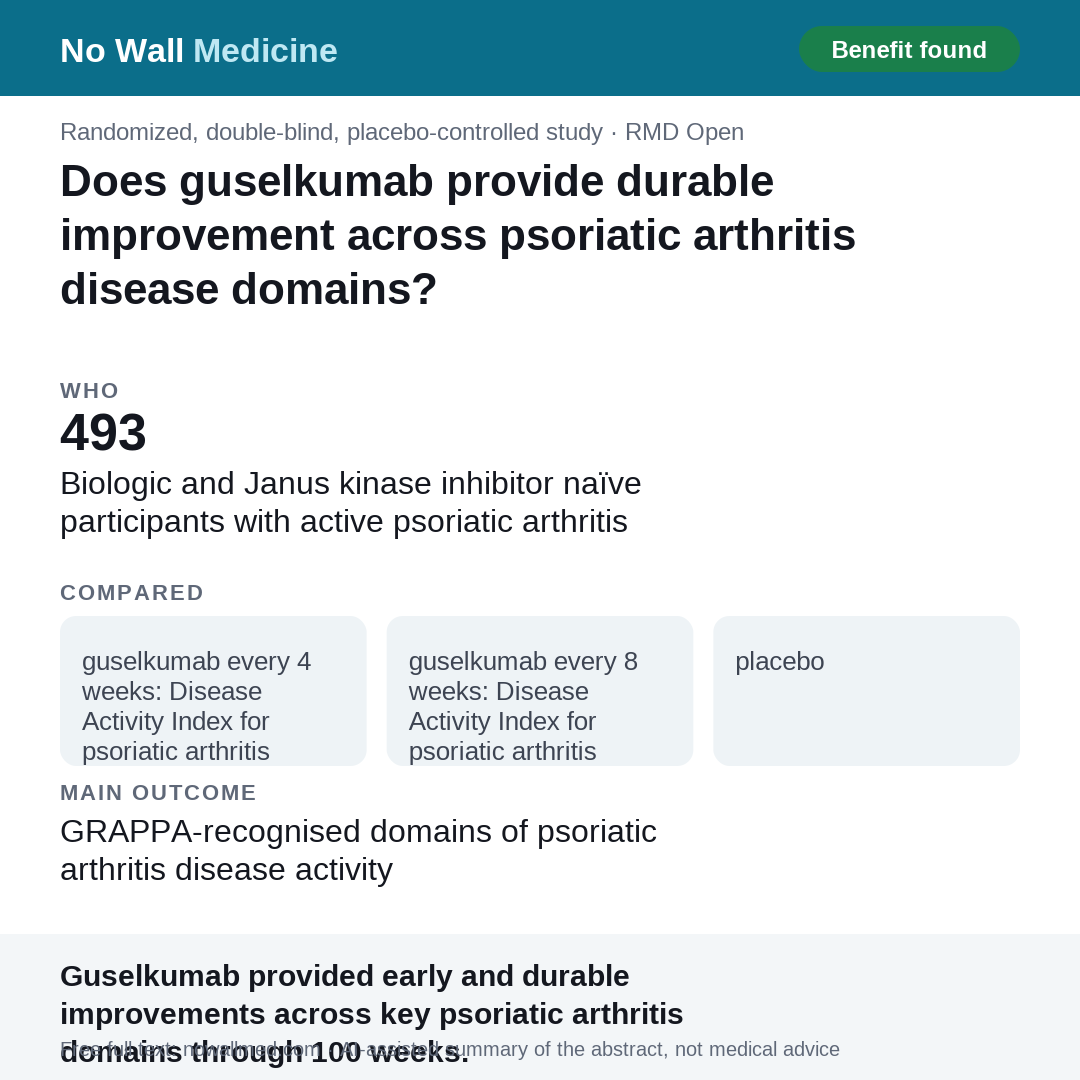
Does guselkumab provide durable improvement across psoriatic arthritis disease domains?
Who
493
Biologic and Janus kinase inhibitor naïve participants with active psoriatic arthritis
Compared
guselkumab every 4 weeks: Disease Activity Index for psoriatic arthritis low disease activity 62%
guselkumab every 8 weeks: Disease Activity Index for psoriatic arthritis low disease activity 59%
placebo
Main outcome
GRAPPA-recognised domains of psoriatic arthritis disease activity
Bottom line: Guselkumab provided early and durable improvements across key psoriatic arthritis domains through 100 weeks.
RMD Open · 2024-03-26Download image
Clinical question: Does guselkumab provide durable improvement across psoriatic arthritis disease domains?
Why it matters: It was unknown if guselkumab provides long-term effectiveness across all recognized domains of psoriatic arthritis, including skin, joints, and spinal pain.
Key points
- The study analyzed 493 biologic-naïve participants with active psoriatic arthritis randomized to receive guselkumab every 4 or 8 weeks or a placebo.
- Through week 100, guselkumab every 4 or 8 weeks was associated with response rates of 62%/59% for low disease activity and 72%/83% for dactylitis resolution.
- No cases of inflammatory bowel disease were reported through week 112, while one case of uveitis, an eye inflammation, was reported.
Headline and key points written with AI from the paper’s abstract, with every number checked against it. Read the paper before relying on them.
Was this summary helpful?
Abstract
Objective
Evaluate long-term guselkumab effectiveness across Group for Research and Assessment of Psoriasis and Psoriatic Arthritis (GRAPPA)-recognised domains/related conditions of psoriatic arthritis (PsA). Methods
Post hoc analyses used data from DISCOVER-2 (NCT03158285) biologic/Janus-kinase inhibitor-naïve participants with active PsA (≥5 swollen/≥5 tender joints, C-reactive protein ≥0.6 mg/dL), randomised (1:1:1) to guselkumab every 4 or 8 weeks (Q4W/Q8W) or placebo with crossover to guselkumab. Outcomes aligned with key GRAPPA-recognised domains of overall disease activity, peripheral arthritis, axial disease, enthesitis/dactylitis and skin psoriasis (nail psoriasis was not evaluated). PsA-related conditions (inflammatory bowel disease (IBD)/uveitis) were assessed via adverse events through W112. Least squares mean changes from baseline through W100 in continuous outcomes employed repeated measures mixed-effects models adjusting for baseline scores. Binary measure response rates were determined with non-responder imputation for missing data. Results
442/493 (90%) of guselkumab-randomised patients completed treatment through W100. Following early reductions in disease activity with guselkumab, durable improvements were observed across key PsA domains (swollen/tender joints, psoriasis, spinal pain, enthesitis/dactylitis) through W100. Response rates of therapeutically relevant targets generally increased through W100 with guselkumab Q4W/Q8W: Disease Activity Index for PsA low disease activity (LDA) 62%/59%, enthesitis resolution 61%/70%, dactylitis resolution 72%/83%, 100% improvement in Psoriasis Area and Severity Index 59%/53%, Psoriatic Arthritis Disease Activity Score LDA 51%/49% and minimal disease activity 38%/40%. Through W112, no cases of IBD developed among guselkumab-randomised patients and one case of uveitis was reported. Conclusion
In biologic-naïve patients with active PsA, guselkumab provided early and durable improvements in key GRAPPA-recognised domains through 2 years, with substantial proportions achieving important treatment targets.
Abstract reproduced under the article’s CC BY NC licence.
Subject terms
Cite this article
Coates LC, Gossec L, Zimmermann M, et al. Guselkumab provides durable improvement across psoriatic arthritis disease domains: post hoc analysis of a phase 3, randomised, double-blind, placebo-controlled study. RMD Open. 2024. doi:10.1136/rmdopen-2023-003977
Spotted a mistake? Suggest a correction