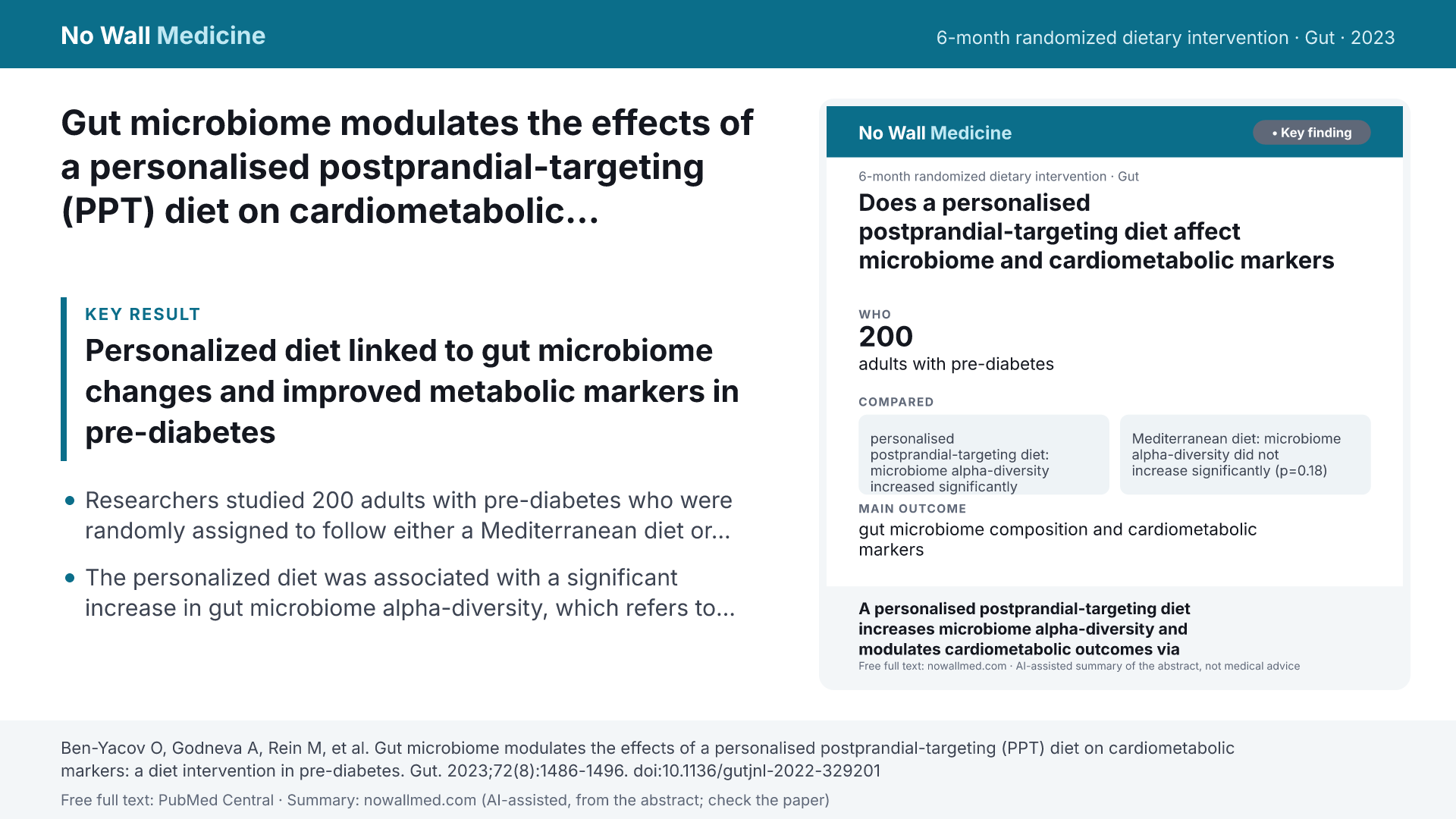
Personalized diet linked to gut microbiome changes and improved metabolic markers in pre-diabetes
Gut microbiome modulates the effects of a personalised postprandial-targeting (PPT) diet on cardiometabolic markers: a diet intervention in pre-diabetes
6-month randomized dietary interventionBenefit found
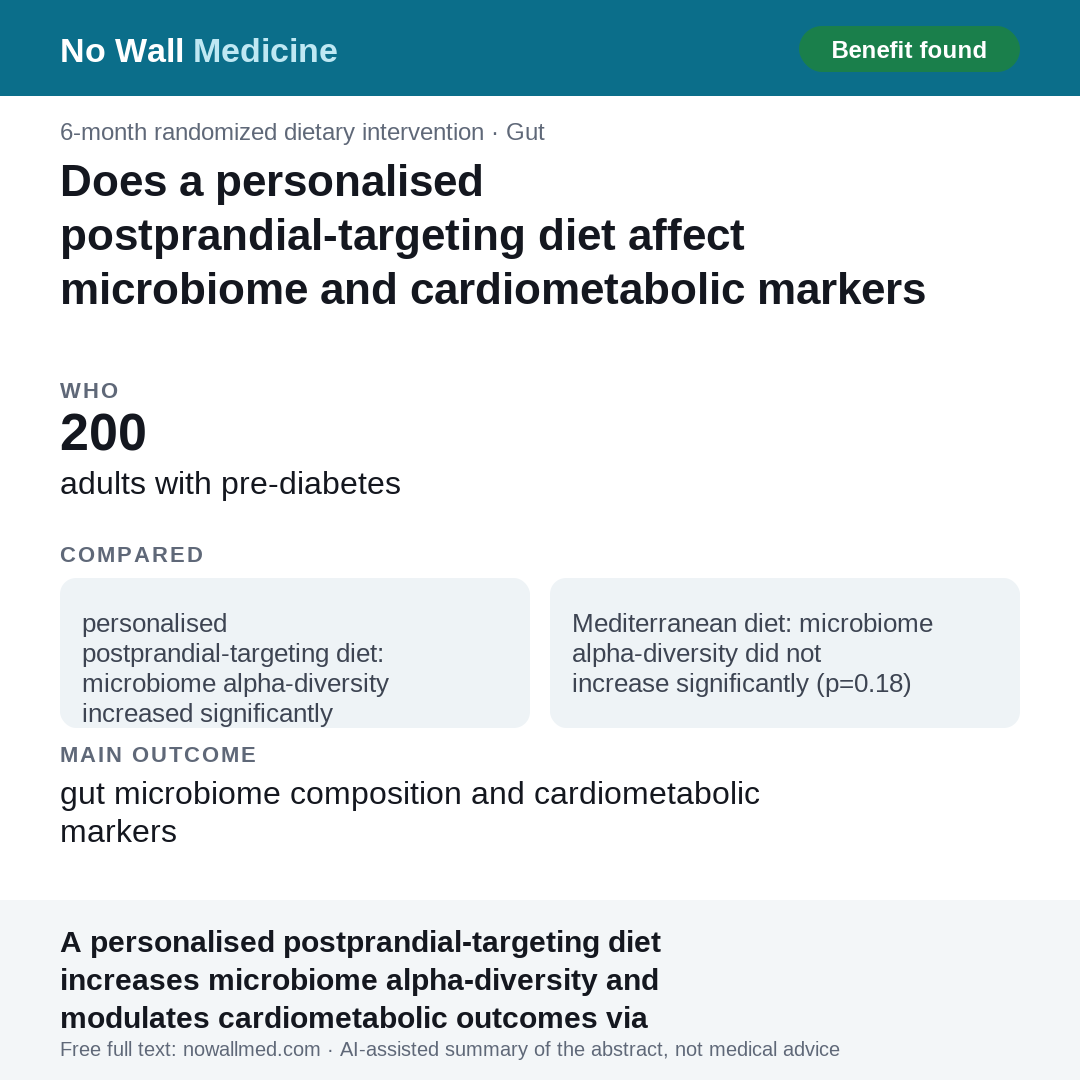
Does a personalised postprandial-targeting diet affect microbiome and cardiometabolic markers in pre-diabetes?
Who
200
adults with pre-diabetes
Compared
personalised postprandial-targeting diet: microbiome alpha-diversity increased significantly (p=0.007)
Mediterranean diet: microbiome alpha-diversity did not increase significantly (p=0.18)
Main outcome
gut microbiome composition and cardiometabolic markers
Bottom line: A personalised postprandial-targeting diet increases microbiome alpha-diversity and modulates cardiometabolic outcomes via specific microbial species.
Gut · 2023-05-03Download image
Clinical question: Does a personalised postprandial-targeting diet affect microbiome and cardiometabolic markers in pre-diabetes?
Why it matters: It is unknown how dietary modifications and gut microbiome composition interact to influence metabolic responses in individuals with pre-diabetes.
Key points
- Researchers studied 200 adults with pre-diabetes who were randomly assigned to follow either a Mediterranean diet or a personalized postprandial-targeting diet for 6 months.
- The personalized diet was associated with a significant increase in gut microbiome alpha-diversity, which refers to the variety of microbes in the gut, compared to the Mediterranean diet.
- Three specific microbial species were found to partially mediate the association between adherence to the personalized diet and clinical outcomes including hemoglobin A1c, high-density lipoprotein cholesterol, and triglycerides.
Headline and key points written with AI from the paper’s abstract, with every number checked against it. Read the paper before relying on them.
Was this summary helpful?
Abstract
Objective
To explore the interplay between dietary modifications, microbiome composition and host metabolic responses in a dietary intervention setting of a personalised postprandial-targeting (PPT) diet versus a Mediterranean (MED) diet in pre-diabetes. Design
In a 6-month dietary intervention, adults with pre-diabetes were randomly assigned to follow an MED or PPT diet (based on a machine-learning algorithm for predicting postprandial glucose responses). Data collected at baseline and 6 months from 200 participants who completed the intervention included: dietary data from self-recorded logging using a smartphone application, gut microbiome data from shotgun metagenomics sequencing of faecal samples, and clinical data from continuous glucose monitoring, blood biomarkers and anthropometrics. Results
PPT diet induced more prominent changes to the gut microbiome composition, compared with MED diet, consistent with overall greater dietary modifications observed. Particularly, microbiome alpha-diversity increased significantly in PPT (p=0.007) but not in MED arm (p=0.18). Post hoc analysis of changes in multiple dietary features, including food-categories, nutrients and PPT-adherence score across the cohort, demonstrated significant associations between specific dietary changes and species-level changes in microbiome composition. Furthermore, using causal mediation analysis we detect nine microbial species that partially mediate the association between specific dietary changes and clinical outcomes, including three species (from Bacteroidales, Lachnospiraceae, Oscillospirales orders) that mediate the association between PPT-adherence score and clinical outcomes of hemoglobin A1c (HbA1c), high-density lipoprotein cholesterol (HDL-C) and triglycerides. Finally, using machine-learning models trained on dietary changes and baseline clinical data, we predict personalised metabolic responses to dietary modifications and assess features importance for clinical improvement in cardiometabolic markers of blood lipids, glycaemic control and body weight. Conclusions
Our findings support the role of gut microbiome in modulating the effects of dietary modifications on cardiometabolic outcomes, and advance the concept of precision nutrition strategies for reducing comorbidities in pre-diabetes. Trial registration number
NCT03222791.
Abstract reproduced under the article’s CC BY NC licence.
Subject terms
Cite this article
Ben-Yacov O, Godneva A, Rein M, et al. Gut microbiome modulates the effects of a personalised postprandial-targeting (PPT) diet on cardiometabolic markers: a diet intervention in pre-diabetes. Gut. 2023. doi:10.1136/gutjnl-2022-329201
Spotted a mistake? Suggest a correction