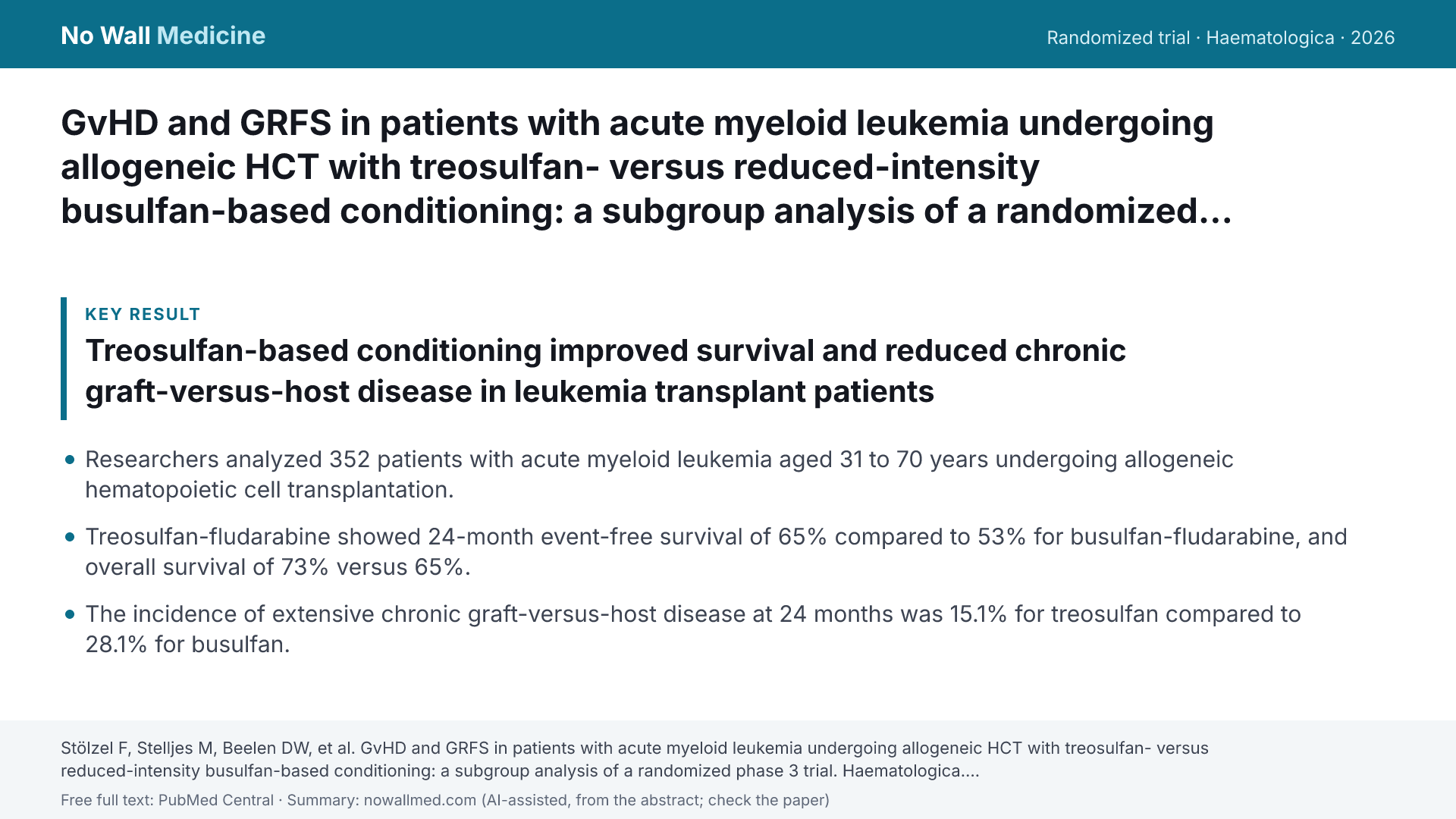
Treosulfan-based conditioning improved survival and reduced chronic graft-versus-host disease in leukemia transplant patients
GvHD and GRFS in patients with acute myeloid leukemia undergoing allogeneic HCT with treosulfan- versus reduced-intensity busulfan-based conditioning: a subgroup analysis of a randomized phase 3 trial
Why it matters: Graft-versus-host disease remains a major complication for patients receiving allogeneic hematopoietic cell transplantation for acute myeloid leukemia.
Key points
- Researchers analyzed 352 patients with acute myeloid leukemia aged 31 to 70 years undergoing allogeneic hematopoietic cell transplantation.
- Treosulfan-fludarabine showed 24-month event-free survival of 65% compared to 53% for busulfan-fludarabine, and overall survival of 73% versus 65%.
- The incidence of extensive chronic graft-versus-host disease at 24 months was 15.1% for treosulfan compared to 28.1% for busulfan.
Headline and key points written with AI from the paper’s abstract, with every number checked against it. Read the paper before relying on them.
Was this summary helpful?
Subject terms
Headline, design, result, key points, caveat and citation as plain text.
Cite this article
Stölzel F, Stelljes M, Beelen DW, et al. GvHD and GRFS in patients with acute myeloid leukemia undergoing allogeneic HCT with treosulfan- versus reduced-intensity busulfan-based conditioning: a subgroup analysis of a randomized phase 3 trial. Haematologica. 2026. doi:10.3324/haematol.2025.288770
Spotted a mistake? Suggest a correction