High levels of H3.1 nucleosomes at admission associate with mortality and kidney support needs in sepsis
H3.1 Nucleosomes to Predict Renal Replacement Therapy and Mortality in Sepsis-A Secondary Analysis of the SISPCT Randomized Control Trial
Secondary analysis of a randomized controlled trialBenefit found
Can plasma H3.1 nucleosome levels predict renal replacement therapy and mortality in sepsis?
Who
971
Patients with sepsis, septic shock, and sepsis-associated acute kidney injury · 33 intensive care units in Germany
Compared
Septic shock: median 921.84 ng/mL
Sepsis: median 432.71 ng/mL
Main outcome
Renal replacement therapy requirements and 28-day mortality
Bottom line: Elevated admission H3.1 nucleosome levels are associated with mortality and acute kidney injury requiring renal replacement therapy.
Crit Care Med · 2026-08-03Download image
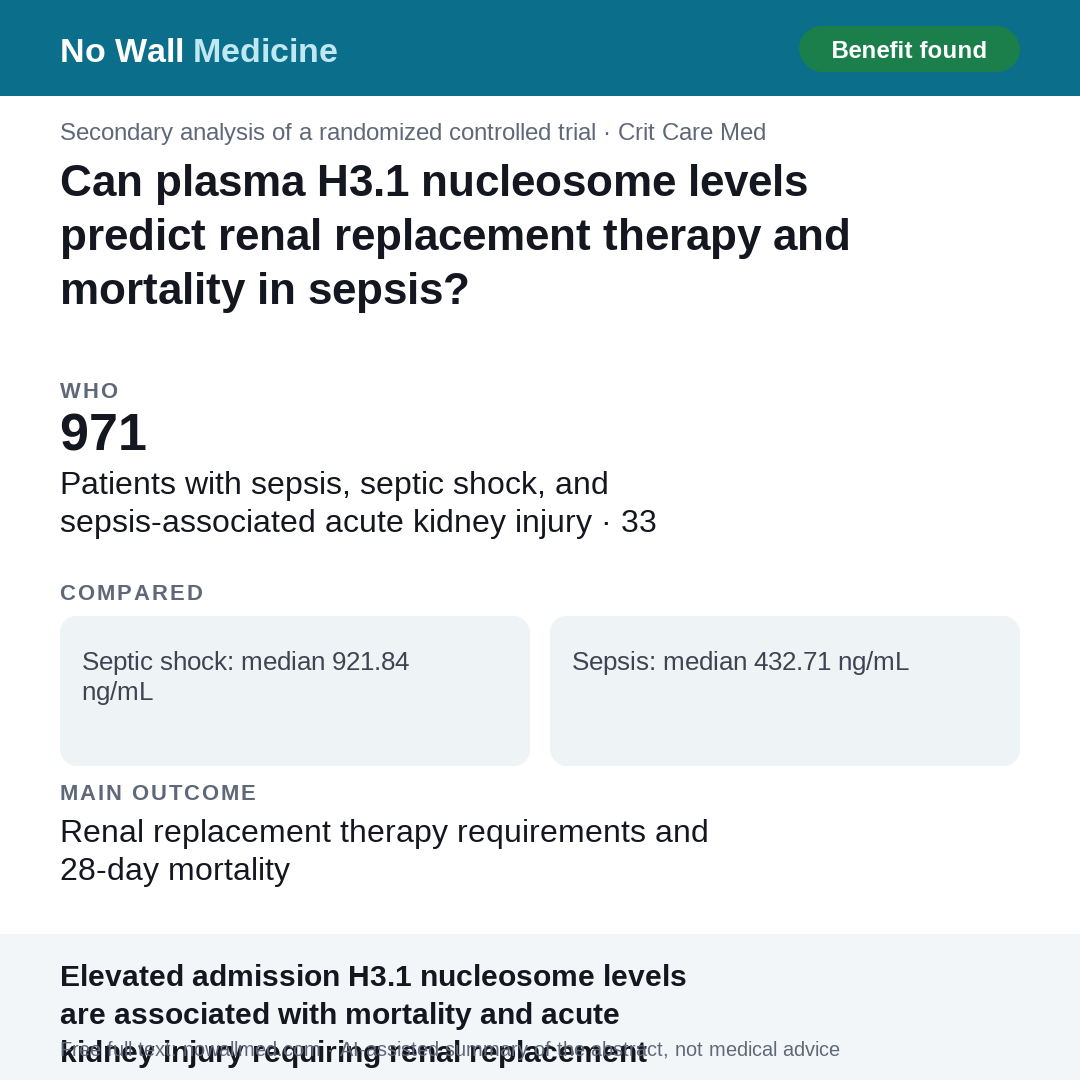
Clinical question: Can plasma H3.1 nucleosome levels predict renal replacement therapy and mortality in sepsis?
Why it matters: It is unclear if H3.1 nucleosome levels can serve as predictive biomarkers for mortality and the need for renal replacement therapy in sepsis.
Key points
- Researchers analyzed 971 patients with sepsis or septic shock from 33 intensive care units to evaluate H3.1 nucleosome levels.
- Patients with septic shock had higher median admission H3.1 levels than those with sepsis, at 921.84 vs. 432.71 ng/mL.
- Elevated H3.1 nucleosome levels at admission were associated with mortality and acute kidney injury requiring renal replacement therapy.
Headline and key points written with AI from the paper’s abstract, with every number checked against it. Read the paper before relying on them.
Topics
Spotted a mistake? Suggest a correction