Hemoadsorption did not reduce 28-day mortality in patients with septic shock requiring high-dose norepinephrine
HA-330 hemoadsorption in septic shock requiring high-dose norepinephrine: a multicenter randomized controlled trial (CLEANSE)
Multicenter, randomized controlled trialNo clear difference
Does adjunctive hemoadsorption reduce 28-day mortality in septic shock requiring high-dose norepinephrine?
Who
128
Patients with septic shock requiring norepinephrine ≥ 0.2 mcg/kg/min · Two tertiary care centers in Thailand
Compared
Standard treatment alone: 38 of 65 (58%)
Standard treatment with hemoadsorption: 28 of 63 (44%)
Main outcome
28-day mortality
Result: relative risk 0.76 (95% CI 0.54-1.07)
Bottom line: Adjunctive hemoadsorption with HA-330 did not statistically reduce 28-day mortality in septic shock patients.
Crit Care · 2026-06-11Download image
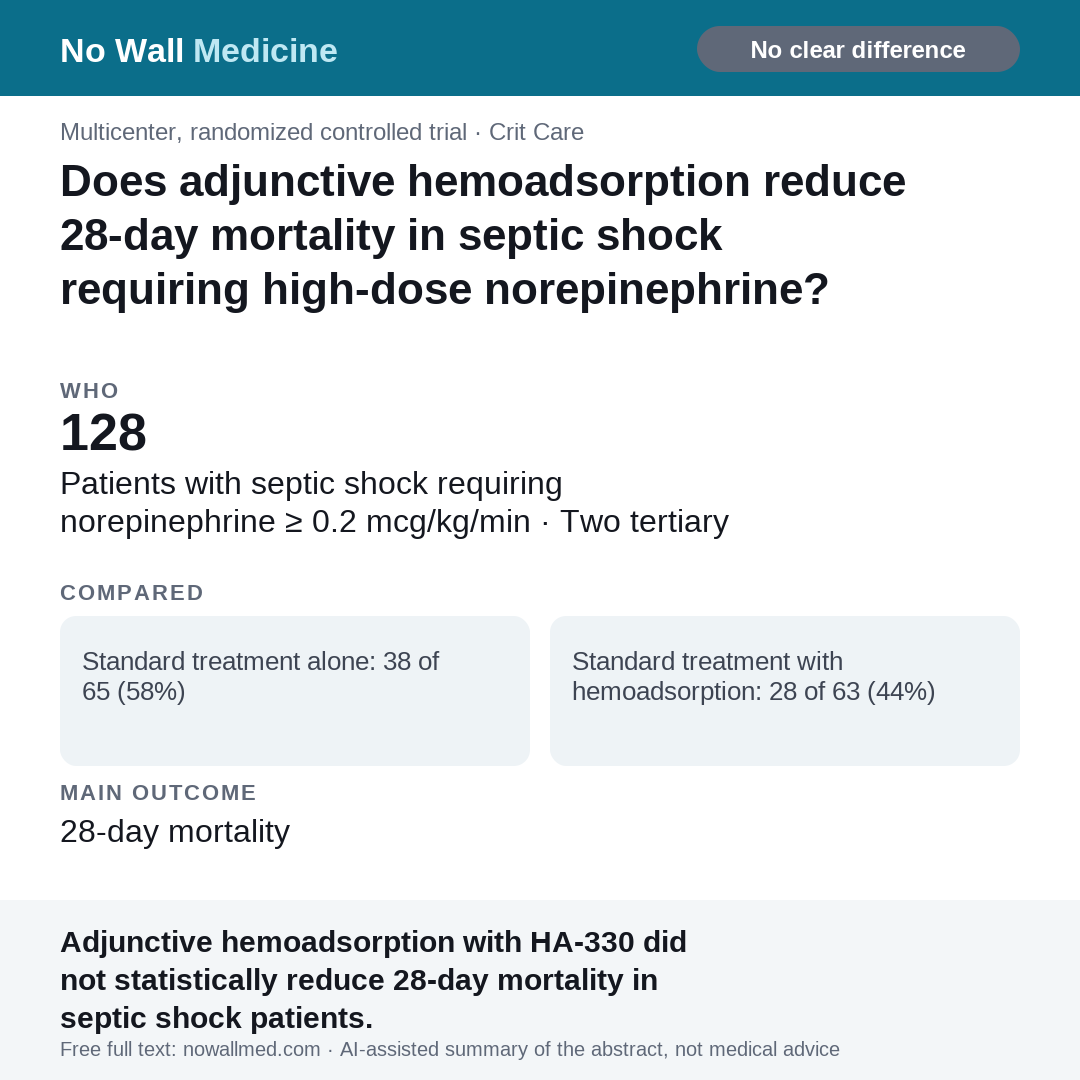
Clinical question: Does adjunctive hemoadsorption reduce 28-day mortality in septic shock requiring high-dose norepinephrine?
Why it matters: It is unclear if removing inflammatory mediators through hemoadsorption provides clinical benefit for patients in septic shock requiring high doses of vasopressors.
Key points
- Researchers studied 128 patients with septic shock requiring norepinephrine at 0.2 mcg/kg/min or more, comparing standard treatment to standard treatment plus two 3-hour sessions of hemoadsorption.
- The 28-day mortality rate was 58% for the 65 patients in the standard treatment group and 44% for the 63 patients in the hemoadsorption group.
- No significant differences were found between the groups regarding organ support-free days, shock reversal, vasopressor doses, or inflammatory markers.
Headline and key points written with AI from the paper’s abstract, with every number checked against it. Read the paper before relying on them.
Topics
Spotted a mistake? Suggest a correction