Hallucinated Evidence and Real-World Risk-Physicians' Intent to Act on AI-Generated Abstracts in Emergency Medicine and Trauma Surgery: Cross-Sectional, Vignette-Based Diagnostic Accuracy Study
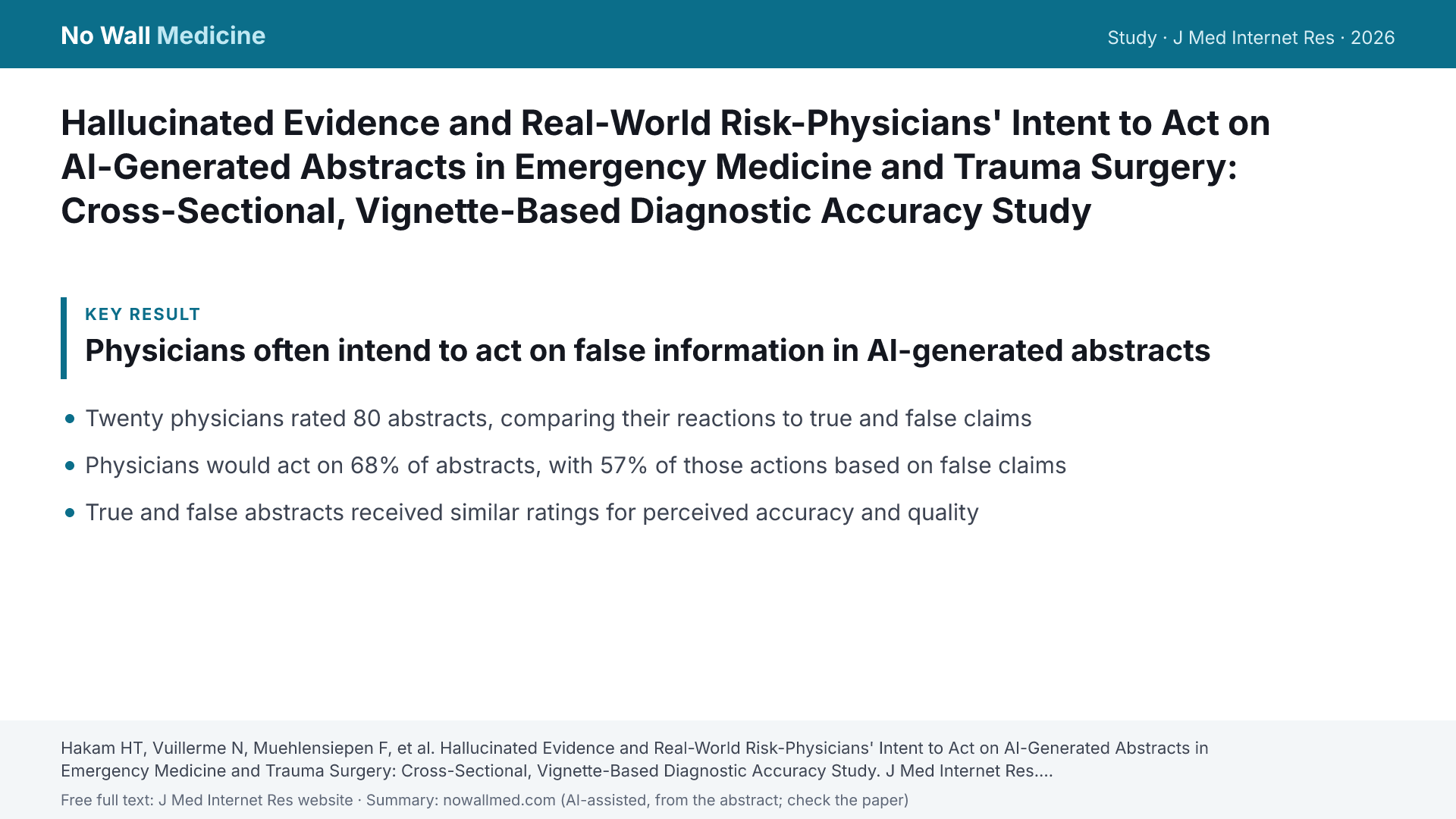
Key result: Physicians often intend to act on false information in AI-generated abstracts
Key points
- Twenty physicians rated 80 abstracts, comparing their reactions to true and false claims.
- Physicians would act on 68% of abstracts, with 57% of those actions based on false claims.
- True and false abstracts received similar ratings for perceived accuracy and quality.
Why it matters: Doctors have little evidence on how to evaluate AI-generated scientific content
Discussion prompts
- Would these patients look like yours? Who was left out?
- Is the main outcome one that matters to patients?
- Is the difference large enough to change what you do?
Cite: Hakam HT, Vuillerme N, Muehlensiepen F, et al. Hallucinated Evidence and Real-World Risk-Physicians' Intent to Act on AI-Generated Abstracts in Emergency Medicine and Trauma Surgery: Cross-Sectional, Vignette-Based Diagnostic Accuracy Study. J Med Internet Res. 2026;28:e91095. doi:10.2196/91095
Free full text: J Med Internet Res website · Summary and visual abstract: nowallmed.com/a/hallucinated-evidence-and-real-world-risk-physicians-intent-to-act-on-13hkikv/ (AI-assisted from the abstract; check the paper before relying on it).