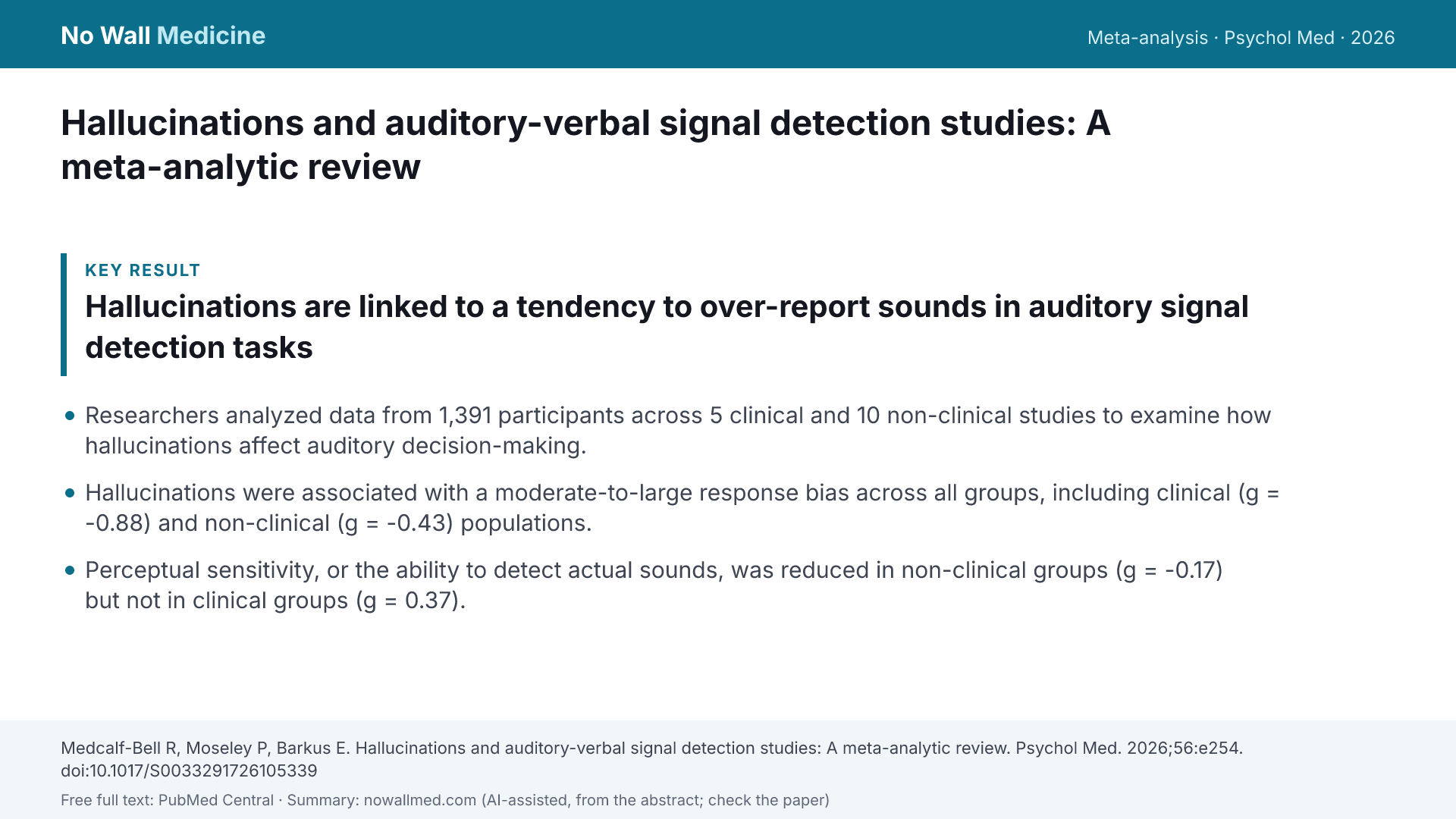
Hallucinations are linked to a tendency to over-report sounds in auditory signal detection tasks
Hallucinations and auditory-verbal signal detection studies: A meta-analytic review
Key points
- Researchers analyzed data from 1,391 participants across 5 clinical and 10 non-clinical studies to examine how hallucinations affect auditory decision-making.
- Hallucinations were associated with a moderate-to-large response bias across all groups, including clinical (g = -0.88) and non-clinical (g = -0.43) populations.
- Perceptual sensitivity, or the ability to detect actual sounds, was reduced in non-clinical groups (g = -0.17) but not in clinical groups (g = 0.37).
Limitation the authors note: The lack of support for reduced perceptual sensitivity in clinical groups may be due to limited data.
Headline and key points written with AI from the paper’s abstract, with every number checked against it. Read the paper before relying on them.
Was this summary helpful?
Subject terms
Cite this article
Medcalf-Bell R, Moseley P, Barkus E. Hallucinations and auditory-verbal signal detection studies: A meta-analytic review. Psychol Med. 2026. doi:10.1017/S0033291726105339
Spotted a mistake? Suggest a correction