Handheld fans directed at the face reduced shortness of breath in patients with respiratory failure
Handheld fans for dyspnoea in respiratory failure: randomised controlled trial
Randomised controlled trialBenefit found
Does handheld fan therapy mitigate dyspnoea in patients with respiratory failure?
Who
Patients with respiratory failure undergoing continuous oxygen therapy
Compared
Handheld fan directed at face: statistically significant reduction in Visual Analogue Scale scores
Fan aimed at the legs
Main outcome
Visual Analogue Scale scores
Bottom line: Handheld fans directed at the face effectively alleviate dyspnoea in patients with respiratory failure.
BMJ Support Palliat Care · 2025-02-26Download image
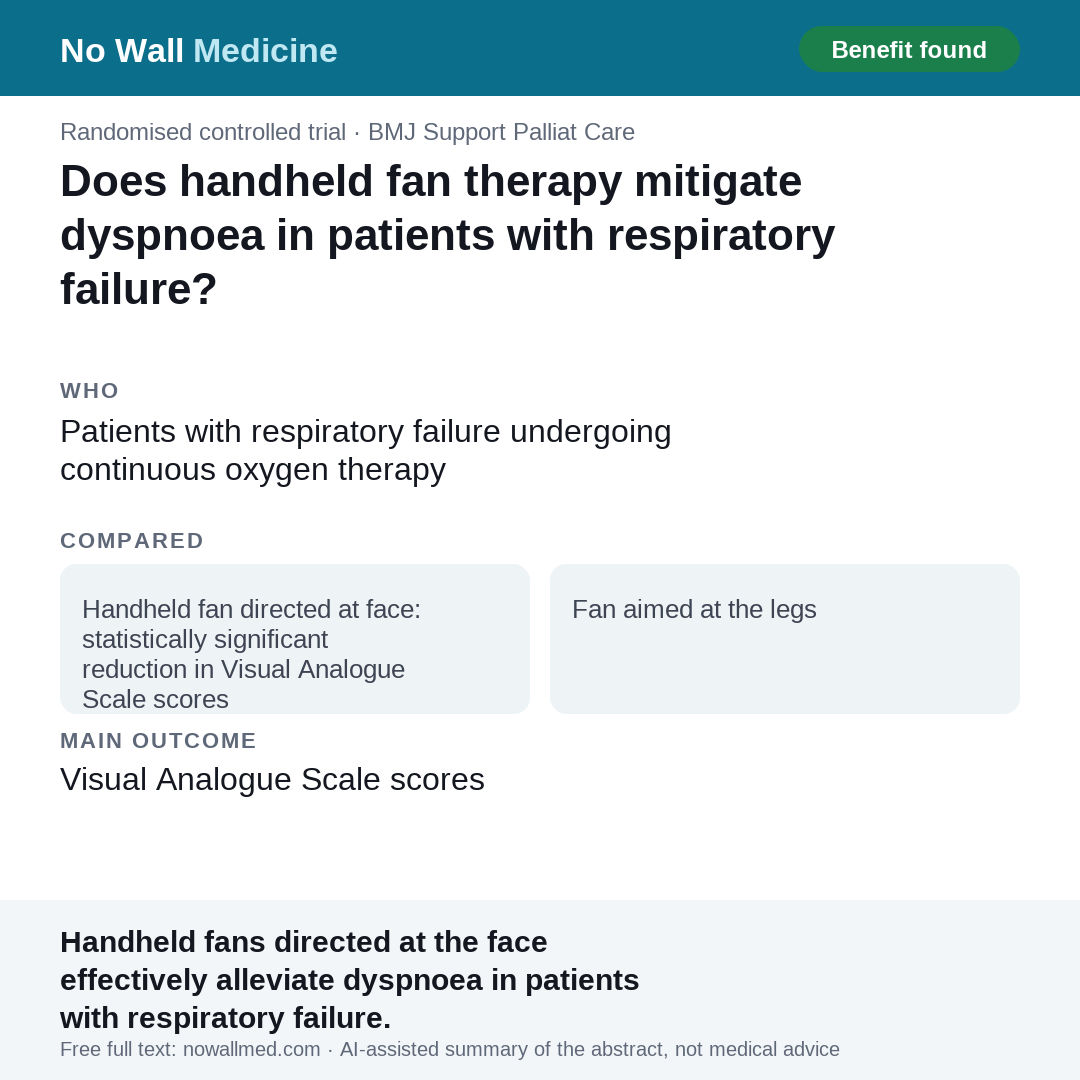
Clinical question: Does handheld fan therapy mitigate dyspnoea in patients with respiratory failure?
Why it matters: It was unknown if fan therapy effectively reduces shortness of breath in patients with respiratory failure who are already receiving continuous oxygen therapy.
Key points
- Researchers conducted a randomized controlled trial comparing patients receiving a handheld fan directed at the face to those receiving a fan directed at the legs.
- The group with the fan directed at the face showed a statistically significant reduction in Visual Analogue Scale scores, which measure the intensity of shortness of breath, compared to the control group (p<0.05).
Headline and key points written with AI from the paper’s abstract, with every number checked against it. Read the paper before relying on them.
Abstract
Objective
Fan therapy is widely acknowledged as an essential component in the management of dyspnoea with numerous studies supporting its efficacy in alleviating dyspnoea among patients with chronic illnesses. However, there is limited evidence regarding the effectiveness of fan therapy in reducing dyspnoea in patients with respiratory failure undergoing continuous oxygen therapy. This study aimed to assess the efficacy of fan therapy in mitigating dyspnoea in this specific patient population through a randomised controlled trial. Methods
Participants meeting the inclusion criteria were randomly assigned to either an experimental group or a control group. In the experimental group, a handheld fan (HHF) was directed at the face, while in the control group the fan was aimed at the legs. Both interventions were conducted at a distance of 15-30 cm for 10 min. Key physiological and subjective measures, including heart rate, respiratory rate, blood pressure, blood oxygen saturation, facial skin temperature and Visual Analogue Scale (VAS) scores, were recorded immediately after fan therapy. Results
The experimental group demonstrated a statistically significant reduction in VAS scores (p<0.05) compared with the control group indicating that fan therapy effectively alleviates dyspnoea in patients with respiratory failure receiving continuous oxygen therapy. Conclusion
HHFs are affordable, widely accessible and highly effective in relieving dyspnoea with minimal risk. Therefore, fan therapy should be considered as a complementary treatment for patients with respiratory failure and incorporated alongside standard therapeutic interventions for the condition.
Abstract reproduced under the article’s CC BY NC licence.
Topics
Cite this article
Yue D, Xie X, Chen G, Luo Z, Fan L, Sun D. Handheld fans for dyspnoea in respiratory failure: randomised controlled trial. BMJ Support Palliat Care. 2025. doi:10.1136/spcare-2024-004922
Spotted a mistake? Suggest a correction
Top studies every Monday
The week’s key trials and guidelines in your specialties, plus any topics you follow. By email, free.
Get the weekly digest