Hand preference does not impact chest compression quality during cardiopulmonary resuscitation on a mannequin
Hands at work: A randomised cross-over mannequin-based trial exploring the impact of hand preference of health care professionals on effectiveness of chest compressions
Randomized cross-over trialNo clear difference
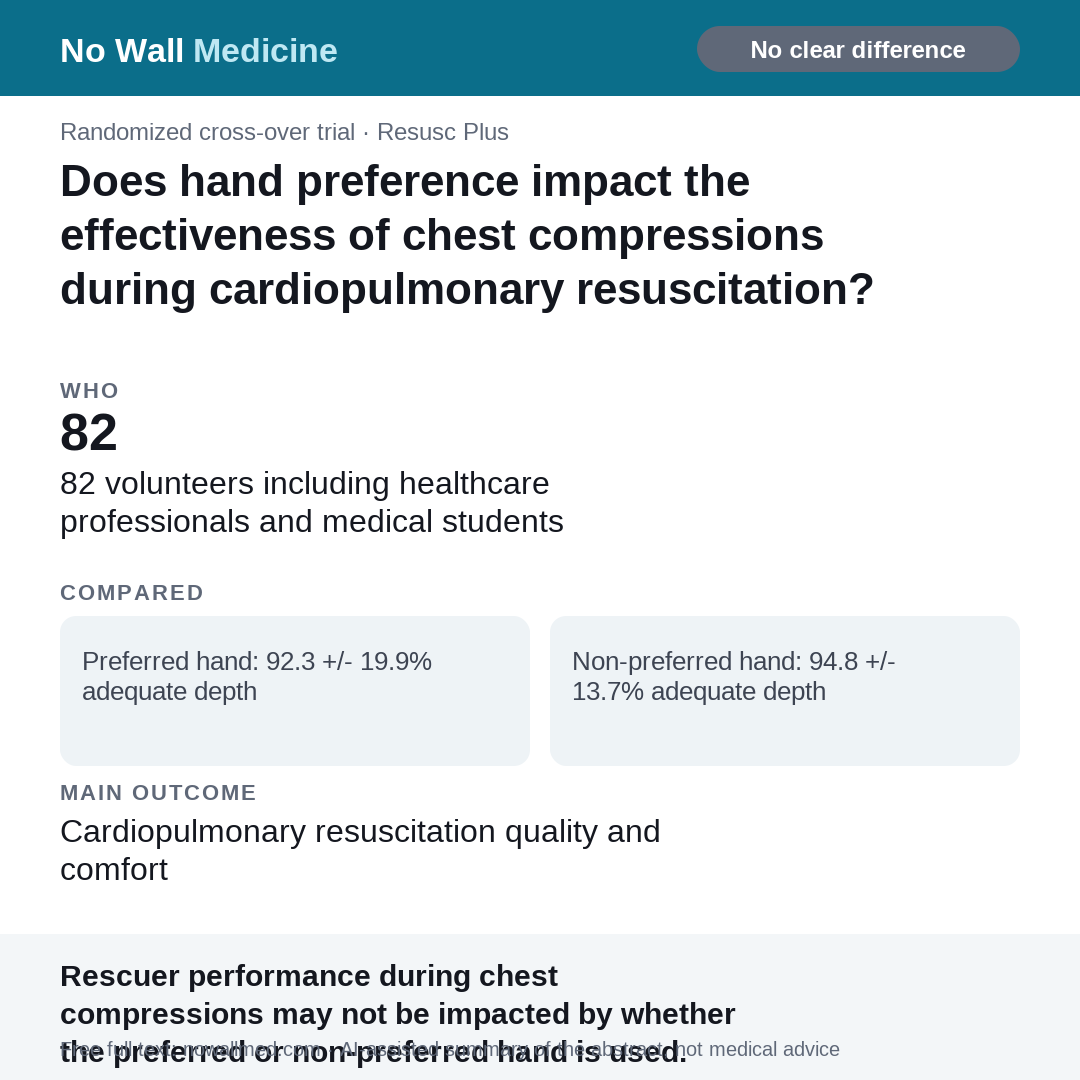
Does hand preference impact the effectiveness of chest compressions during cardiopulmonary resuscitation?
Who
82
82 volunteers including healthcare professionals and medical students
Compared
Preferred hand: 92.3 +/- 19.9% adequate depth
Non-preferred hand: 94.8 +/- 13.7% adequate depth
Main outcome
Cardiopulmonary resuscitation quality and comfort
Bottom line: Rescuer performance during chest compressions may not be impacted by whether the preferred or non-preferred hand is used.
Resusc Plus · 2024-12-20Download image
Clinical question: Does hand preference impact the effectiveness of chest compressions during cardiopulmonary resuscitation?
Why it matters: It is unknown whether using a healthcare professional's preferred or non-preferred hand on the sternum affects the quality of chest compressions during cardiopulmonary resuscitation.
Key points
- The study involved 82 volunteers who performed 2 minutes of chest compressions using their preferred and non-preferred hands on a mannequin.
- Results for compression rate, mean depth, and good recoil percentage were comparable between the preferred and non-preferred hand groups.
- The non-preferred hand group had a higher adequate depth percentage of 94.8 +/- 13.7 compared to 92.3 +/- 19.9 for the preferred hand group.
Headline and key points written with AI from the paper’s abstract, with every number checked against it. Read the paper before relying on them.
Cite this article
Thaker S, Nagesh SK, Ravindra P, Kharade EV, Lingala NR, Joshi SV. Hands at work: A randomised cross-over mannequin-based trial exploring the impact of hand preference of health care professionals on effectiveness of chest compressions. Resusc Plus. 2024. doi:10.1016/j.resplu.2024.100849
Spotted a mistake? Suggest a correction
Top studies every Monday
The week’s key trials and guidelines in your specialties, by email. Free.
Get the weekly digest