Proteomic changes were observed in patients with pulmonary arterial hypertension treated with famotidine
Harnessing metabolomics and proteomics in a clinical trial for pulmonary arterial hypertension: insights from post-hoc analysis of the REHAB-PH trial
Randomized, placebo-controlled trialMixed results
How do famotidine treatment and placebo affect multi-omic profiles in pulmonary arterial hypertension?
Who
79
Participants with pulmonary arterial hypertension
Compared
famotidine: significant changes across 191 proteomic pathways (q-value <0.05)
placebo: high molecular stability
Main outcome
plasma metabolomic and proteomic profiles
Bottom line: Famotidine caused significant proteomic changes but provided no clinical benefit in pulmonary arterial hypertension.
Funded by: US National Institutes of Health
eBioMedicine · 2026-03-17Download image
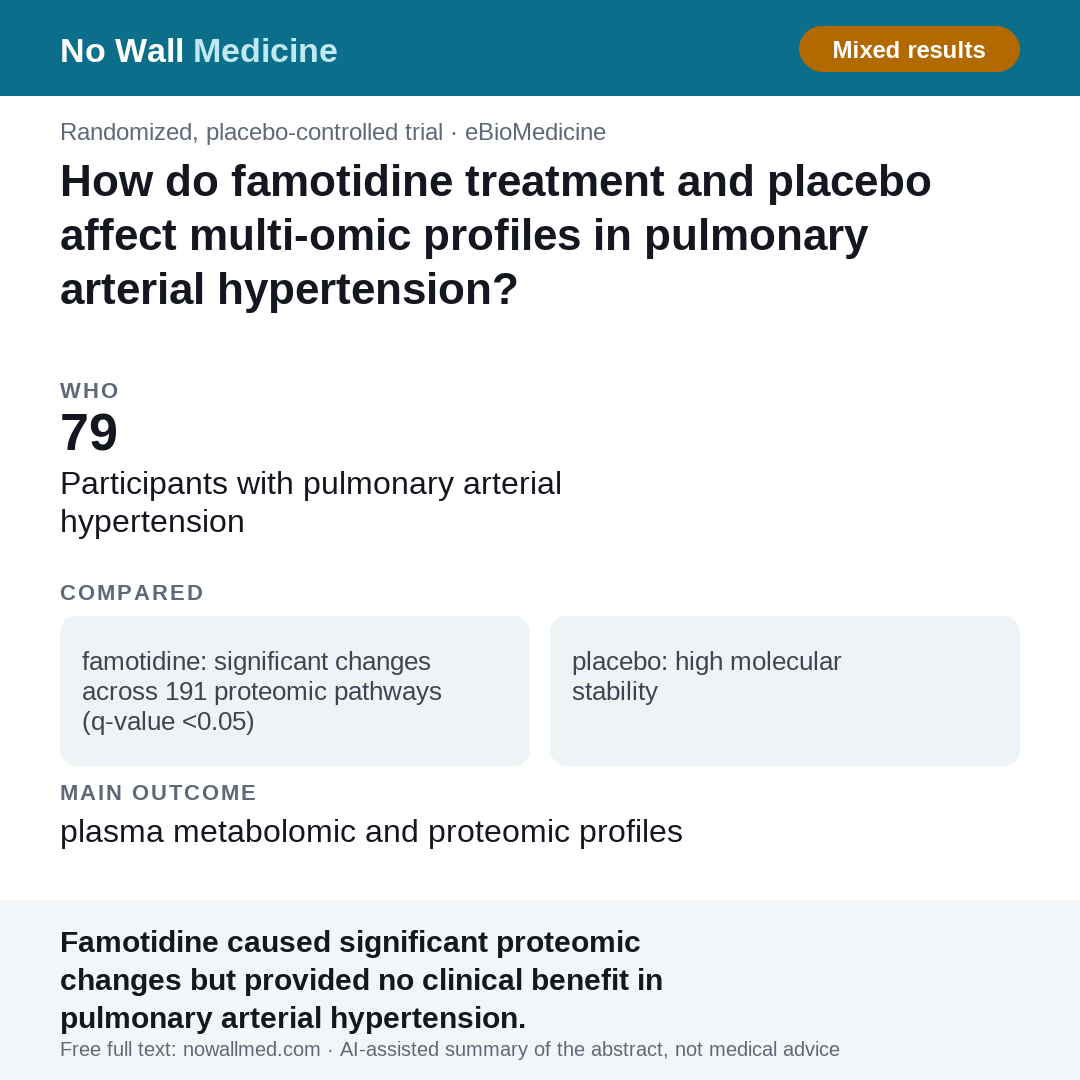
Clinical question: How do famotidine treatment and placebo affect multi-omic profiles in pulmonary arterial hypertension?
Why it matters: The clinical and molecular diversity of pulmonary arterial hypertension makes it difficult to identify effective therapies.
Key points
- Researchers analyzed 79 participants with pulmonary arterial hypertension in a randomized, placebo-controlled trial of famotidine.
- Famotidine treatment was associated with significant changes across 191 proteomic pathways, though no metabolomic changes remained significant after correction.
- The placebo group showed high molecular stability, while the famotidine group showed greater variability at 24 weeks.
Headline and key points written with AI from the paper’s abstract, with every number checked against it. Read the paper before relying on them.
Topics
Cite this article
Pi H, Xia L, Rayner SG, Probstfield JL, Branch KR, Shojaie A. Harnessing metabolomics and proteomics in a clinical trial for pulmonary arterial hypertension: insights from post-hoc analysis of the REHAB-PH trial. eBioMedicine. 2026. doi:10.1016/j.ebiom.2026.106191
Spotted a mistake? Suggest a correction