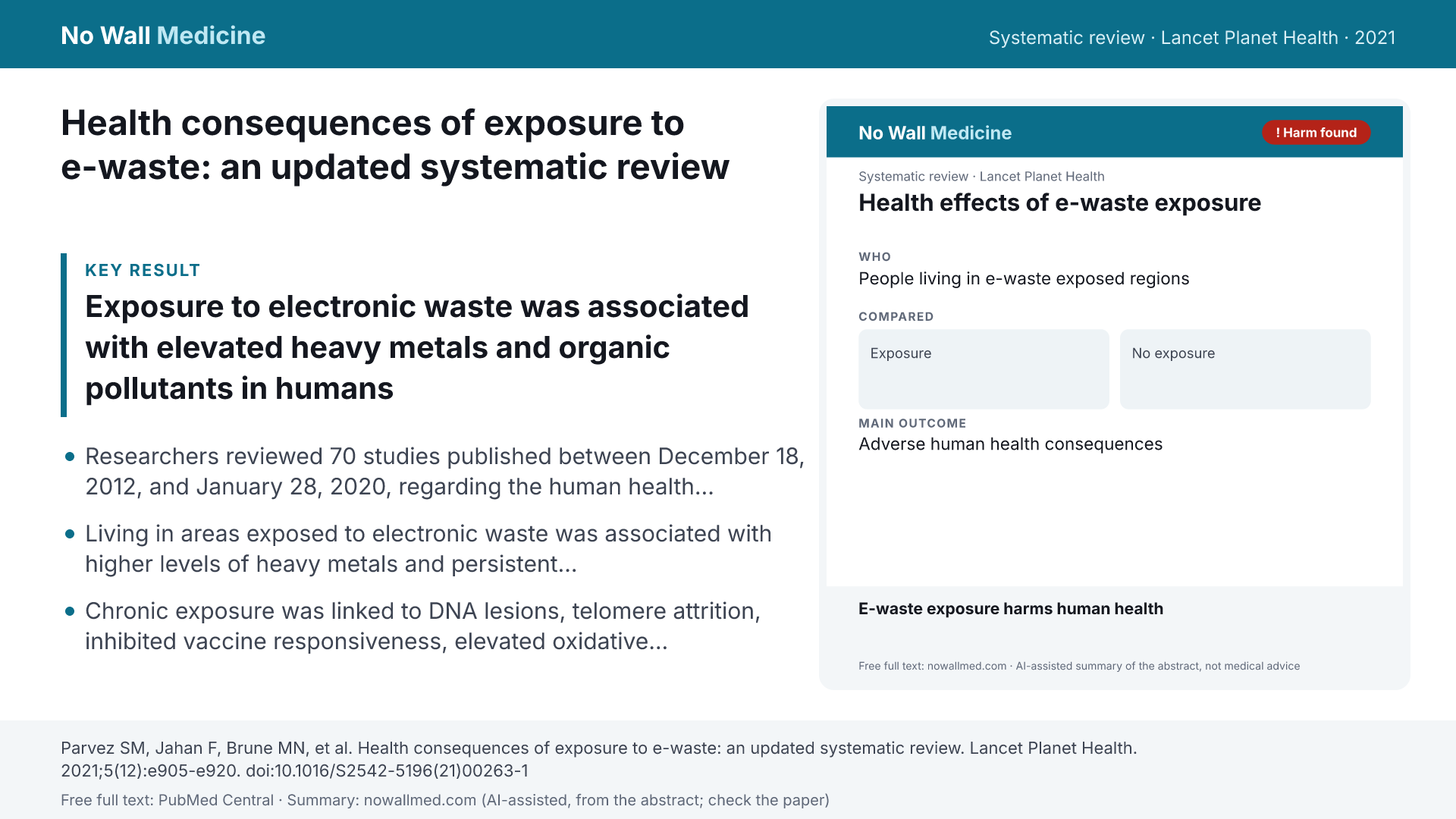
Exposure to electronic waste was associated with elevated heavy metals and organic pollutants in humans
Health consequences of exposure to e-waste: an updated systematic review
Systematic reviewHarm found
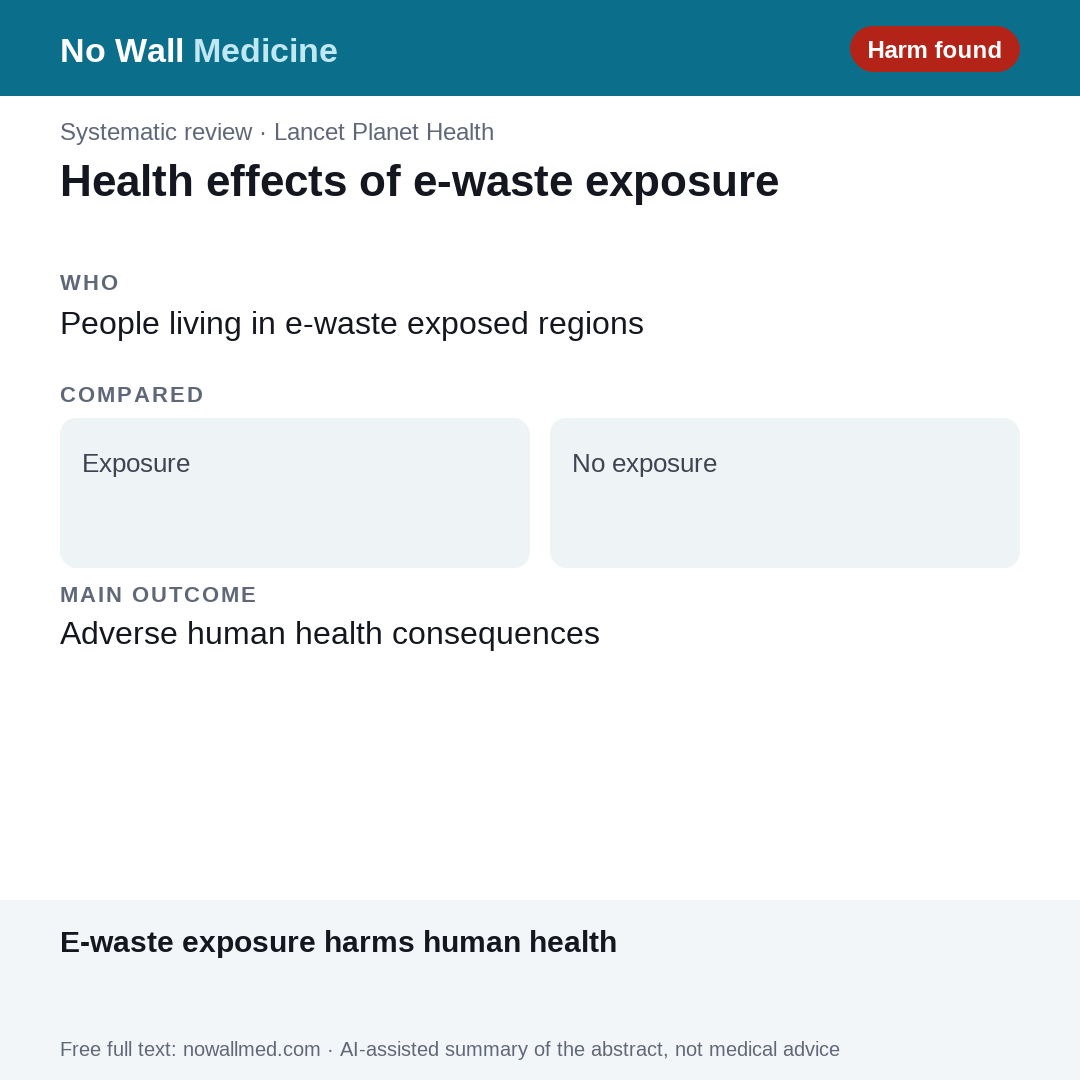
Health effects of e-waste exposure
Who
People living in e-waste exposed regions
Compared
Exposure
No exposure
Main outcome
Adverse human health consequences
Bottom line: E-waste exposure harms human health
Lancet Planet Health · 2021-12-13Download image
Why it matters: The health consequences of exposure to the various toxic chemicals found in electronic waste needed to be updated since the previous review in 2013.
Key points
- Researchers reviewed 70 studies published between December 18, 2012, and January 28, 2020, regarding the human health effects of electronic waste exposure.
- Living in areas exposed to electronic waste was associated with higher levels of heavy metals and persistent organic pollutants, particularly in children and pregnant women.
- Chronic exposure was linked to DNA lesions, telomere attrition, inhibited vaccine responsiveness, elevated oxidative stress, and altered immune function.
Headline and key points written with AI from the paper’s abstract, with every number checked against it. Read the paper before relying on them.
Was this summary helpful?
Abstract
Electronic waste (e-waste) contains numerous chemicals harmful to human and ecological health. To update a 2013 review assessing adverse human health consequences of exposure to e-waste, we systematically reviewed studies reporting effects on humans related to e-waste exposure. We searched EMBASE, PsycNET, Web of Science, CINAHL, and PubMed for articles published between Dec 18, 2012, and Jan 28, 2020, restricting our search to publications in English. Of the 5645 records identified, we included 70 studies that met the preset criteria. People living in e-waste exposed regions had significantly elevated levels of heavy metals and persistent organic pollutants. Children and pregnant women were especially susceptible during the critical periods of exposure that detrimentally affect diverse biological systems and organs. Elevated toxic chemicals negatively impact on neonatal growth indices and hormone level alterations in e-waste exposed populations. We recorded possible connections between chronic exposure to e-waste and DNA lesions, telomere attrition, inhibited vaccine responsiveness, elevated oxidative stress, and altered immune function. The existence of various toxic chemicals in e-waste recycling areas impose plausible adverse health outcomes. Novel cost-effective methods for safe recycling operations need to be employed in e-waste sites to ensure the health and safety of vulnerable populations.
Abstract reproduced under the article’s CC BY licence.
Subject terms
Headline, design, result, key points, caveat and citation as plain text.
Cite this article
Parvez SM, Jahan F, Brune MN, et al. Health consequences of exposure to e-waste: an updated systematic review. Lancet Planet Health. 2021;5(12):e905-e920. doi:10.1016/S2542-5196(21)00263-1
Spotted a mistake? Suggest a correction