Fortified complementary foods reduce anaemia risk in children aged 6 to 23 months
Health outcomes associated with micronutrient-fortified complementary foods in infants and young children aged 6-23 months: a systematic review and meta-analysis
Systematic review and meta-analysisBenefit found
Do micronutrient-fortified complementary foods affect health outcomes in infants and young children?
Who
6423
Infants and children aged 6-23 months with no identified health problems
Compared
Fortified complementary foods
Non-fortified complementary foods
Main outcome
Growth, stunting, wasting, nutrient adequacy, anaemia, and micronutrient concentrations
Result: risk ratio 0·57 (95% CI 0·39 to 0·82) for anaemia
Bottom line: Fortified complementary foods reduce anaemia risk in infants and young children, particularly in malaria-endemic regions.
Limitation: Effects should be further investigated in high-income countries and regions where malaria is not endemic.
Funded by: World Health Organization
Lancet Child Adolesc Health · 2022-06-24Download image
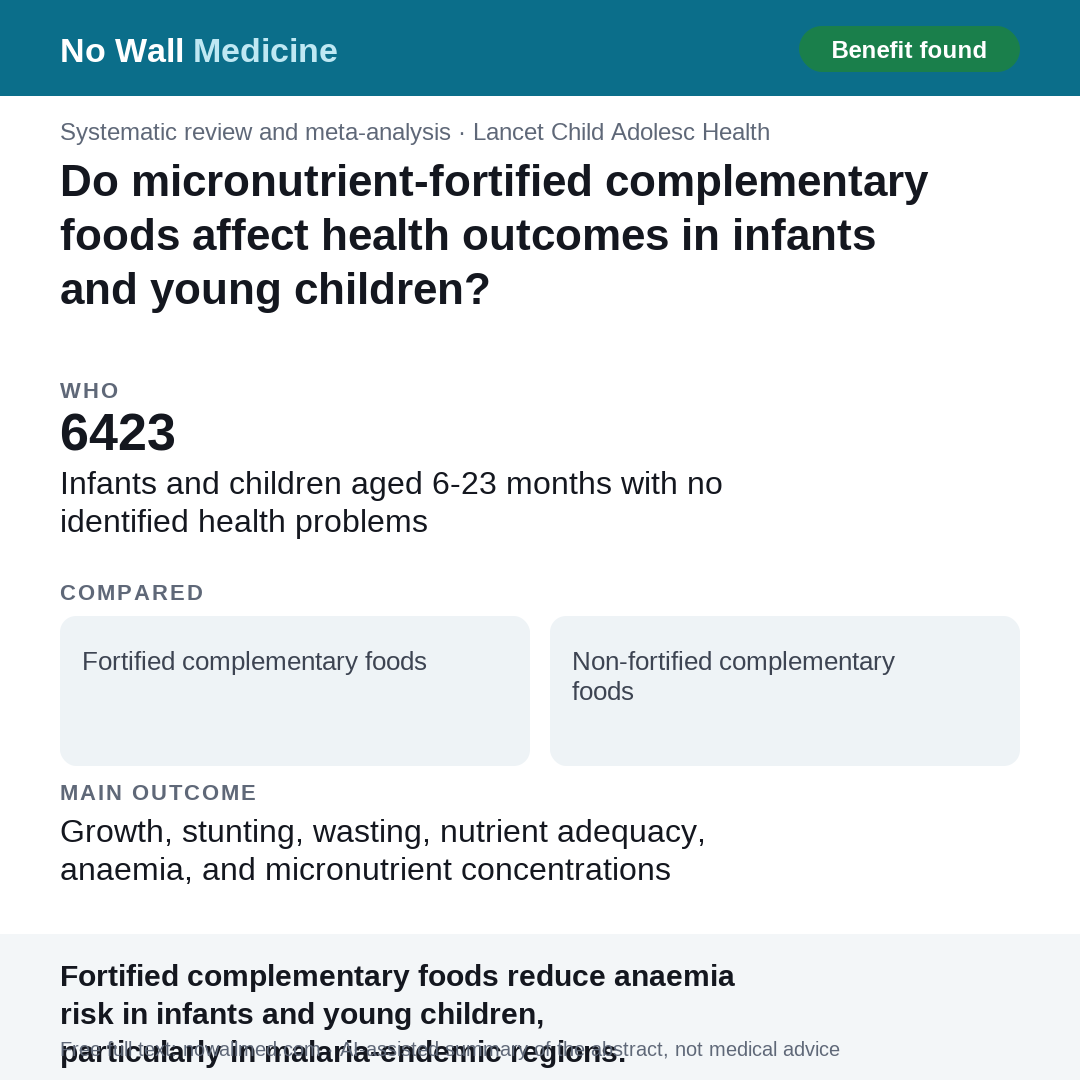
Clinical question: Do micronutrient-fortified complementary foods affect health outcomes in infants and young children?
Why it matters: It is unknown whether providing foods fortified with micronutrients during the complementary feeding period has beneficial or harmful effects on growth and nutrient status in young children.
Key points
- Researchers analyzed 16 studies involving 6423 children to compare foods fortified with vitamins or minerals against non-fortified foods.
- Fortified foods were associated with a reduced risk of anaemia (risk ratio 0.57, 95% CI 0.39 to 0.82) and higher haemoglobin concentrations (mean difference 3.44 g/L, 95% CI 1.33 to 5.55).
- No significant differences were found in weight-for-age, weight-for-height, height-for-age, serum zinc, or serum retinol concentrations.
Headline and key points written with AI from the paper’s abstract, with every number checked against it. Read the paper before relying on them.
Was this summary helpful?
Abstract
Background
Appropriate feeding of infants and young children is essential for healthy growth and the prevention of stunting, wasting, and overweight. We aimed to assess the beneficial versus harmful effects of providing fortified complementary foods to children in the complementary feeding period. Methods
In this systematic review and meta-analysis, we searched the databases Cochrane Central Register of Controlled Trials, MEDLINE, Embase, Cumulative Index to Nursing and Allied Health Literature, Global Index Medicus, Web of Science, ClinicalTrials.gov, and WHO International Clinical Trials Registry Platform from inception to March 9, 2021. We included randomised controlled trials and controlled clinical trials done in infants and children aged 6-23 months with no identified health problems. Consumption of foods fortified centrally (ie, during industrial processing) with one micronutrient or a combination of vitamins, minerals, or both was compared with the same complementary foods, but without micronutrient fortification. Two review authors independently screened studies for eligibility, extracted data, assessed risk of bias, and rated the certainty of the evidence. The main outcomes were growth (measured by Z scores for weight for age, weight for height or length, and height or length for age, or other growth measures), stunting, wasting, nutrient adequacy or excess, anaemia, haemoglobin concentration, iron status, serum zinc concentration, and serum retinol concentration. We used a random-effects meta-analysis for combining data. This study is registered with PROSPERO, CRD42021245876. Findings
We included 16 studies with 6423 participants, 13 of which were done in malaria-endemic areas. Overall, 12 studies were included in the quantitative syntheses. We identified five further ongoing studies. There was no difference between participants who received fortified complementary foods and those who received non-fortified complementary foods in weight-for-age Z scores (mean difference -0·01, 95% CI -0·07 to 0·06; five trials; 1206 participants; moderate-certainty evidence), weight-for-height or length Z scores (-0·05, -0·19 to 0·10; four trials; 1109 participants; moderate-certainty evidence), and height or length-for-age Z scores (-0·01, -0·21 to 0·20; four trials; 811 participants; low-certainty evidence); stunting and wasting were not assessed in any study as outcomes. Moderate-certainty evidence from six trials with 1209 patients showed that providing fortified complementary foods to children aged 6-23 months reduced the risk of anaemia (risk ratio 0·57, 95% CI 0·39 to 0·82). Those who received fortified complementary foods compared with those who did not had higher haemoglobin concentrations (mean difference 3·44 g/L, 95% CI 1·33 to 5·55; 11 trials; 2175 participants; moderate-certainty evidence) and ferritin concentration (0·43 μg/L on log scale, 0·14 to 0·72; six trials; 903 participants; low-certainty evidence). The intervention led to no effects on serum zinc concentration (-0·13 g/dL, -0·82 to 0·56; two trials; 333 participants; low-certainty evidence) and serum retinol concentration (0·03 μmol/L, -0·02 to 0·08; five trials; 475 participants; moderate-certainty evidence). Interpretation
Fortified complementary foods are effective strategies to prevent anaemia in infants and young children aged 6-23 months in malaria-endemic regions. Effects of complementary food fortification should be further investigated in low-income and middle-income countries, but should also be assessed in high-income countries, and in regions where malaria is not endemic. Funding
WHO.
Abstract reproduced under the article’s CC BY licence.
Subject terms
Cite this article
Csölle I, Felső R, Szabó É, Metzendorf MI, Schwingshackl L, Ferenci T. Health outcomes associated with micronutrient-fortified complementary foods in infants and young children aged 6-23 months: a systematic review and meta-analysis. Lancet Child Adolesc Health. 2022. doi:10.1016/S2352-4642(22)00147-X
Spotted a mistake? Suggest a correction
Top studies every Monday
The week’s key trials and guidelines in your specialties, plus any topics you follow. By email, free.
Get the weekly digest