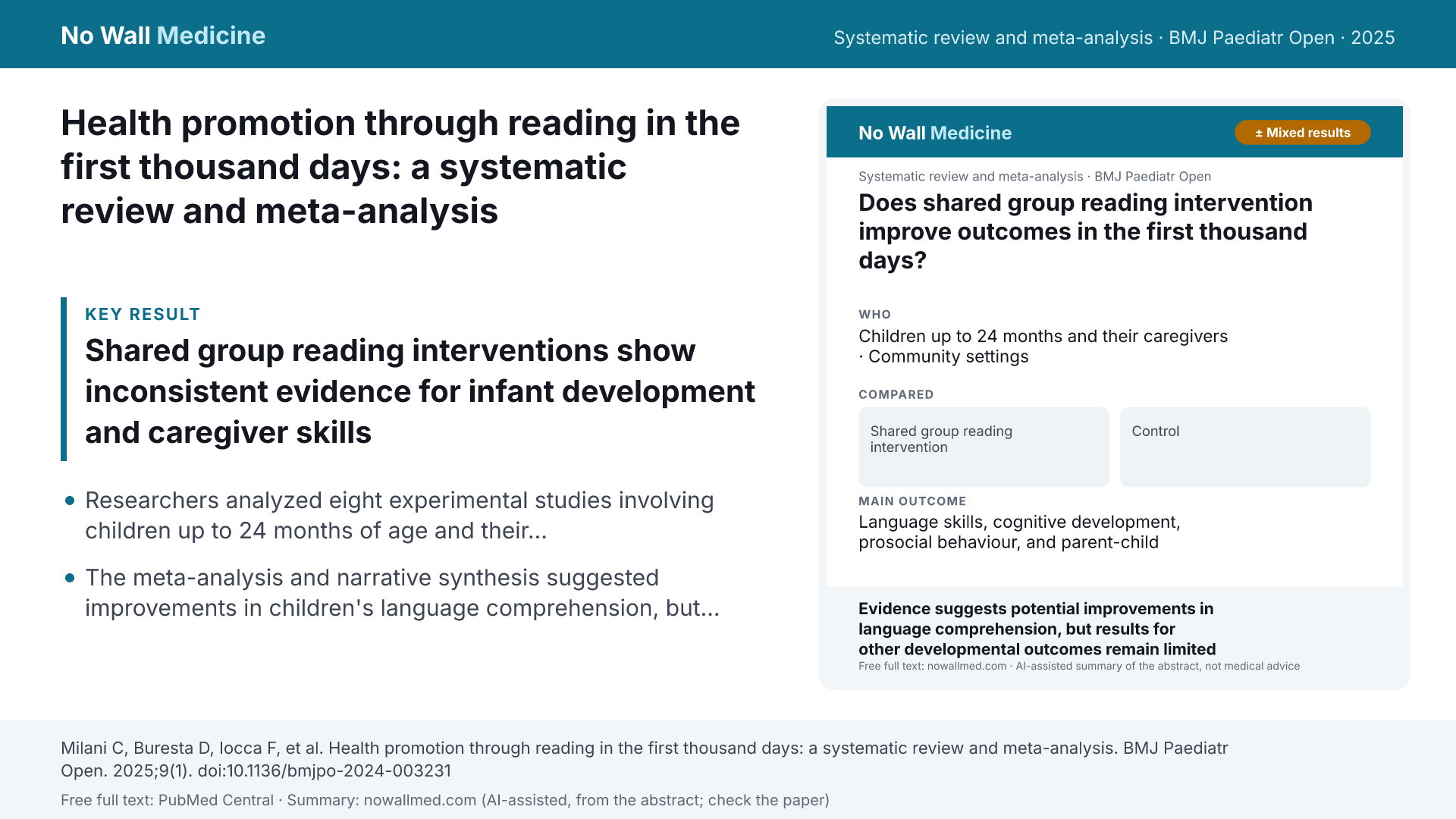
Shared group reading interventions show inconsistent evidence for infant development and caregiver skills
Health promotion through reading in the first thousand days: a systematic review and meta-analysis
Systematic review and meta-analysisMixed results
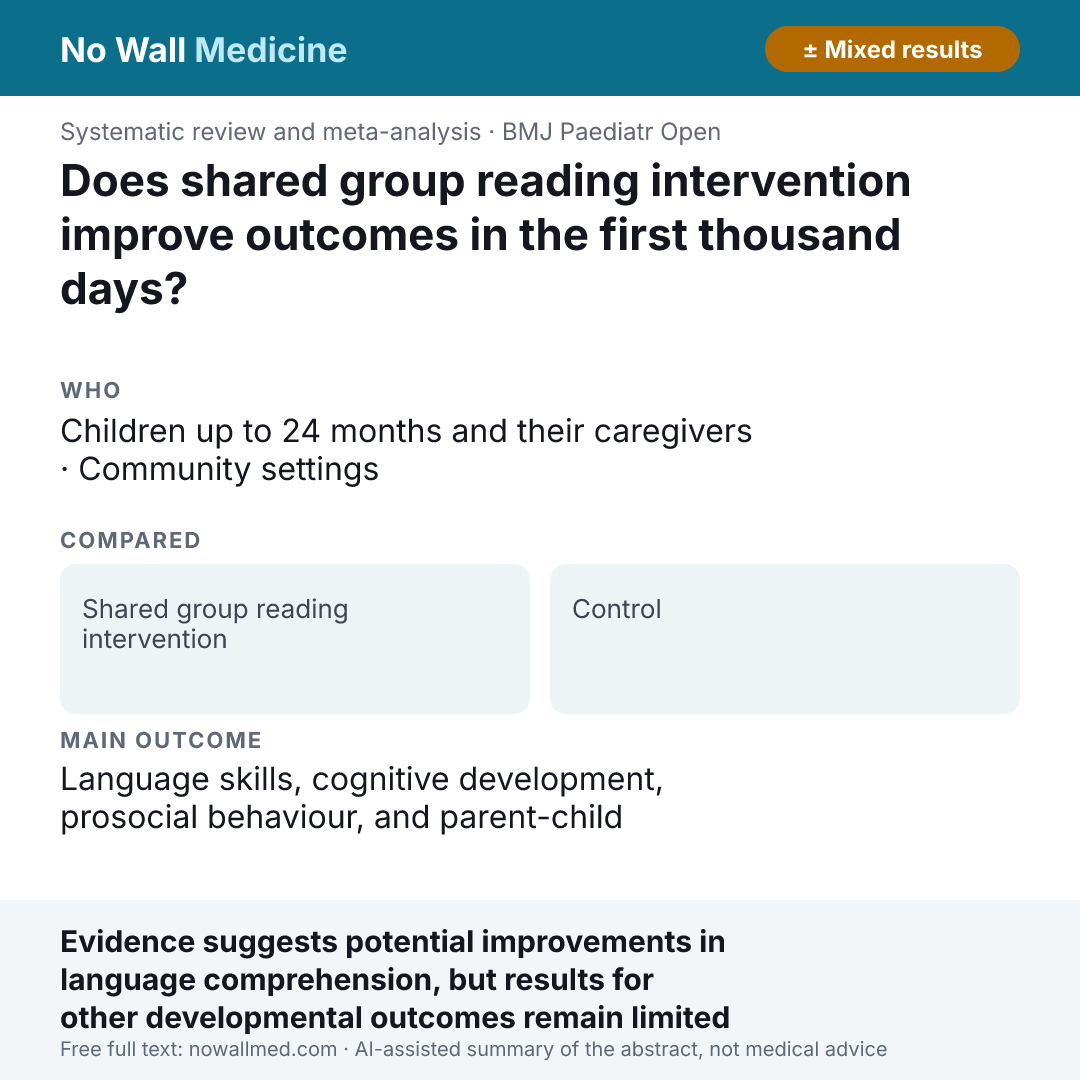
Does shared group reading intervention improve outcomes in the first thousand days?
Who
Children up to 24 months and their caregivers · Community settings
Compared
Shared group reading intervention
Control
Main outcome
Language skills, cognitive development, prosocial behaviour, and parent-child relationship
Bottom line: Evidence suggests potential improvements in language comprehension, but results for other developmental outcomes remain limited and inconsistent.
Limitation: Evidence was limited and inconsistent.
BMJ Paediatr Open · 2025-12-17 · Save PNG
Clinical question: Does shared group reading intervention improve outcomes in the first thousand days?
Key points
- Researchers analyzed eight experimental studies involving children up to 24 months of age and their caregivers participating in shared group reading sessions.
- The meta-analysis and narrative synthesis suggested improvements in children's language comprehension, but evidence for cognitive development and prosocial behavior was limited and inconsistent.
- Narrative analysis also suggested positive changes in the parent-child relationship and parental skills following the interventions.
Limitation the authors note: The evidence across the included studies was limited and inconsistent.
Headline and key points written with AI from the paper’s abstract, with every number checked against it. Read the paper before relying on them.
Was this summary helpful?
Abstract
Background
The first thousand days, the period from the conception to the second year of life, play a fundamental role in establishing the foundation of a newborn's health, growth and neurological development, finally impacting its entire life. Reading interventions during this period produce numerous positive outcomes for the infants, such as their language skills and development, as well as enhancing the relationship between caregivers and children, supporting the importance of studying the effectiveness of shared reading groups in this period among children without pathologies and their caregivers. This research aims to systematically review evidence on shared group activity in the first thousand days, including also their caregivers, exploring the following outcomes: children's language skills, cognitive development, prosocial behaviour, parent-child relationship, reading habits, health literacy, quality of life and empowerment. Methods
We conducted a systematic review and meta-analysis based on the Preferred Reporting Items for Systematic Reviews and Meta-Analyses guidelines. Eight experimental studies met the inclusion criteria: shared group reading intervention involving children up to 24 months with their caregivers (especially parents, but also other caregivers). These interventions typically consisted of 6-12 group sessions led by trained facilitators in community settings. Results
The results showed no clear conclusions. Both the narrative synthesis and meta-analysis suggested improvements on children's language skills (comprehension), only the narrative analysis suggested positive changes in cognitive development and prosocial behaviour, alongside improved parent-child relationship and enhanced parental skills following the intervention. However, evidence was limited and inconsistent. Conclusions
These findings highlighted the importance of evidence-based interventions in supporting infant development, particularly in disadvantaged contexts addressing inequalities, and the promising role of shared reading as an integral part of such interventions. However, further studies are needed to confirm the effectiveness of these early interventions in fostering optimal developmental outcomes during the critical first thousand days.
Abstract reproduced under the article’s CC BY NC licence.
Subject terms
Headline, design, result, key points, caveat and citation as plain text.
Cite this article
Milani C, Buresta D, Iocca F, et al. Health promotion through reading in the first thousand days: a systematic review and meta-analysis. BMJ Paediatr Open. 2025;9(1). doi:10.1136/bmjpo-2024-003231
Spotted a mistake? Suggest a correction