Computed tomography and invasive coronary angiography show similar quality of life and chest pain outcomes
Health Status Outcomes After Computed Tomography or Invasive Coronary Angiography for Stable Chest Pain: A Prespecified Secondary Analysis of the DISCHARGE Randomized Clinical Trial
Randomized clinical trialNo clear difference
How do computed tomography and invasive coronary angiography affect health status outcomes?
Who
3561
Patients with stable chest pain and intermediate probability of coronary artery disease · 26 European centers
Compared
Computed tomography: mean EQ-5D-3L-VAS 3.5 year minus baseline score 4.0
Invasive coronary angiography: mean EQ-5D-3L-VAS 3.5 year minus baseline score 4.6
Main outcome
Quality of life and angina
Bottom line: Computed tomography and invasive coronary angiography resulted in similar quality of life and chest pain outcomes at 3.5 years.
JAMA Cardiol · 2025-05-14Download image
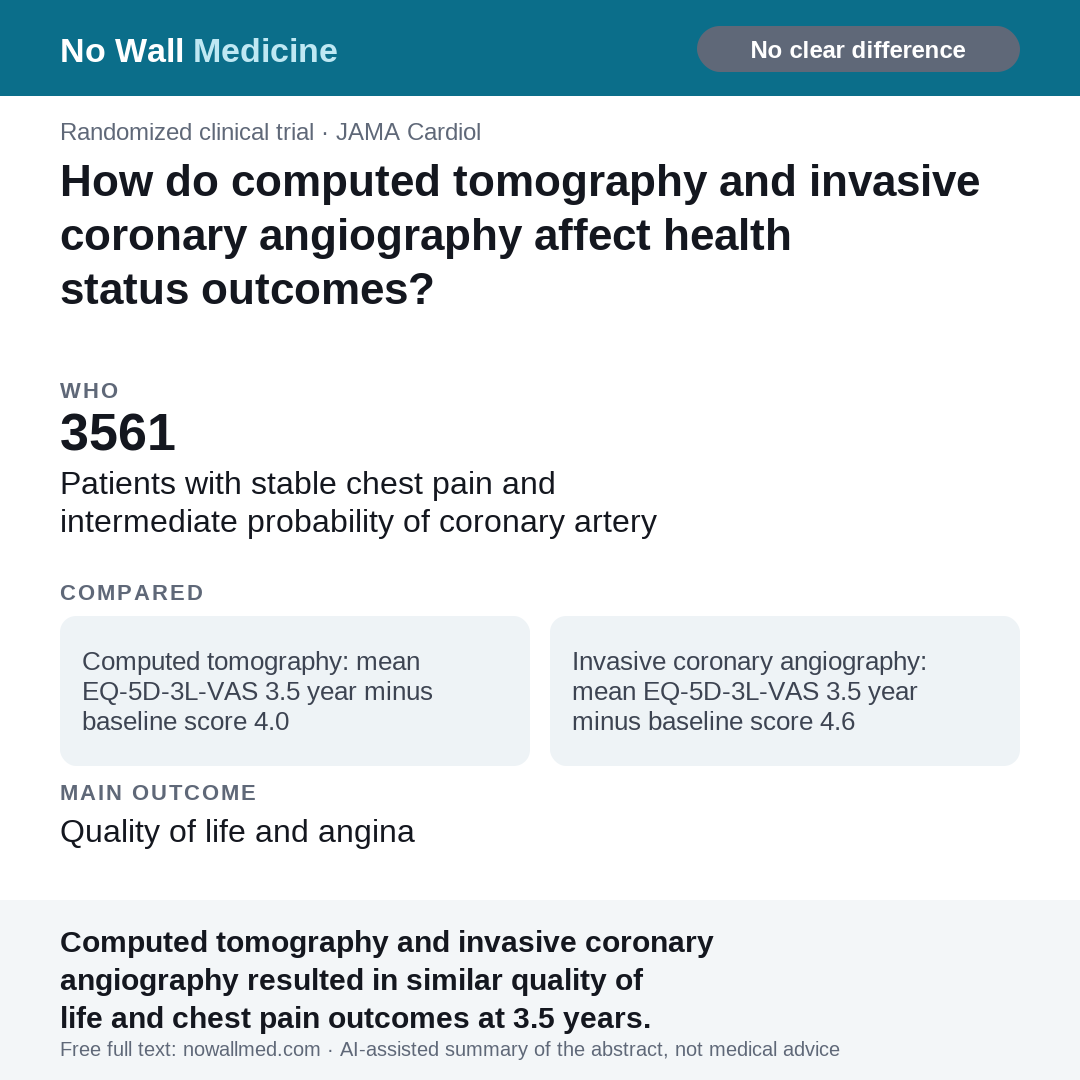
Clinical question: How do computed tomography and invasive coronary angiography affect health status outcomes?
Why it matters: The effect of computed tomography versus invasive coronary angiography on quality of life and angina for patients with stable chest pain is unknown.
Key points
- Researchers studied 3561 patients with stable chest pain and intermediate risk of coronary artery disease, comparing computed tomography to invasive coronary angiography.
- Health status outcomes were similar between groups at 3.5 years, including a mean EQ-5D-3L visual analog scale improvement of 4.0 for computed tomography and 4.6 for invasive coronary angiography.
- Female patients reported worse baseline and follow-up quality of life than male patients, though both testing strategies showed similar results for these groups.
Headline and key points written with AI from the paper’s abstract, with every number checked against it. Read the paper before relying on them.
Was this summary helpful?
Subject terms
Cite this article
DISCHARGE Trial Group, Rieckmann N, Neumann K, Maurovich-Horvat P, Kofoed KF, Benedek T. Health Status Outcomes After Computed Tomography or Invasive Coronary Angiography for Stable Chest Pain: A Prespecified Secondary Analysis of the DISCHARGE Randomized Clinical Trial. JAMA Cardiol. 2025. doi:10.1001/jamacardio.2025.0992
Spotted a mistake? Suggest a correction
Top studies every Monday
The week’s key trials and guidelines in your specialties, plus any topics you follow. By email, free.
Get the weekly digest