Higher health system use and quality were associated with increased COVID-19 vaccination rates
Health system quality and COVID-19 vaccination: a cross-sectional analysis in 14 countries
Cross-sectional analysis and random effects meta-analysisMixed results
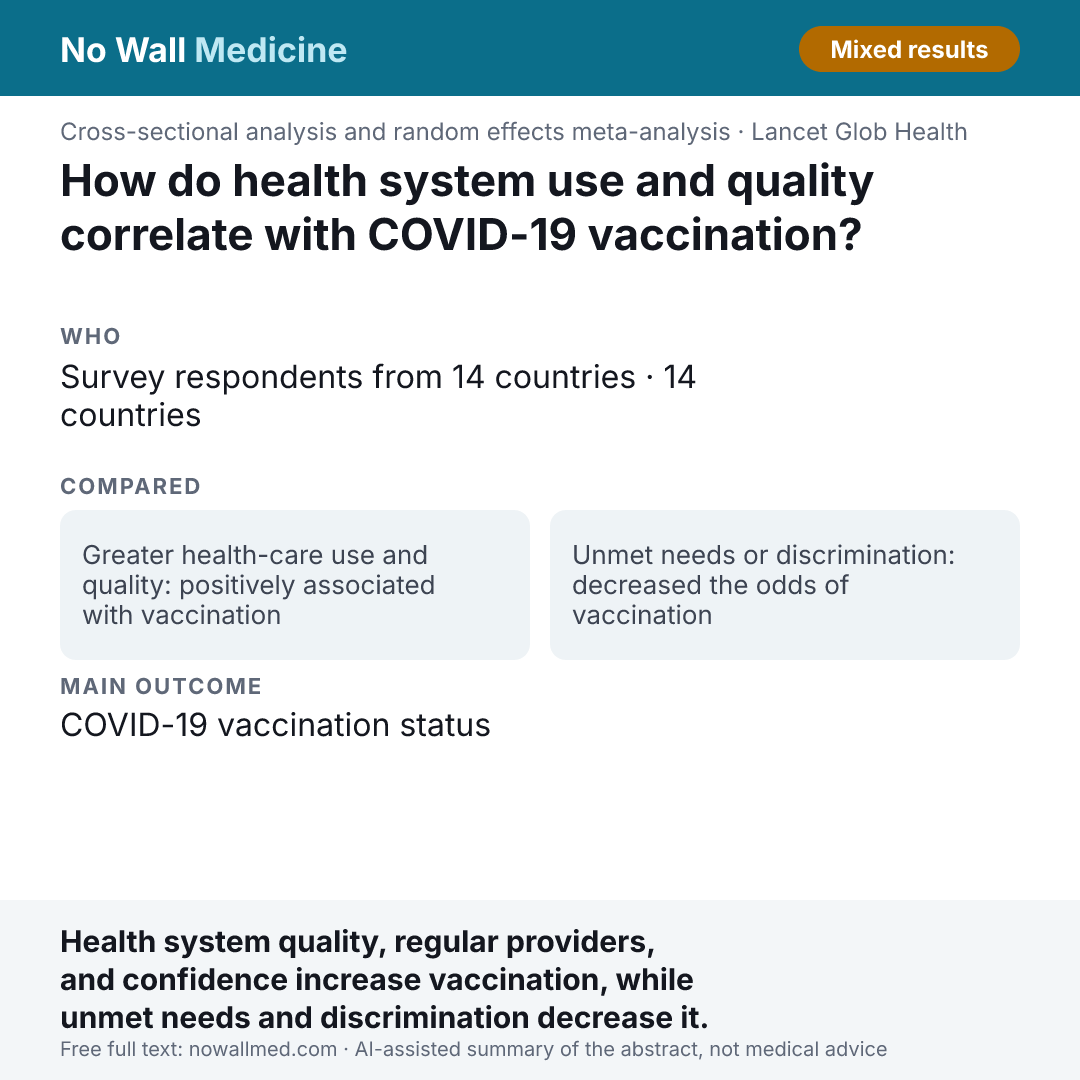
How do health system use and quality correlate with COVID-19 vaccination?
Who
Survey respondents from 14 countries · 14 countries
Compared
Greater health-care use and quality: positively associated with vaccination
Unmet needs or discrimination: decreased the odds of vaccination
Main outcome
COVID-19 vaccination status
Bottom line: Health system quality, regular providers, and confidence increase vaccination, while unmet needs and discrimination decrease it.
Lancet Glob Health · 2023-12-11 · Save PNG
Clinical question: How do health system use and quality correlate with COVID-19 vaccination?
Key points
- Researchers analyzed survey data from 14 countries where COVID-19 vaccination coverage for at least two or three doses ranged from 29% in India to 85% in Peru.
- Increased vaccination was associated with greater healthcare use, having a regular high-quality provider, receiving preventive services, and having confidence in the government and health system.
- Unmet healthcare needs, experiencing discrimination, or experiencing a medical mistake were associated with lower odds of vaccination.
Headline and key points written with AI from the paper’s abstract, with every number checked against it. Read the paper before relying on them.
Was this summary helpful?
Abstract
The social and behavioural determinants of COVID-19 vaccination have been described previously. However, little is known about how vaccinated people use and rate their health system. We used surveys conducted in 14 countries to study the health system correlates of COVID-19 vaccination. Country-specific logistic regression models were adjusted for respondent age, education, income, chronic illness, history of COVID-19, urban residence, and minority ethnic, racial, or linguistic group. Estimates were summarised across countries using random effects meta-analysis. Vaccination coverage with at least two or three doses ranged from 29% in India to 85% in Peru. Greater health-care use, having a regular and high-quality provider, and receiving other preventive health services were positively associated with vaccination. Confidence in the health system and government also increased the odds of vaccination. By contrast, having unmet health-care needs or experiencing discrimination or a medical mistake decreased the odds of vaccination. Associations between health system predictors and vaccination tended to be stronger in high-income countries and in countries with the most COVID-19-related deaths. Access to quality health systems might affect vaccine decisions. Building strong primary care systems and ensuring a baseline level of quality that is affordable for all should be central to pandemic preparedness strategies.
Abstract reproduced under the article’s CC BY licence.
Subject terms
Headline, design, result, key points, caveat and citation as plain text.
Cite this article
Arsenault C, Lewis TP, Kapoor NR, et al. Health system quality and COVID-19 vaccination: a cross-sectional analysis in 14 countries. Lancet Glob Health. 2024;12(1):e156-e165. doi:10.1016/S2214-109X(23)00490-4
Spotted a mistake? Suggest a correction