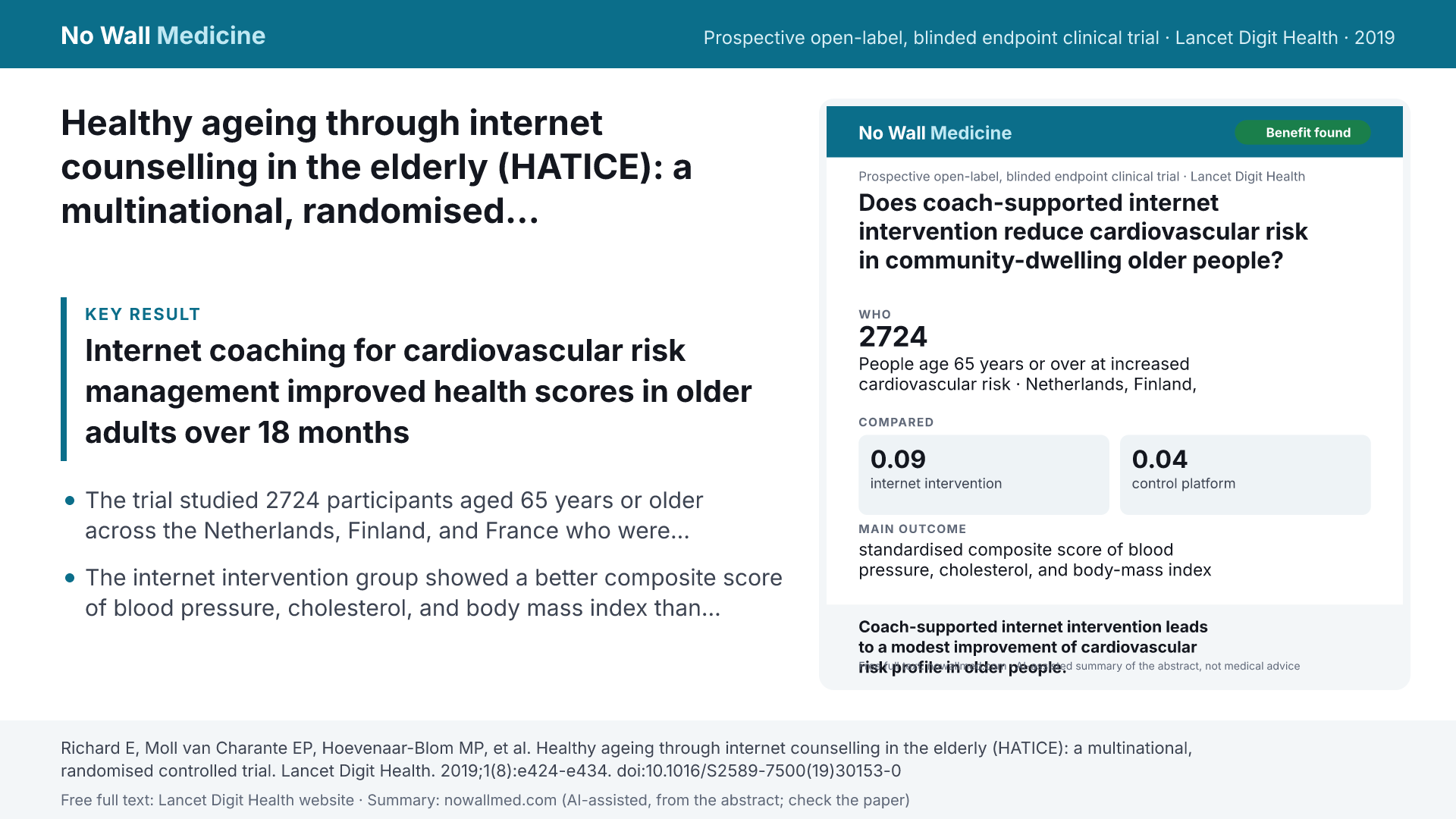
Internet coaching for cardiovascular risk management improved health scores in older adults over 18 months
Healthy ageing through internet counselling in the elderly (HATICE): a multinational, randomised controlled trial
Prospective open-label, blinded endpoint clinical trialBenefit found
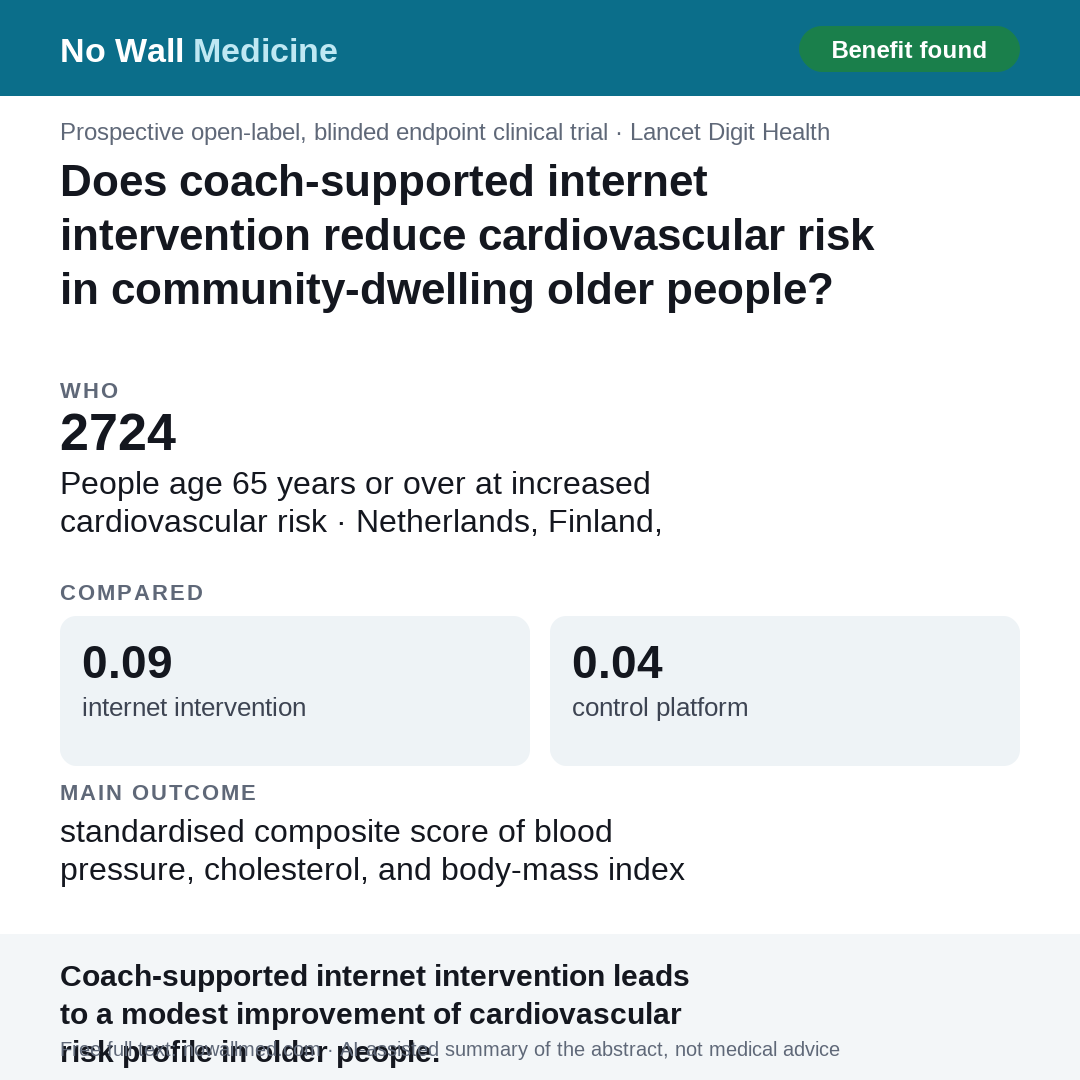
Does coach-supported internet intervention reduce cardiovascular risk in community-dwelling older people?
Who
2724
People age 65 years or over at increased cardiovascular risk · Netherlands, Finland, and France
Compared
0.09internet intervention
0.04control platform
Main outcome
standardised composite score of blood pressure, cholesterol, and body-mass index
Result: mean difference -0.05, 95% CI -0.08 to -0.01
Bottom line: Coach-supported internet intervention leads to a modest improvement of cardiovascular risk profile in older people.
Funded by: European Commission Seventh Framework Programme
Lancet Digit Health · 2019-11-14Download image
Clinical question: Does coach-supported internet intervention reduce cardiovascular risk in community-dwelling older people?
Why it matters: Evidence is limited regarding whether web-based interventions are effective for managing cardiovascular risk in people older than 65 years.
Key points
- The trial studied 2724 participants aged 65 years or older across the Netherlands, Finland, and France who were at increased risk of cardiovascular disease.
- The internet intervention group showed a better composite score of blood pressure, cholesterol, and body mass index than the control group (0.09 vs 0.04; mean difference -0.05).
- Cardiovascular disease occurred in 2.2% of the intervention group and 2.4% of the control group, which was not a statistically significant difference.
Headline and key points written with AI from the paper’s abstract, with every number checked against it. Read the paper before relying on them.
Was this summary helpful?
Abstract
Background
Although web-based interventions have been promoted for cardiovascular risk management over the past decade, there is limited evidence for effectiveness of these interventions in people older than 65 years. The healthy ageing through internet counselling in the elderly (HATICE) trial aimed to determine whether a coach-supported internet intervention for self-management can reduce cardiovascular risk in community-dwelling older people. Methods
This prospective open-label, blinded endpoint clinical trial among people age 65 years or over at increased risk of cardiovascular disease randomly assigned participants in the Netherlands, Finland, and France to an interactive internet intervention stimulating coach-supported self-management or a control platform. Primary outcome was the difference from baseline to 18 months on a standardised composite score (Z score) of systolic blood pressure, LDL cholesterol, and body-mass index (BMI). Secondary outcomes included individual risk factors and cardiovascular endpoints. This trial is registered with the ISRCTN registry, 48151589, and is closed to accrual. Findings
Among 2724 participants, complete primary outcome data were available for 2398 (88%). After 18 months, the primary outcome improved in the intervention group versus the control group (0·09 vs 0·04, respectively; mean difference -0·05, 95% CI -0·08 to -0·01; p=0·008). For individual components of the primary outcome, mean differences (intervention vs control) were systolic blood pressure -1·79 mm Hg versus -0·67 mm Hg (-1·12, -2·51 to 0·27); BMI -0·23 kg/m2 versus -0·08 kg/m2 (-0·15, -0·28 to -0·01); and LDL -0·12 mmol/L versus -0·07 mmol/L (-0·05, -0·11 to 0·01). Cardiovascular disease occurred in 30 (2·2%) of 1382 patients in the intervention versus 32 (2·4%) of 1333 patients in the control group (hazard ratio 0·86, 95% CI 0·52 to 1·43). Interpretation
Coach-supported self-management of cardiovascular risk factors using an interactive internet intervention is feasible in an older population, and leads to a modest improvement of cardiovascular risk profile. When implemented on a large scale this could potentially reduce the burden of cardiovascular disease. Funding
European Commission Seventh Framework Programme.
Abstract reproduced under the article’s CC BY licence.
Subject terms
Cite this article
Richard E, Moll van Charante EP, Hoevenaar-Blom MP, Coley N, Barbera M, van der Groep A. Healthy ageing through internet counselling in the elderly (HATICE): a multinational, randomised controlled trial. Lancet Digit Health. 2019. doi:10.1016/S2589-7500(19)30153-0
Spotted a mistake? Suggest a correction
Top studies every Monday
The week’s key trials and guidelines in your specialties, plus any topics you follow. By email, free.
Get the weekly digest