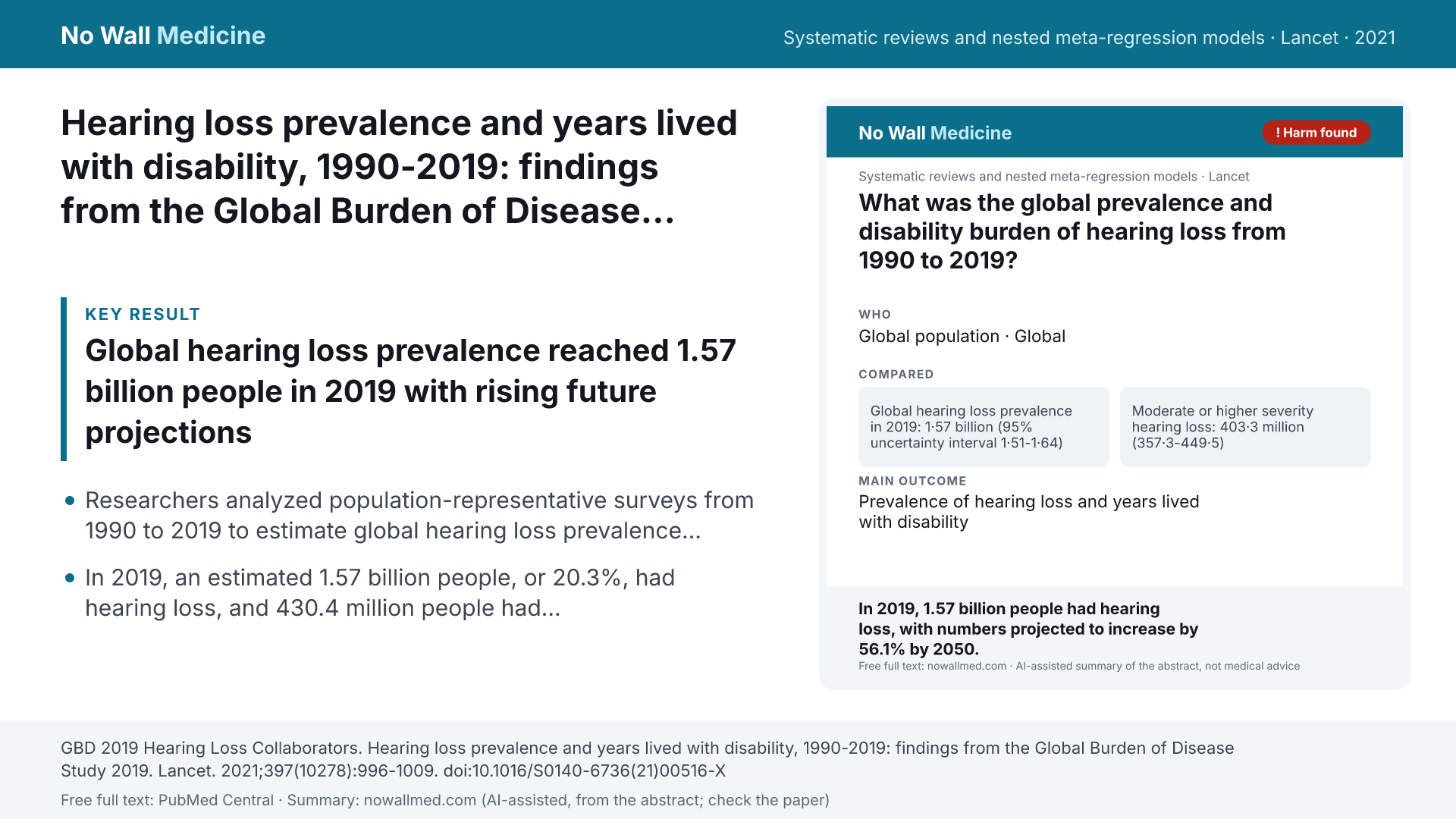
Global hearing loss prevalence reached 1.57 billion people in 2019 with rising future projections
Hearing loss prevalence and years lived with disability, 1990-2019: findings from the Global Burden of Disease Study 2019
Systematic reviews and nested meta-regression modelsHarm found
What was the global prevalence and disability burden of hearing loss from 1990 to 2019?
Who
Global population · Global
Compared
Global hearing loss prevalence in 2019: 1·57 billion (95% uncertainty interval 1·51-1·64)
Moderate or higher severity hearing loss: 403·3 million (357·3-449·5)
Main outcome
Prevalence of hearing loss and years lived with disability
Bottom line: In 2019, 1.57 billion people had hearing loss, with numbers projected to increase by 56.1% by 2050.
Funded by: Bill & Melinda Gates Foundation and WHO
Lancet · 2021-03-14Download image
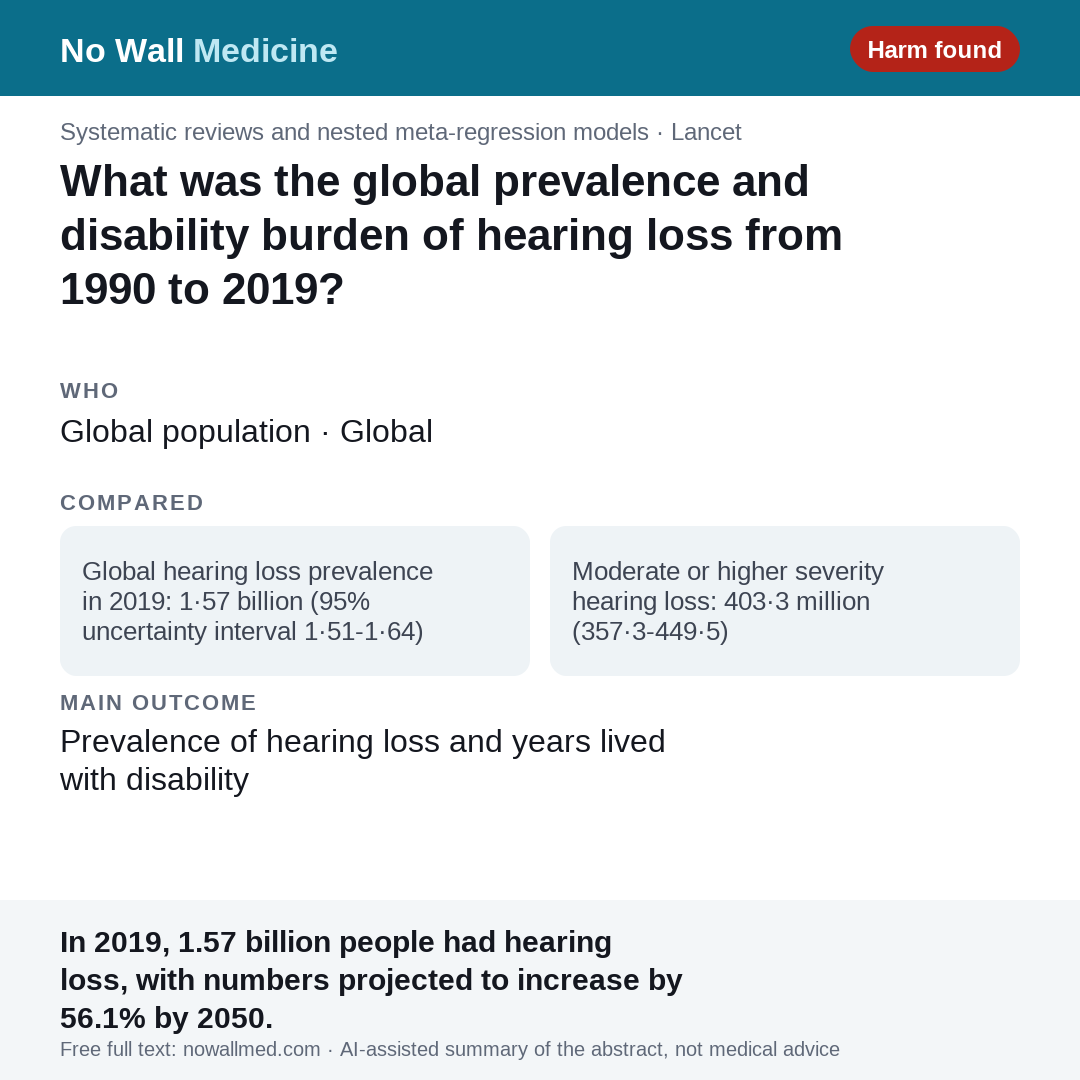
Clinical question: What was the global prevalence and disability burden of hearing loss from 1990 to 2019?
Why it matters: The global burden of hearing loss and its associated years lived with disability, a measure of time spent in poor health, required updated estimates.
Key points
- Researchers analyzed population-representative surveys from 1990 to 2019 to estimate global hearing loss prevalence and disability.
- In 2019, an estimated 1.57 billion people, or 20.3%, had hearing loss, and 430.4 million people had moderate-to-complete hearing loss without adjusting for hearing aid use.
- The number of people with hearing loss is projected to increase by 56.1% to 2.45 billion people by 2050.
Headline and key points written with AI from the paper’s abstract, with every number checked against it. Read the paper before relying on them.
Was this summary helpful?
Abstract
Background
Hearing loss affects access to spoken language, which can affect cognition and development, and can negatively affect social wellbeing. We present updated estimates from the Global Burden of Disease (GBD) study on the prevalence of hearing loss in 2019, as well as the condition's associated disability. Methods
We did systematic reviews of population-representative surveys on hearing loss prevalence from 1990 to 2019. We fitted nested meta-regression models for severity-specific prevalence, accounting for hearing aid coverage, cause, and the presence of tinnitus. We also forecasted the prevalence of hearing loss until 2050. Findings
An estimated 1·57 billion (95% uncertainty interval 1·51-1·64) people globally had hearing loss in 2019, accounting for one in five people (20·3% [19·5-21·1]). Of these, 403·3 million (357·3-449·5) people had hearing loss that was moderate or higher in severity after adjusting for hearing aid use, and 430·4 million (381·7-479·6) without adjustment. The largest number of people with moderate-to-complete hearing loss resided in the Western Pacific region (127·1 million people [112·3-142·6]). Of all people with a hearing impairment, 62·1% (60·2-63·9) were older than 50 years. The Healthcare Access and Quality (HAQ) Index explained 65·8% of the variation in national age-standardised rates of years lived with disability, because countries with a low HAQ Index had higher rates of years lived with disability. By 2050, a projected 2·45 billion (2·35-2·56) people will have hearing loss, a 56·1% (47·3-65·2) increase from 2019, despite stable age-standardised prevalence. Interpretation
As populations age, the number of people with hearing loss will increase. Interventions such as childhood screening, hearing aids, effective management of otitis media and meningitis, and cochlear implants have the potential to ameliorate this burden. Because the burden of moderate-to-complete hearing loss is concentrated in countries with low health-care quality and access, stronger health-care provision mechanisms are needed to reduce the burden of unaddressed hearing loss in these settings. Funding
Bill & Melinda Gates Foundation and WHO.
Abstract reproduced under the article’s CC BY licence.
Subject terms
Cite this article
GBD 2019 Hearing Loss Collaborators. Hearing loss prevalence and years lived with disability, 1990-2019: findings from the Global Burden of Disease Study 2019. Lancet. 2021. doi:10.1016/S0140-6736(21)00516-X
Spotted a mistake? Suggest a correction
Top studies every Monday
The week’s key trials and guidelines in your specialties, plus any topics you follow. By email, free.
Get the weekly digest