Heart attack education program did not increase emergency medical service use in high-risk communities
Heart Attack Education and EMS Response in High-Risk, Low EMS Usage Areas: A Stepped-Wedge Cluster-Randomized Trial
Stepped-wedge cluster randomized clinical trialNo clear difference
Does heart attack education improve emergency medical service use for acute coronary syndrome?
Who
1775
Adult residents in 8 high-risk communities in Victoria, Australia · 8 high-risk communities in Victoria, Australia
Compared
68.6%Control period
63.4%Intervention period
Main outcome
Proportion of patients with acute coronary syndrome transported by emergency medical services
Result: adjusted risk difference -8.98% (95% CI -17.50% to -0.46%)
Bottom line: The heart attack education intervention did not improve emergency medical service use or prehospital care-seeking.
JAMA Netw Open · 2026-04-01Download image
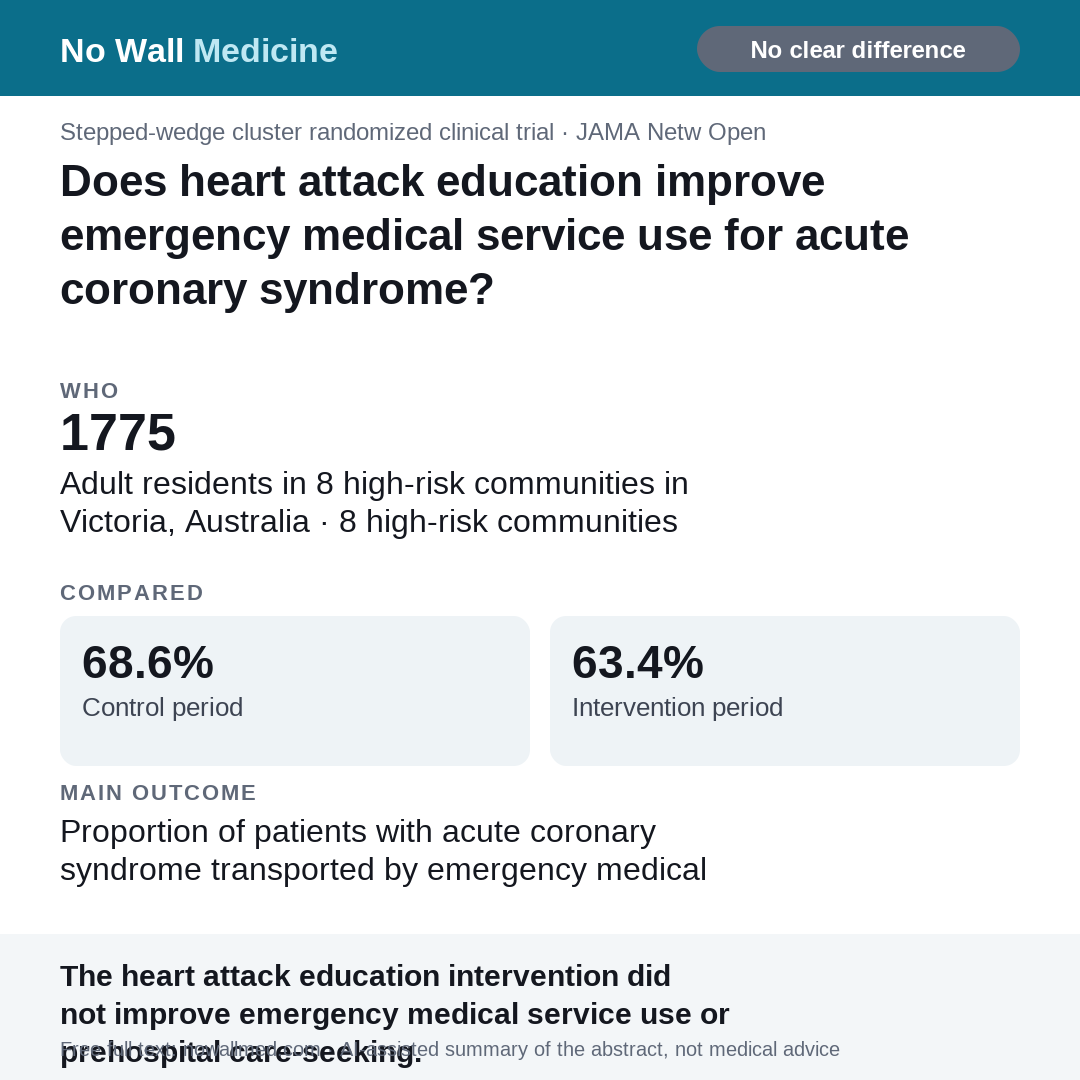
Clinical question: Does heart attack education improve emergency medical service use for acute coronary syndrome?
Why it matters: Delays in recognizing and acting on heart attack symptoms can worsen patient outcomes in areas with high cardiovascular risk and low emergency medical service use.
Key points
- Researchers studied 1,775 patients with acute coronary syndrome, which is a range of conditions including heart attacks, across 8 high-risk communities in Australia.
- Emergency medical service transport occurred in 68.6% of 910 control patients compared to 63.4% of 865 intervention patients.
- The study found that external factors like the COVID-19 pandemic and natural disasters may have influenced patient behavior and reduced the intervention's effects.
Headline and key points written with AI from the paper’s abstract, with every number checked against it. Read the paper before relying on them.
Topics
Spotted a mistake? Suggest a correction