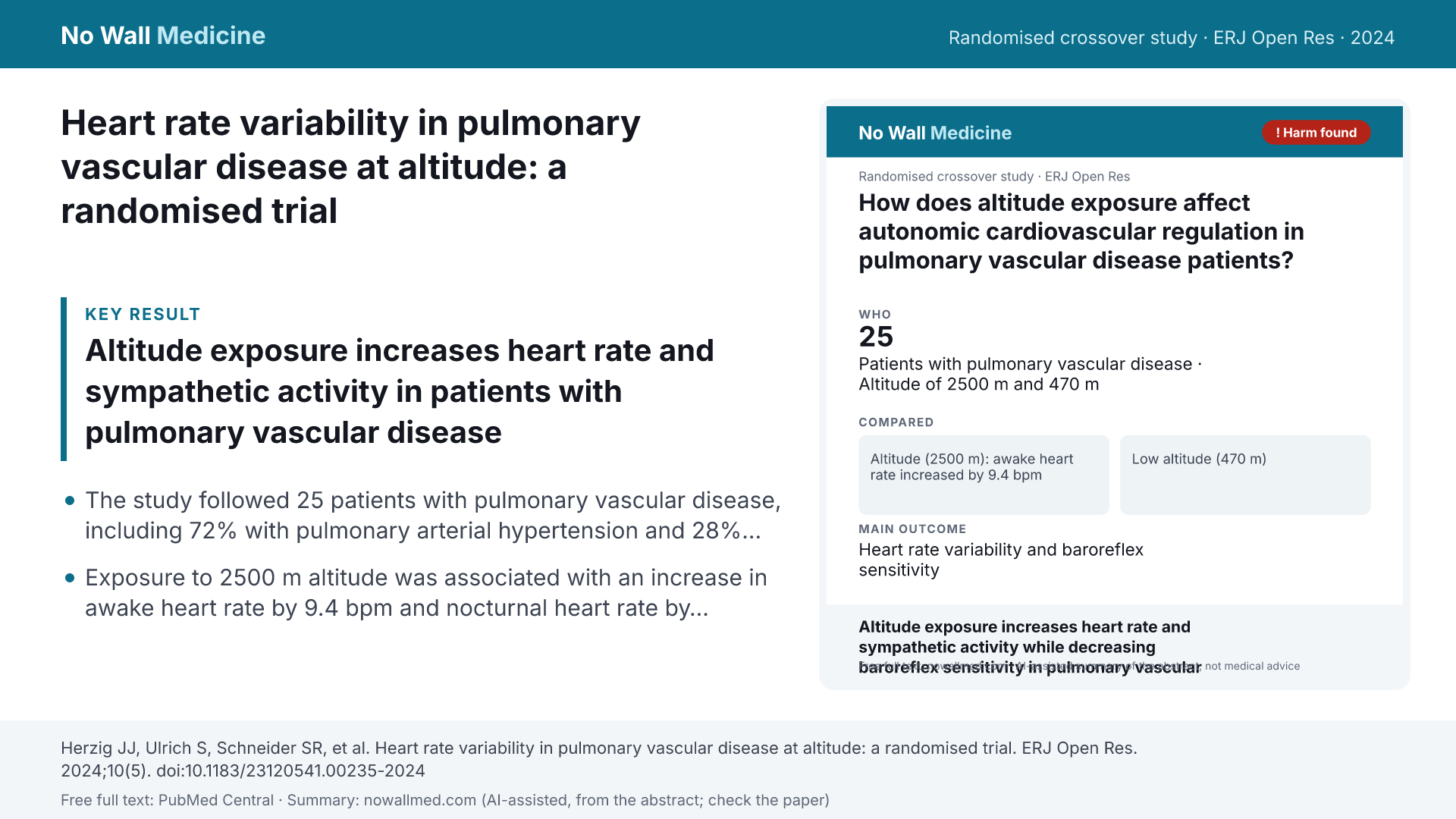
Altitude exposure increases heart rate and sympathetic activity in patients with pulmonary vascular disease
Heart rate variability in pulmonary vascular disease at altitude: a randomised trial
Randomised crossover studyHarm found
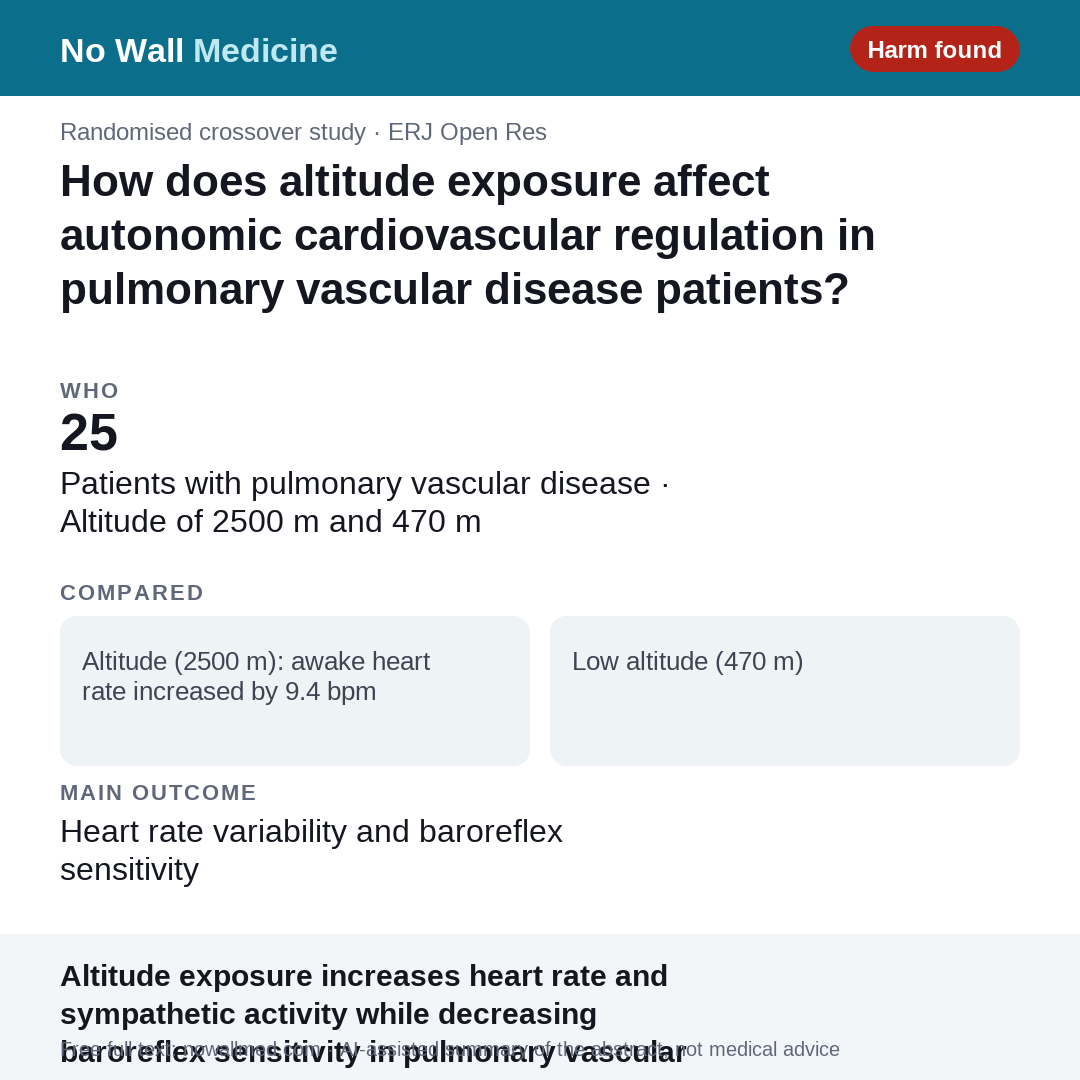
How does altitude exposure affect autonomic cardiovascular regulation in pulmonary vascular disease patients?
Who
25
Patients with pulmonary vascular disease · Altitude of 2500 m and 470 m
Compared
Altitude (2500 m): awake heart rate increased by 9.4 bpm
Low altitude (470 m)
Main outcome
Heart rate variability and baroreflex sensitivity
Bottom line: Altitude exposure increases heart rate and sympathetic activity while decreasing baroreflex sensitivity in pulmonary vascular disease patients.
ERJ Open Res · 2024-10-28Download image
Clinical question: How does altitude exposure affect autonomic cardiovascular regulation in pulmonary vascular disease patients?
Key points
- The study followed 25 patients with pulmonary vascular disease, including 72% with pulmonary arterial hypertension and 28% with distal chronic thromboembolic pulmonary hypertension.
- Exposure to 2500 m altitude was associated with an increase in awake heart rate by 9.4 bpm and nocturnal heart rate by 9.0 bpm.
- Altitude exposure was associated with changes in heart rate variability indicating increased sympathetic activity and a decrease in baroreflex sensitivity by -2.4 mmHg-1.
Headline and key points written with AI from the paper’s abstract, with every number checked against it. Read the paper before relying on them.
Was this summary helpful?
Headline, design, result, key points, caveat and citation as plain text.
Cite this article
Herzig JJ, Ulrich S, Schneider SR, et al. Heart rate variability in pulmonary vascular disease at altitude: a randomised trial. ERJ Open Res. 2024. doi:10.1183/23120541.00235-2024
Spotted a mistake? Suggest a correction