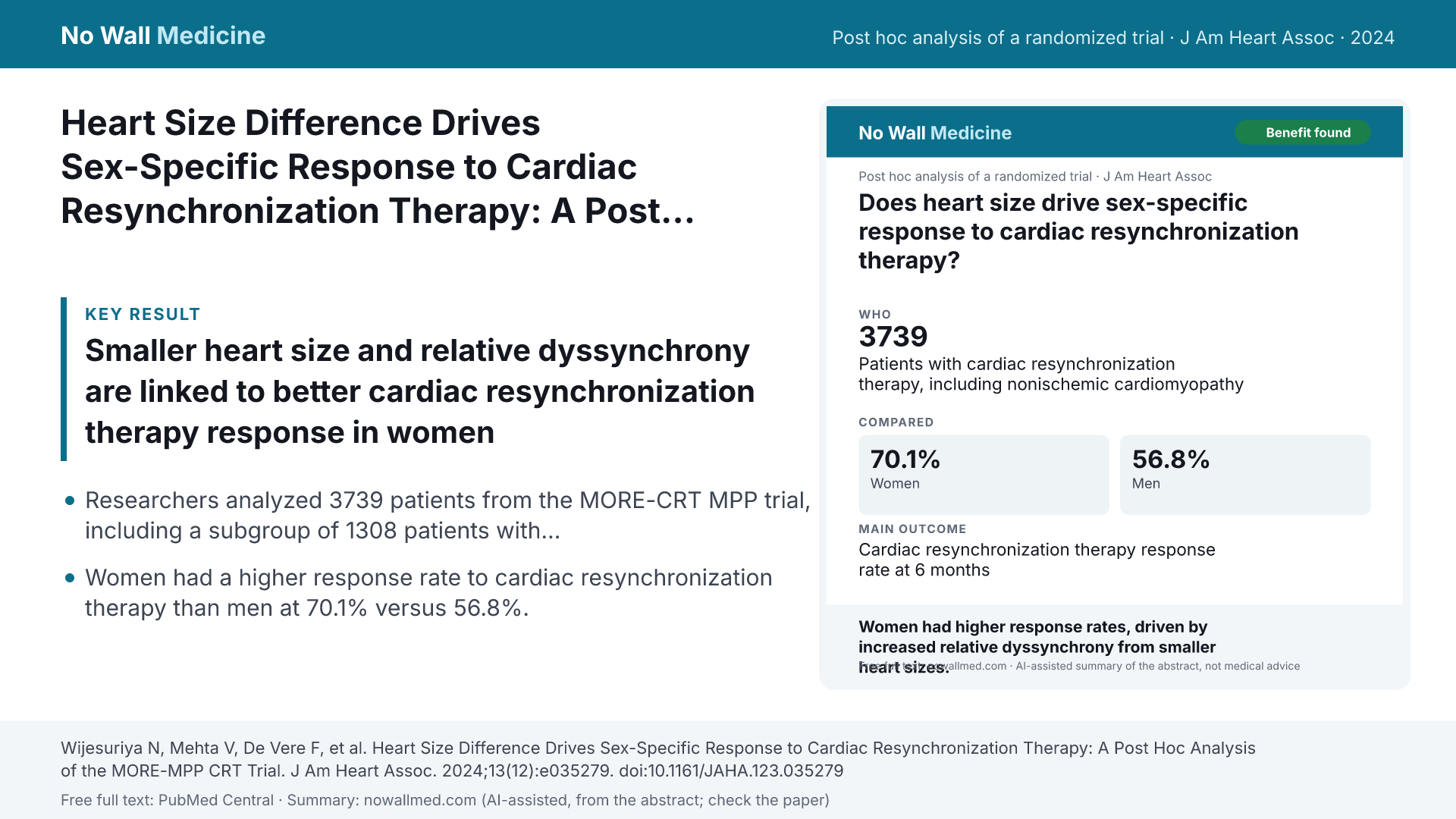
Heart Size Difference Drives Sex-Specific Response to Cardiac Resynchronization Therapy: A Post Hoc Analysis of the MORE-MPP CRT Trial
Key result: Smaller heart size and relative dyssynchrony are linked to better cardiac resynchronization therapy response in women
Post hoc analysis of a randomized trialBenefit found
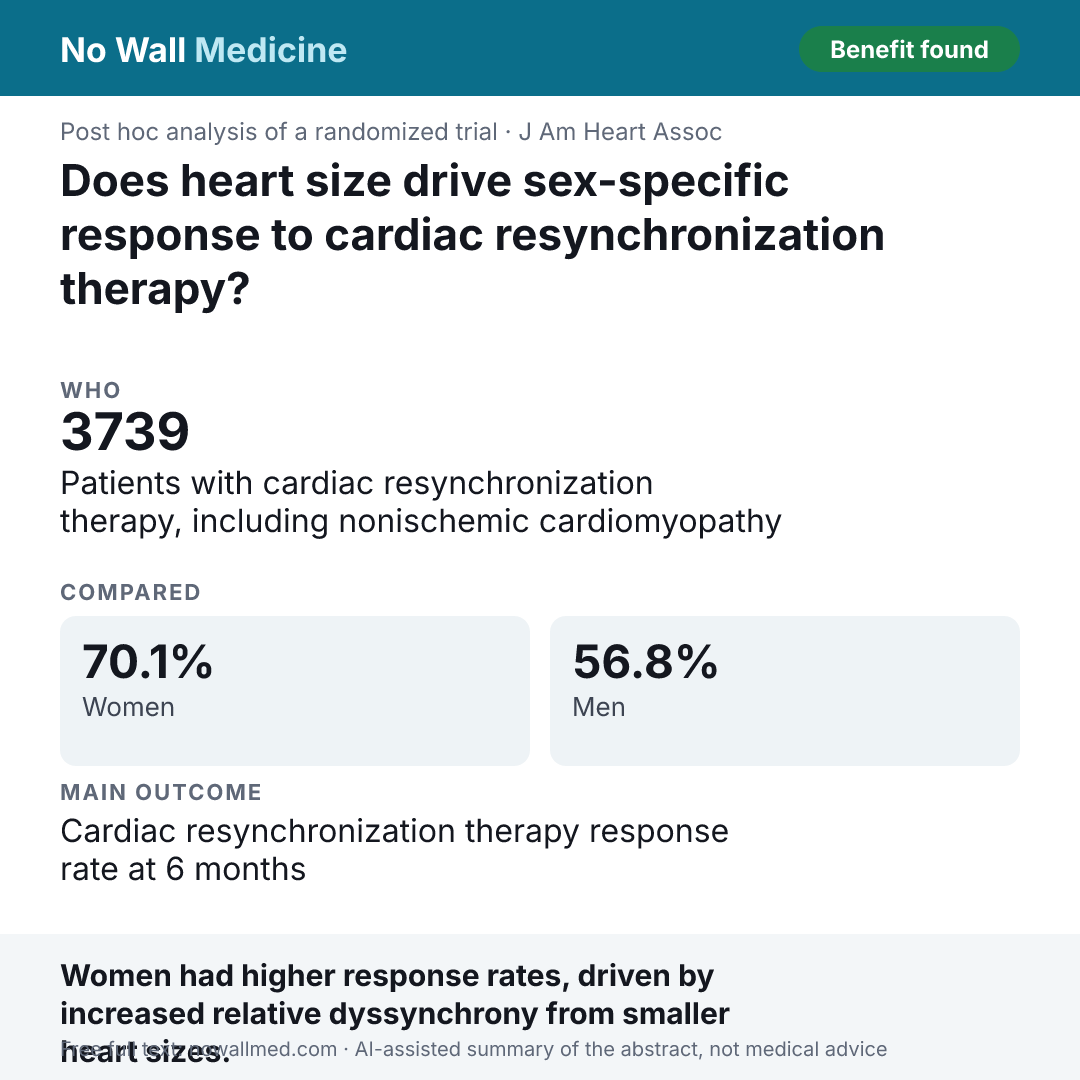
Does heart size drive sex-specific response to cardiac resynchronization therapy?
Who
3739
Patients with cardiac resynchronization therapy, including nonischemic cardiomyopathy and left bundle-branch block
Compared
70.1%Women
56.8%Men
Main outcome
Cardiac resynchronization therapy response rate at 6 months
Bottom line: Women had higher response rates, driven by increased relative dyssynchrony from smaller heart sizes.
Limitation: This is a post hoc analysis of a randomized trial.
J Am Heart Assoc · 2024-06-15 · Save PNG
Key points
- Researchers analyzed 3739 patients from the MORE-CRT MPP trial, including a subgroup of 1308 patients with nonischemic cardiomyopathy and left bundle-branch block.
- Women had a higher response rate to cardiac resynchronization therapy than men at 70.1% versus 56.8%.
- In the subgroup, women had a higher relative dyssynchrony ratio of 0.919 compared to 0.708 in men.
Discussion prompts
- Would these patients look like yours? Who was left out?
- Is the main outcome one that matters to patients?
- Is the difference large enough to change what you do?
Cite: Wijesuriya N, Mehta V, De Vere F, et al. Heart Size Difference Drives Sex-Specific Response to Cardiac Resynchronization Therapy: A Post Hoc Analysis of the MORE-MPP CRT Trial. J Am Heart Assoc. 2024;13(12):e035279. doi:10.1161/JAHA.123.035279
Free full text: PubMed Central · Summary and visual abstract: nowallmed.com/a/heart-size-difference-drives-sex-specific-response-to-cardiac-5e5ie6/ (AI-assisted from the abstract; check the paper before relying on it).