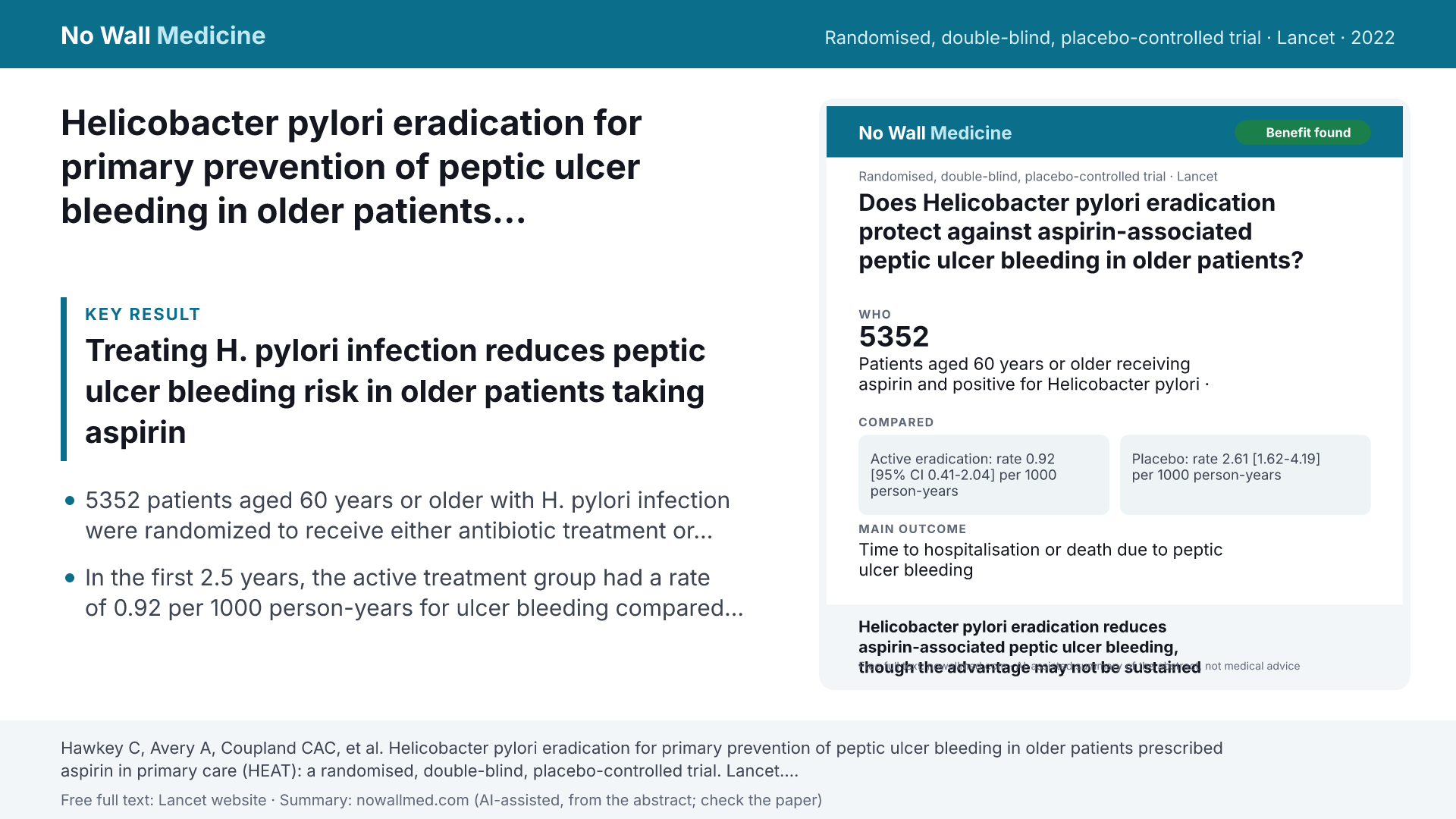
Treating H. pylori infection reduces peptic ulcer bleeding risk in older patients taking aspirin
Helicobacter pylori eradication for primary prevention of peptic ulcer bleeding in older patients prescribed aspirin in primary care (HEAT): a randomised, double-blind, placebo-controlled trial
Randomised, double-blind, placebo-controlled trialBenefit found
Does Helicobacter pylori eradication protect against aspirin-associated peptic ulcer bleeding in older patients?
Who
5352
Patients aged 60 years or older receiving aspirin and positive for Helicobacter pylori · 1208 primary care centres in the UK
Compared
Active eradication: rate 0.92 [95% CI 0.41-2.04] per 1000 person-years
Placebo: rate 2.61 [1.62-4.19] per 1000 person-years
Main outcome
Time to hospitalisation or death due to peptic ulcer bleeding
Result: hazard ratio 0.35 (95% CI 0.14-0.89)
Bottom line: Helicobacter pylori eradication reduces aspirin-associated peptic ulcer bleeding, though the advantage may not be sustained long term.
Funded by: National Institute for Health and Care Research Health Technology Assessment
Lancet · 2022-11-07 · Save PNG
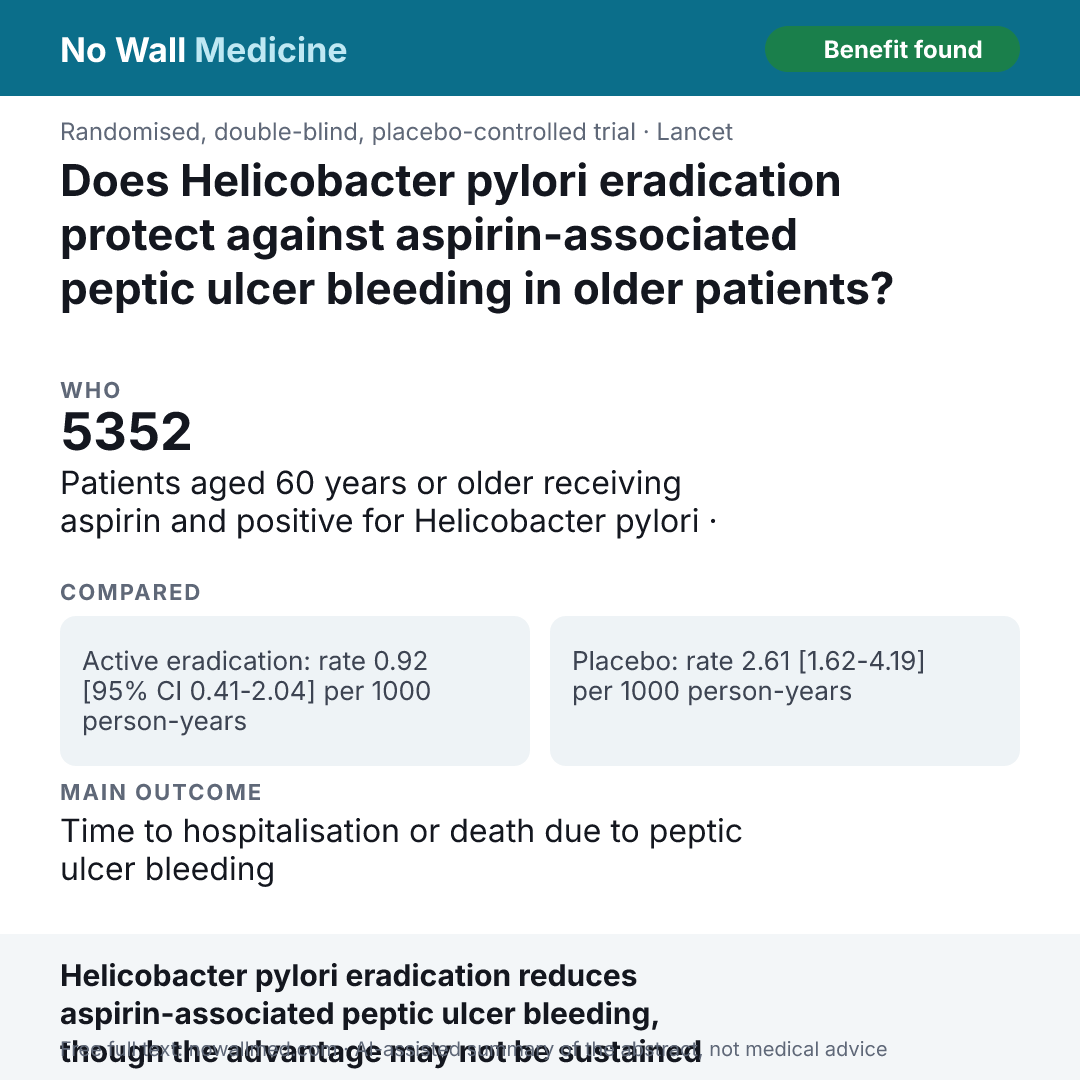
Clinical question: Does Helicobacter pylori eradication protect against aspirin-associated peptic ulcer bleeding in older patients?
Key points
- 5352 patients aged 60 years or older with H. pylori infection were randomized to receive either antibiotic treatment or a placebo.
- In the first 2.5 years, the active treatment group had a rate of 0.92 per 1000 person-years for ulcer bleeding compared to 2.61 per 1000 person-years in the placebo group.
- The benefit of the treatment was not sustained after the first 2.5 years of follow-up, with a hazard ratio of 1.31.
Headline and key points written with AI from the paper’s abstract, with every number checked against it. Read the paper before relying on them.
Was this summary helpful?
Abstract
Background
Peptic ulcers in patients receiving aspirin are associated with Helicobacter pylori infection. We aimed to investigate whether H pylori eradication would protect against aspirin-associated ulcer bleeding. Methods
We conducted a randomised, double-blind, placebo-controlled trial (Helicobacter Eradication Aspirin Trial [HEAT]) at 1208 primary care centres in the UK, using routinely collected clinical data. Eligible patients were aged 60 years or older who were receiving aspirin at a daily dose of 325 mg or less (with four or more 28-day prescriptions in the past year) and had a positive C13 urea breath test for H pylori at screening. Patients receiving ulcerogenic or gastroprotective medication were excluded. Participants were randomly assigned (1:1) to receive either a combination of oral clarithromycin 500 mg, metronidazole 400 mg, and lansoprazole 30 mg (active eradication), or oral placebo (control), twice daily for 1 week. Participants, their general practitioners and health-care providers, and the research nurses, trial team, adjudication committee, and analysis team were all masked to group allocation throughout the trial. Follow-up was by scrutiny of electronic data in primary and secondary care. The primary outcome was time to hospitalisation or death due to definite or probable peptic ulcer bleeding, and was analysed by Cox proportional hazards methods in the intention-to-treat population. This trial is registered with EudraCT, 2011-003425-96. Findings
Between Sept 14, 2012, and Nov 22, 2017, 30 166 patients had breath testing for H pylori, 5367 had a positive result, and 5352 were randomly assigned to receive active eradication (n=2677) or placebo (n=2675) and were followed up for a median of 5·0 years (IQR 3·9-6·4). Analysis of the primary outcome showed a significant departure from proportional hazards assumptions (p=0·0068), requiring analysis over separate time periods. There was a significant reduction in incidence of the primary outcome in the active eradication group in the first 2·5 years of follow-up compared with the control group (six episodes adjudicated as definite or probable peptic ulcer bleeds, rate 0·92 [95% CI 0·41-2·04] per 1000 person-years vs 17 episodes, rate 2·61 [1·62-4·19] per 1000 person-years; hazard ratio [HR] 0·35 [95% CI 0·14-0·89]; p=0·028). This advantage remained significant after adjusting for the competing risk of death (p=0·028) but was lost with longer follow-up (HR 1·31 [95% CI 0·55-3·11] in the period after the first 2·5 years; p=0·54). Reports of adverse events were actively solicited; taste disturbance was the most common event (787 patients). Interpretation
H pylori eradication protects against aspirin-associated peptic ulcer bleeding, but this might not be sustained in the long term. Funding
National Institute for Health and Care Research Health Technology Assessment.
Abstract reproduced under the article’s CC BY licence.
Subject terms
Headline, design, result, key points, caveat and citation as plain text.
Cite this article
Hawkey C, Avery A, Coupland CAC, et al. Helicobacter pylori eradication for primary prevention of peptic ulcer bleeding in older patients prescribed aspirin in primary care (HEAT): a randomised, double-blind, placebo-controlled trial. Lancet. 2022;400(10363):1597-1606. doi:10.1016/S0140-6736(22)01843-8
Spotted a mistake? Suggest a correction