Plain and hyperbaric bupivacaine caused similar blood pressure decreases during knee replacement surgery
Hemodynamic effects of plain versus hyperbaric bupivacaine during spinal anesthesia for total knee arthroplasty: a randomized clinical trial
Prospective, double-blinded, single-center randomized controlled superiority trialNo clear difference
Do plain or hyperbaric bupivacaine cause different early hemodynamic effects during spinal anesthesia?
Who
60
Adult patients undergoing elective total knee arthroplasty under spinal anesthesia · Single-center
Compared
33.1%Hyperbaric bupivacaine (13.3)
33.1%Plain bupivacaine (11.5)
Main outcome
Maximal relative decrease in mean arterial pressure within 1 hour
Bottom line: Plain and hyperbaric bupivacaine resulted in similar maximal relative decreases in mean arterial pressure during spinal anesthesia.
Reg Anesth Pain Med · 2026-03-31Download image
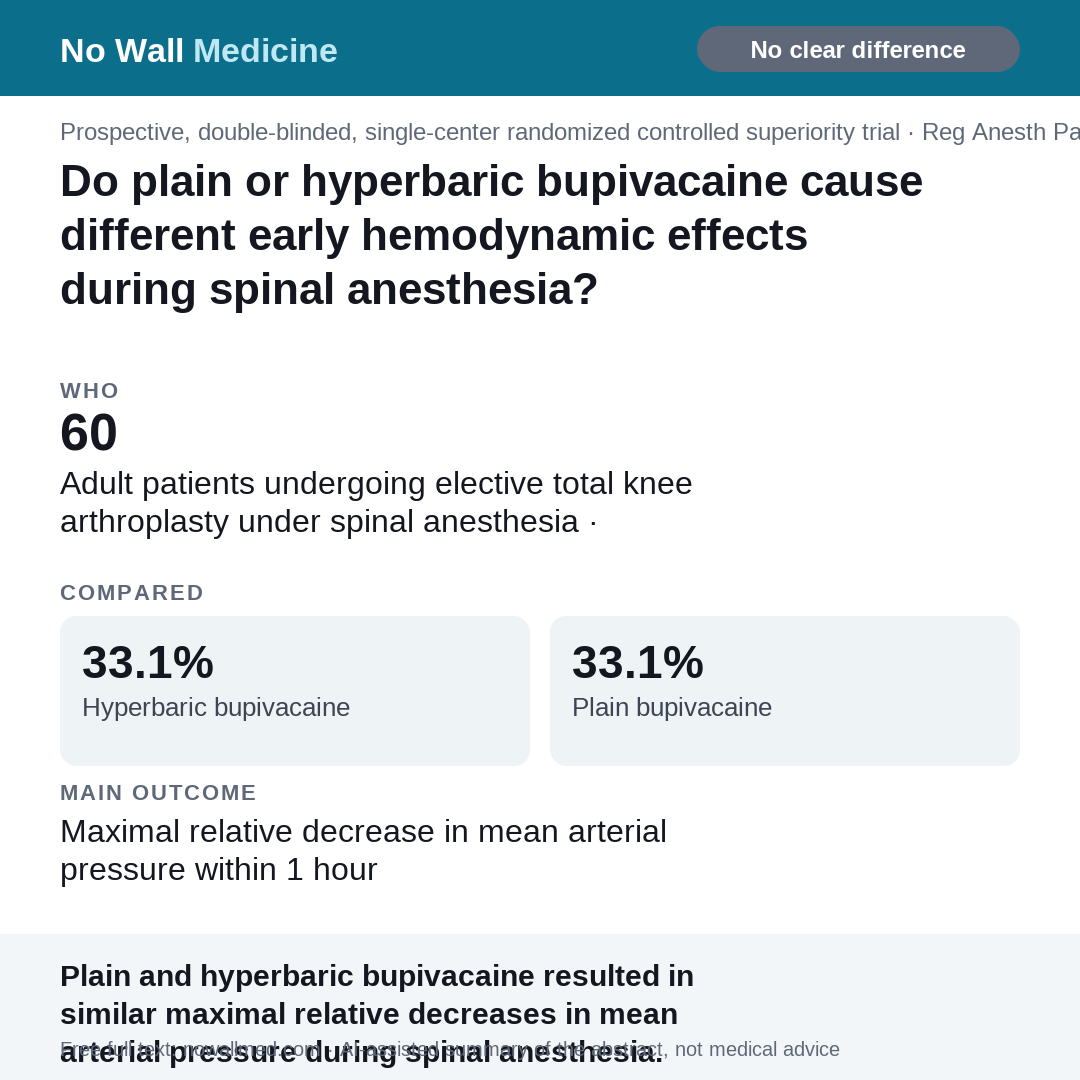
Clinical question: Do plain or hyperbaric bupivacaine cause different early hemodynamic effects during spinal anesthesia?
Why it matters: Spinal anesthesia for knee replacement is frequently associated with episodes of low blood pressure, and it is unclear if different types of bupivacaine affect these early hemodynamic effects.
Key points
- Researchers studied 60 adult patients undergoing total knee replacement who were randomized to receive either plain or hyperbaric bupivacaine for spinal anesthesia.
- The maximal relative decrease in mean arterial pressure within one hour was 33.1% (13.3) for the hyperbaric group and 33.1% (11.5) for the plain group.
- Nausea and vomiting occurred in 23.3% of the hyperbaric group and 16.7% of the plain group.
Headline and key points written with AI from the paper’s abstract, with every number checked against it. Read the paper before relying on them.
Cite this article
Carella M, Piette N, Beck F, Neuray V, Bonhomme VL. Hemodynamic effects of plain versus hyperbaric bupivacaine during spinal anesthesia for total knee arthroplasty: a randomized clinical trial. Reg Anesth Pain Med. 2026. doi:10.1136/rapm-2025-107546
Spotted a mistake? Suggest a correction