Early heparin administration was associated with higher spontaneous blood flow in heart arteries during heart attack treatment
Heparin administration at first medical contact vs immediately before primary percutaneous coronary intervention: the HELP-PCI trial
Randomized controlled trialBenefit found
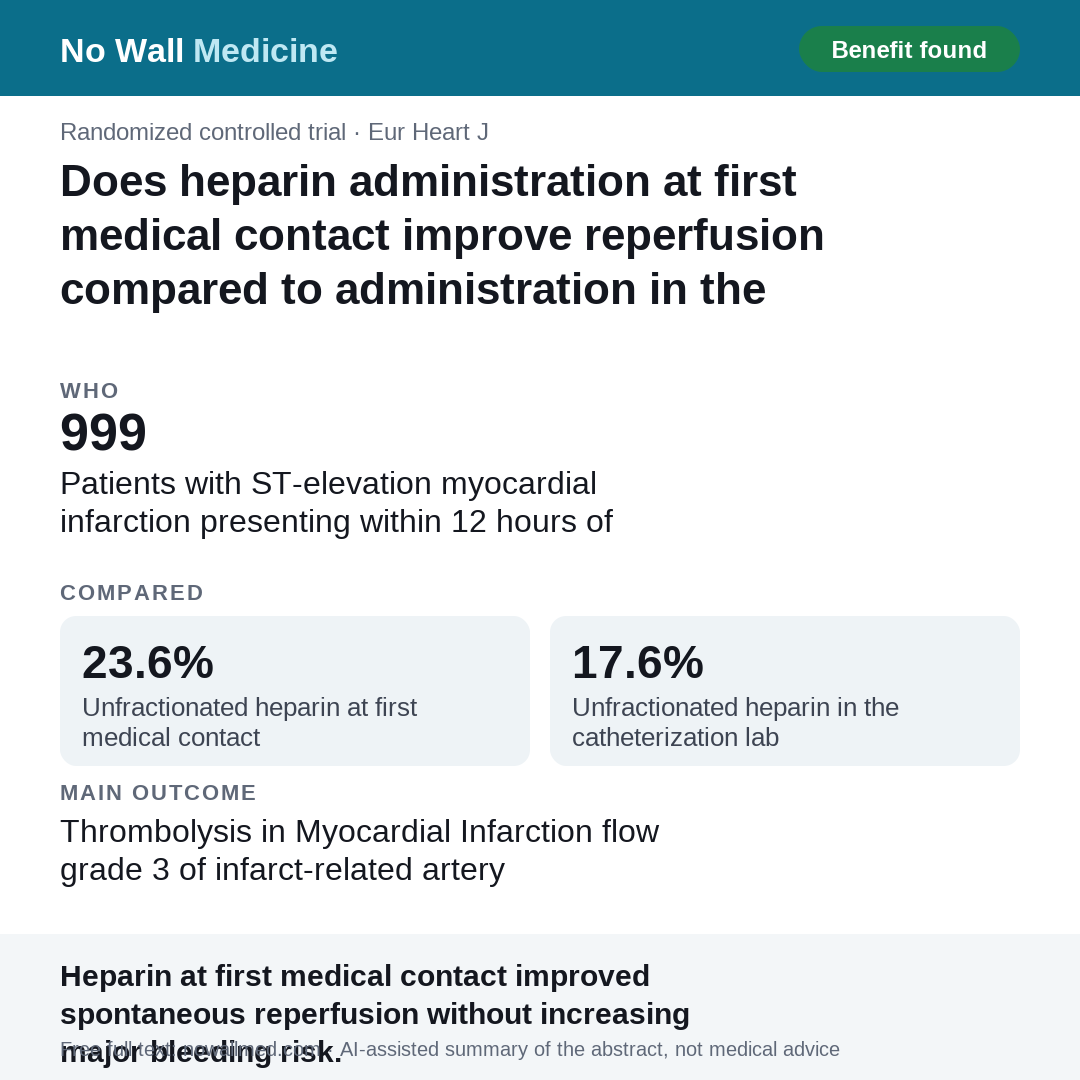
Does heparin administration at first medical contact improve reperfusion compared to administration in the catheterization lab?
Who
999
Patients with ST-elevation myocardial infarction presenting within 12 hours of symptom onset · 36 clinical centres in China
Compared
23.6%Unfractionated heparin at first medical contact
17.6%Unfractionated heparin in the catheterization lab
Main outcome
Thrombolysis in Myocardial Infarction flow grade 3 of infarct-related artery
Result: odds ratio 1.44 (95% confidence interval 1.06-1.97)
Bottom line: Heparin at first medical contact improved spontaneous reperfusion without increasing major bleeding risk.
Eur Heart J · 2025-08-01Download image
Clinical question: Does heparin administration at first medical contact improve reperfusion compared to administration in the catheterization lab?
Why it matters: It is uncertain if administering unfractionated heparin at first medical contact provides benefits for all patients with ST-elevation myocardial infarction before they undergo primary percutaneous coronary intervention.
Key points
- Researchers studied 999 patients with ST-elevation myocardial infarction undergoing primary percutaneous coronary intervention (a procedure to open blocked heart arteries) in China.
- Administering unfractionated heparin at first medical contact resulted in a higher frequency of Thrombolysis in Myocardial Infarction flow grade-3 in the infarct-related artery compared to administration in the catheterization lab (23.6% vs 17.6%).
- There were no significant differences between the two groups regarding 12-month major adverse cardiac and cerebrovascular events, complete reperfusion, or 30-day major bleeding.
Headline and key points written with AI from the paper’s abstract, with every number checked against it. Read the paper before relying on them.
Topics
Cite this article
Chen J, Xu C, Qiu L, Li B, Yao W, Wu H. Heparin administration at first medical contact vs immediately before primary percutaneous coronary intervention: the HELP-PCI trial. Eur Heart J. 2025. doi:10.1093/eurheartj/ehaf481
Spotted a mistake? Suggest a correction
Top studies every Monday
The week’s key trials and guidelines in your specialties, plus any topics you follow. By email, free.
Get the weekly digest