Two heparin management strategies showed similar results for thrombin generation during aortic dissection surgery
Heparin management and coagulation in acute aortic dissection surgery: a randomized controlled trial
Partially blinded, randomized controlled trialNo clear difference
How do two heparin management strategies impact thrombin generation in acute aortic dissection surgery?
Who
26
Patients undergoing emergent surgery for acute type A aortic dissection · Single-center
Compared
Heparin dose-response guided: median change 333 [IQR 654]
Activated clotting time guided: median change -92 pmol/L [IQR 1,984]
Main outcome
Change in prothrombin fragment 1+2 from baseline to heparin reversal
Result: HDR/ACT ratio 0.86, 95% CI 0.63-1.17
Bottom line: Neither heparin management strategy sufficiently suppressed thrombin generation in patients undergoing acute aortic dissection surgery.
J Thromb Haemost · 2026-10-05Download image
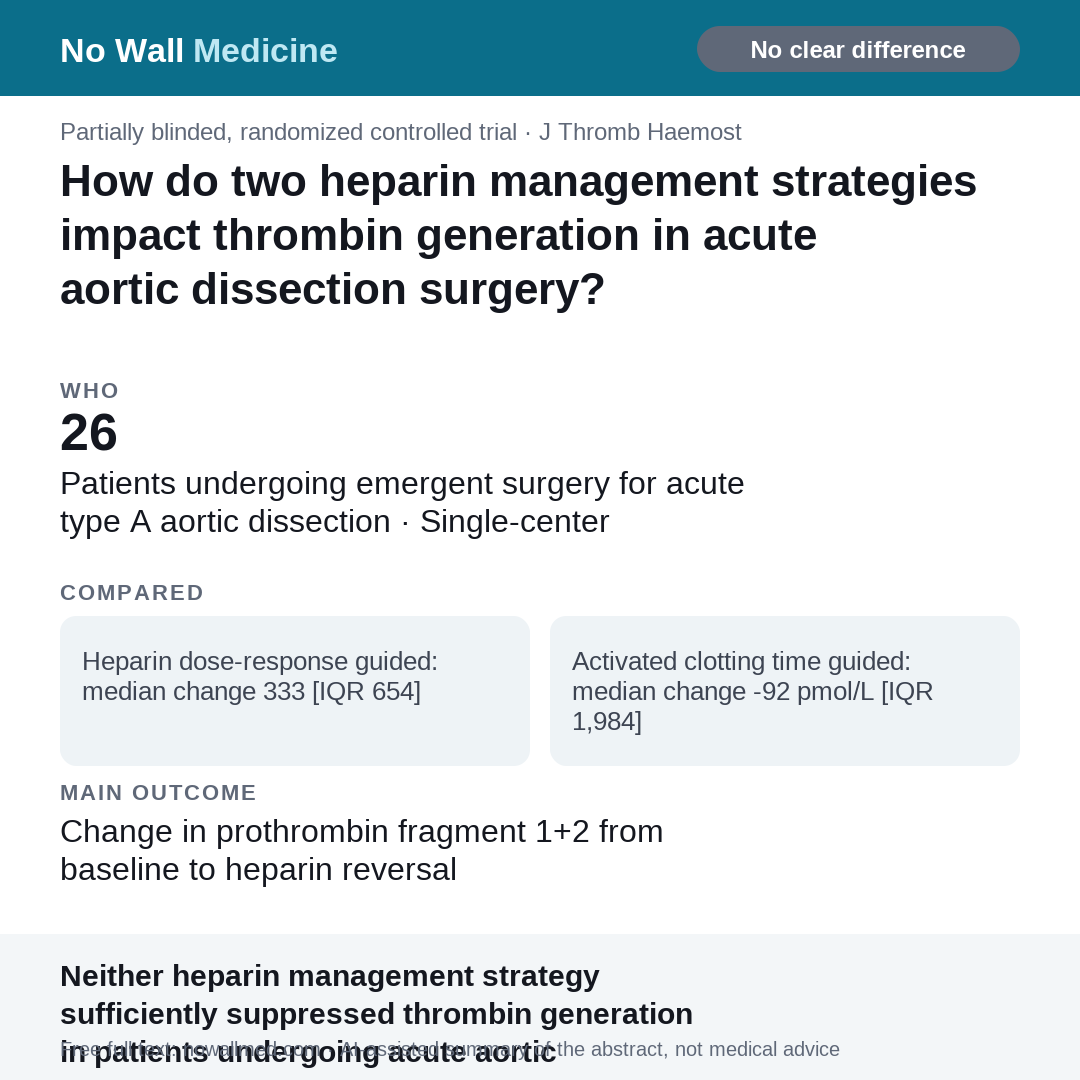
Clinical question: How do two heparin management strategies impact thrombin generation in acute aortic dissection surgery?
Why it matters: The optimal strategy for managing blood clotting during cardiopulmonary bypass in patients with acute type A aortic dissection remains uncertain.
Key points
- Researchers studied 26 patients undergoing emergency surgery for acute type A aortic dissection, comparing heparin dose-response to activated clotting time guided anticoagulation.
- The primary measure of thrombin generation change did not differ significantly between the groups, with a median change of 333 in the dose-response group versus -92 in the activated clotting time group.
- The heparin dose-response group had a lower protamine-to-heparin ratio, which is the amount of reversal agent used compared to the amount of blood thinner administered.
Headline and key points written with AI from the paper’s abstract, with every number checked against it. Read the paper before relying on them.
Spotted a mistake? Suggest a correction