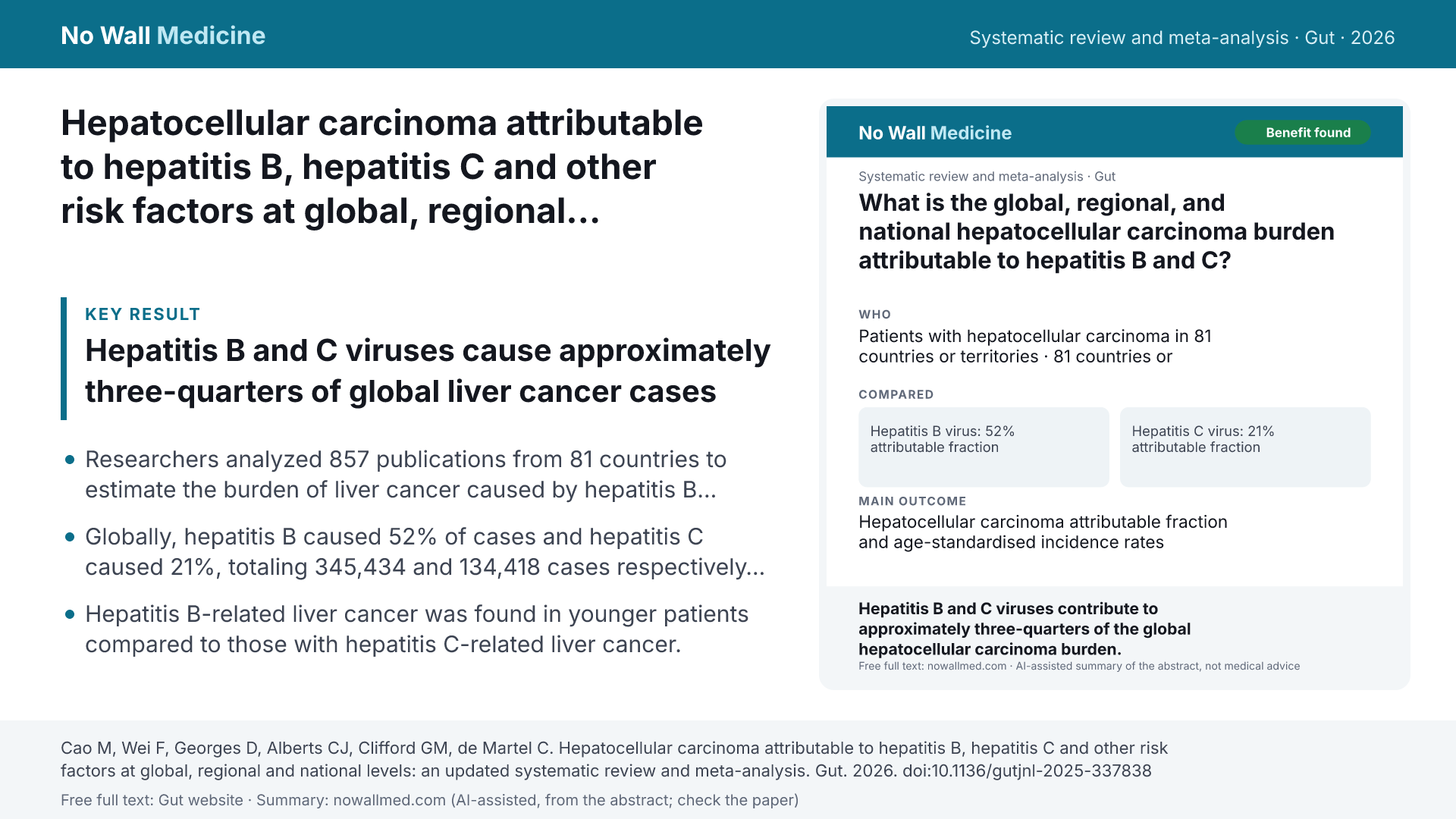
Hepatitis B and C viruses cause approximately three-quarters of global liver cancer cases
Hepatocellular carcinoma attributable to hepatitis B, hepatitis C and other risk factors at global, regional and national levels: an updated systematic review and meta-analysis
Systematic review and meta-analysisBenefit found
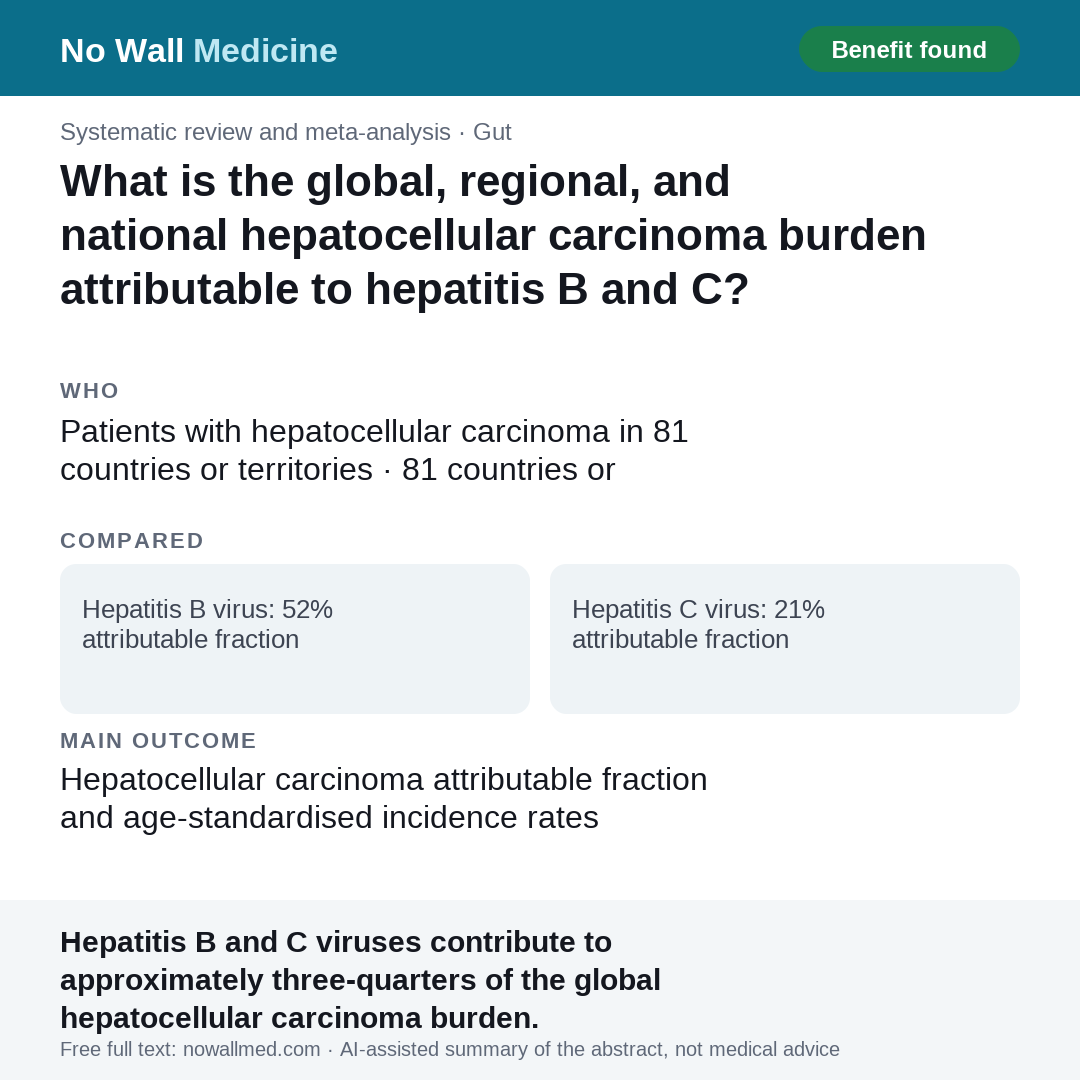
What is the global, regional, and national hepatocellular carcinoma burden attributable to hepatitis B and C?
Who
Patients with hepatocellular carcinoma in 81 countries or territories · 81 countries or territories
Compared
Hepatitis B virus: 52% attributable fraction
Hepatitis C virus: 21% attributable fraction
Main outcome
Hepatocellular carcinoma attributable fraction and age-standardised incidence rates
Bottom line: Hepatitis B and C viruses contribute to approximately three-quarters of the global hepatocellular carcinoma burden.
Gut · 2026-05-14Download image
Clinical question: What is the global, regional, and national hepatocellular carcinoma burden attributable to hepatitis B and C?
Why it matters: Data on how much hepatitis viruses contribute to the burden of liver cancer are essential for global hepatitis elimination.
Key points
- Researchers analyzed 857 publications from 81 countries to estimate the burden of liver cancer caused by hepatitis B and hepatitis C.
- Globally, hepatitis B caused 52% of cases and hepatitis C caused 21%, totaling 345,434 and 134,418 cases respectively in 2022.
- Hepatitis B-related liver cancer was found in younger patients compared to those with hepatitis C-related liver cancer.
Headline and key points written with AI from the paper’s abstract, with every number checked against it. Read the paper before relying on them.
Was this summary helpful?
Abstract
Background
Data on the contribution of hepatitis viruses to the burden of hepatocellular carcinoma (HCC) are essential for global hepatitis elimination. Objective
To estimate the HCC burden attributable to HBV and HCV by country, region and globally. Design
We performed a systematic review and meta-analysis between 1 October 2014 and 31 December 2023 using studies that reported the prevalence of both HBV and HCV in at least 20 patients with HCC. Pooled prevalence estimates by country were calculated to estimate regional and global HBV and HCV attributable fractions (AFs) and HCC-attributable age-standardised incidence rates (ASIRs). Results
857 eligible publications from 81 countries or territories were included. HBV and HCV prevalence among patients with HCC varied substantially by country and region. HBV AF was highest in Eastern Asia (70%), with HBV-attributable ASIRs of >10 per 100 000 observed in Mongolia and Viet Nam and was lowest in Northern Europe (6%). HCV AF was highest in Northern Africa (77%), and HCV-attributable ASIRs of >10 per 100 000 were observed in Egypt and Mongolia. Patients with HBV-related HCC were younger than patients with HCV-related HCC. Globally, HBV and HCV AFs were 52% and 21%, corresponding to 345 434 and 134 418 HCC cases, respectively, in 2022. Alcohol and/or metabolic dysfunction-associated steatotic liver disease were present in more than 30% of HCC in certain countries of Europe and South America. Conclusion
HBV and HCV contribute to approximately three-quarters of the global HCC burden. These data can inform viral hepatitis prevention strategies. Prospero registration number
CRD42023397708.
Abstract reproduced under the article’s CC BY NC licence.
Headline, design, result, key points, caveat and citation as plain text.
Cite this article
Cao M, Wei F, Georges D, Alberts CJ, Clifford GM, de Martel C. Hepatocellular carcinoma attributable to hepatitis B, hepatitis C and other risk factors at global, regional and national levels: an updated systematic review and meta-analysis. Gut. 2026. doi:10.1136/gutjnl-2025-337838
Spotted a mistake? Suggest a correction