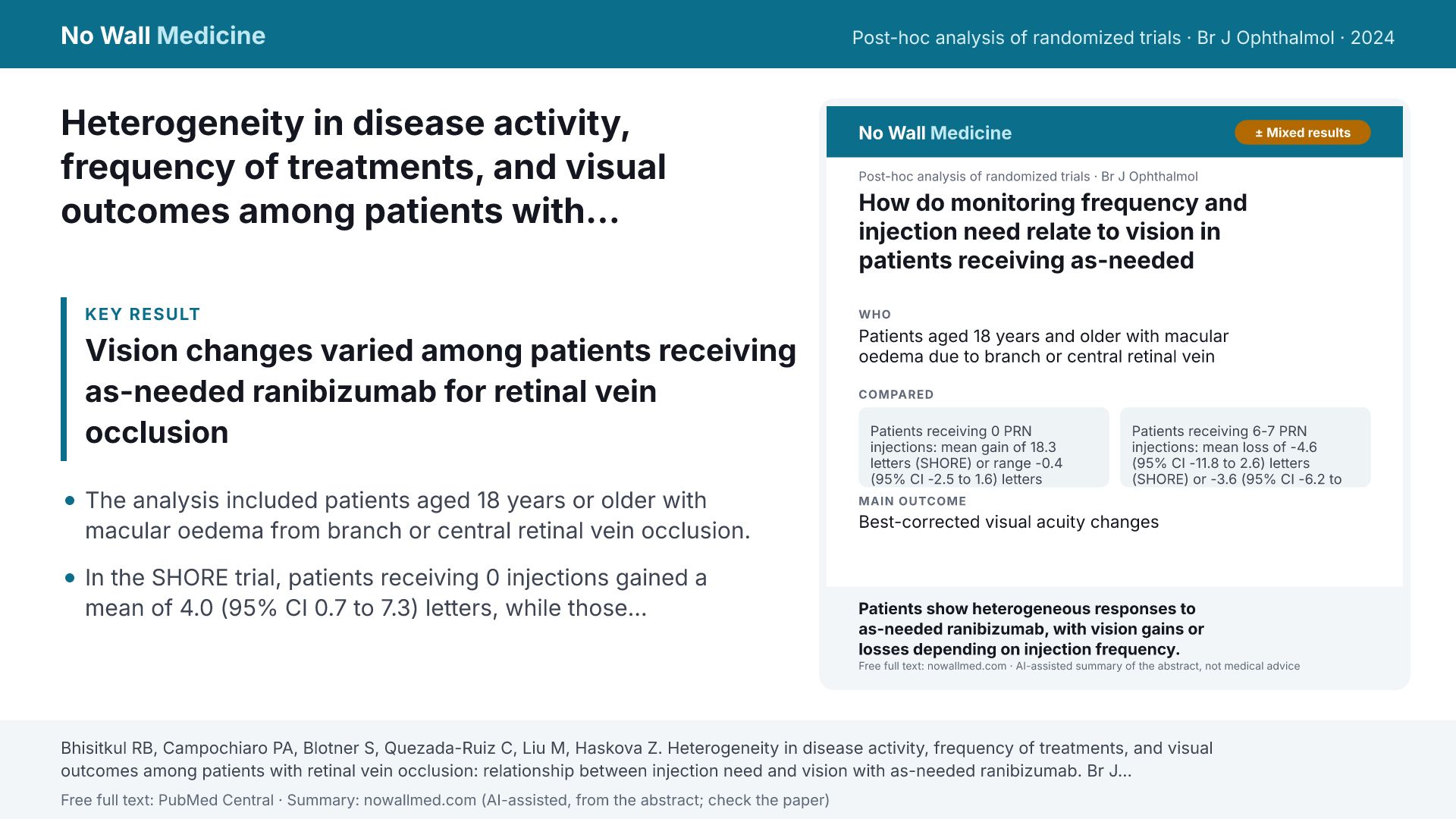
Vision changes varied among patients receiving as-needed ranibizumab for retinal vein occlusion
Heterogeneity in disease activity, frequency of treatments, and visual outcomes among patients with retinal vein occlusion: relationship between injection need and vision with as-needed ranibizumab
Post-hoc analysis of randomized trialsMixed results
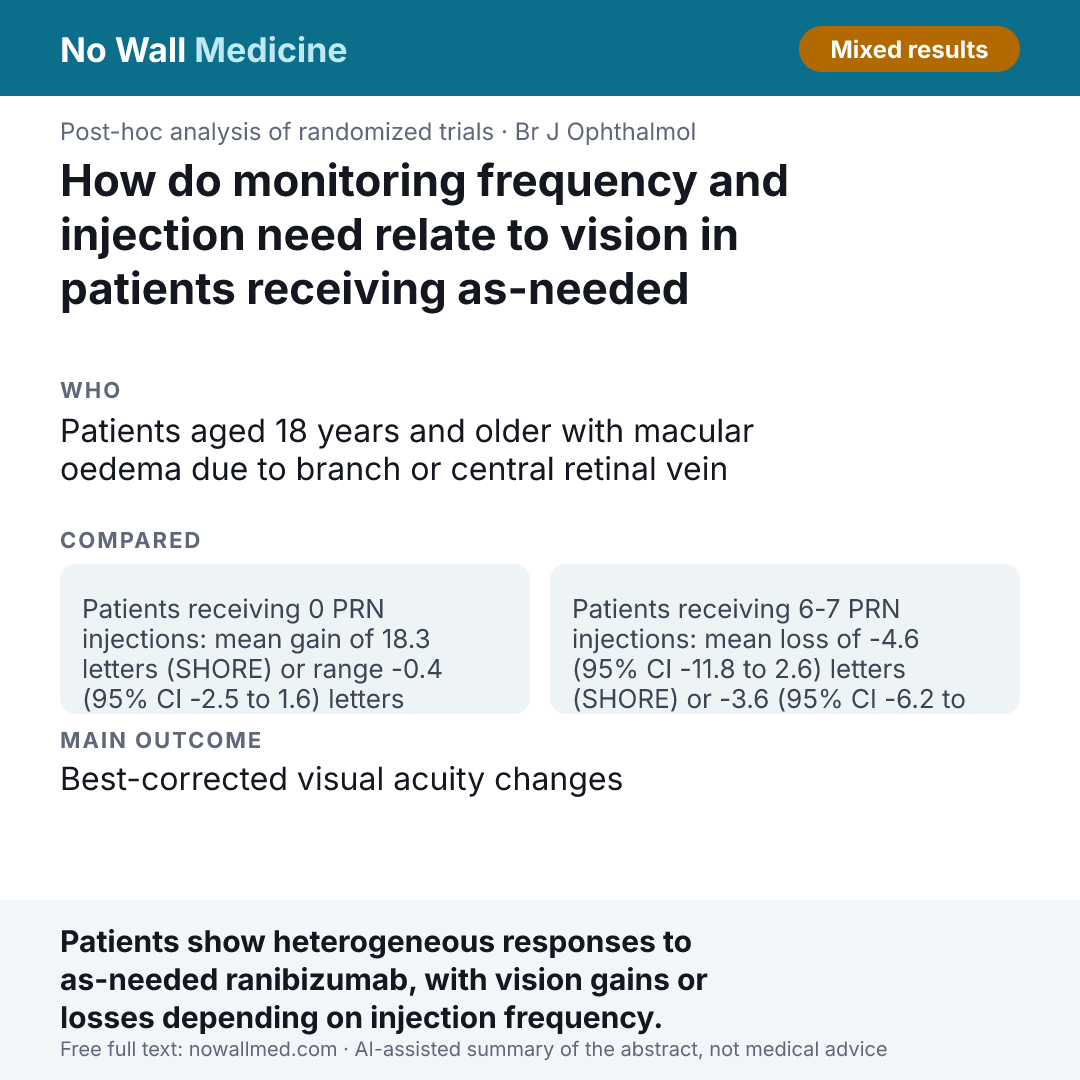
How do monitoring frequency and injection need relate to vision in patients receiving as-needed ranibizumab?
Who
Patients aged 18 years and older with macular oedema due to branch or central retinal vein occlusion · Not specified
Compared
Patients receiving 0 PRN injections: mean gain of 18.3 letters (SHORE) or range -0.4 (95% CI -2.5 to 1.6) letters (HORIZON)
Patients receiving 6-7 PRN injections: mean loss of -4.6 (95% CI -11.8 to 2.6) letters (SHORE) or -3.6 (95% CI -6.2 to -1.0) letters (HORIZON)
Main outcome
Best-corrected visual acuity changes
Bottom line: Patients show heterogeneous responses to as-needed ranibizumab, with vision gains or losses depending on injection frequency.
Limitation: This was a post-hoc analysis of existing trial data.
Br J Ophthalmol · 2024-08-22 · Save PNG
Clinical question: How do monitoring frequency and injection need relate to vision in patients receiving as-needed ranibizumab?
Key points
- The analysis included patients aged 18 years or older with macular oedema from branch or central retinal vein occlusion.
- In the SHORE trial, patients receiving 0 injections gained a mean of 4.0 (95% CI 0.7 to 7.3) letters, while those receiving 6-7 injections lost a mean of -4.6 (95% CI -11.8 to 2.6) letters.
- In the HORIZON trial, mean vision changes from baseline to 12 months ranged from -0.4 (95% CI -2.5 to 1.6) letters for zero injections to -3.6 (95% CI -6.2 to -1.0) letters for six injections.
Headline and key points written with AI from the paper’s abstract, with every number checked against it. Read the paper before relying on them.
Was this summary helpful?
Abstract
Background/aims
We characterised the relationships between monitoring frequency, ranibizumab injection need and vision in patients receiving as-needed (pro re nata; PRN) ranibizumab for macular oedema due to branch retinal vein occlusion (BRVO) or central retinal vein occlusion (CRVO) in this post-hoc analysis of SHORE and HORIZON. Methods
Patients aged 18 years and older with macular oedema due to BRVO/CRVO were included in this analysis. Injection frequency and best-corrected visual acuity (BCVA) were evaluated by PRN injection frequency in the PRN dosing phase (months (M) 7-15) of SHORE and through 12 months of HORIZON. Prespecified PRN re-treatment criteria for each trial were based on protocol-prespecified BCVA and optical coherence tomography outcomes. Results
After the initial 7 monthly ranibizumab injections, patients in SHORE gained a mean of 18.3 letters from baseline. Patients randomised to PRN, on average, maintained these gains. However, some patients experienced additional mean gains, whereas others suffered losses (range 4.0 (95% CI 0.7 to 7.3) to -4.6 (95% CI -11.8 to 2.6) letters in patients who received 0 and 6-7 PRN injections, respectively). In BRAVO and CRUISE (lead-in trials), patients experienced mean gains from baseline to M6 (monthly dosing) of 19.3 and 15.0 letters, respectively, with gains maintained with PRN from M6 to M12. However, mean BCVA changes from baseline to M12 varied in HORIZON (range -0.4 (95% CI -2.5 to 1.6) to -3.6 (95% CI -6.2 to -1.0) letters in patients who received zero and six injections, respectively, during the preceding PRN phase of BRAVO and CRUISE). Conclusion
The BRVO/CRVO population is heterogenous with a varied response to ranibizumab treatment.
Abstract reproduced under the article’s CC BY NC licence.
Subject terms
Headline, design, result, key points, caveat and citation as plain text.
Cite this article
Bhisitkul RB, Campochiaro PA, Blotner S, Quezada-Ruiz C, Liu M, Haskova Z. Heterogeneity in disease activity, frequency of treatments, and visual outcomes among patients with retinal vein occlusion: relationship between injection need and vision with as-needed ranibizumab. Br J Ophthalmol. 2024;108(9):1216-1225. doi:10.1136/bjo-2022-323120
Spotted a mistake? Suggest a correction