Variations in clinical trial characteristics and reporting complicate findings for Staphylococcus aureus blood infections
Heterogeneity in Staphylococcus aureus Bacteraemia Clinical Trials Complicates Interpretation of Findings
Systematic evaluation of randomized-controlled trialsMixed results
Does heterogeneity in Staphylococcus aureus bacteremia clinical trials complicate the interpretation of findings?
Who
Patients with Staphylococcus aureus bacteremia
Compared
Randomized-controlled trials
Observational cohorts
Main outcome
Interpretation and application of Staphylococcus aureus bacteremia results
Bottom line: Heterogeneity in cohort characteristics and outcome definitions complicates the interpretation of Staphylococcus aureus bacteremia randomized-controlled trials.
Limitation: Intertrial heterogeneity in cohort characteristics, reporting, and outcome definitions.
J Infect Dis · 2022-06-01Download image
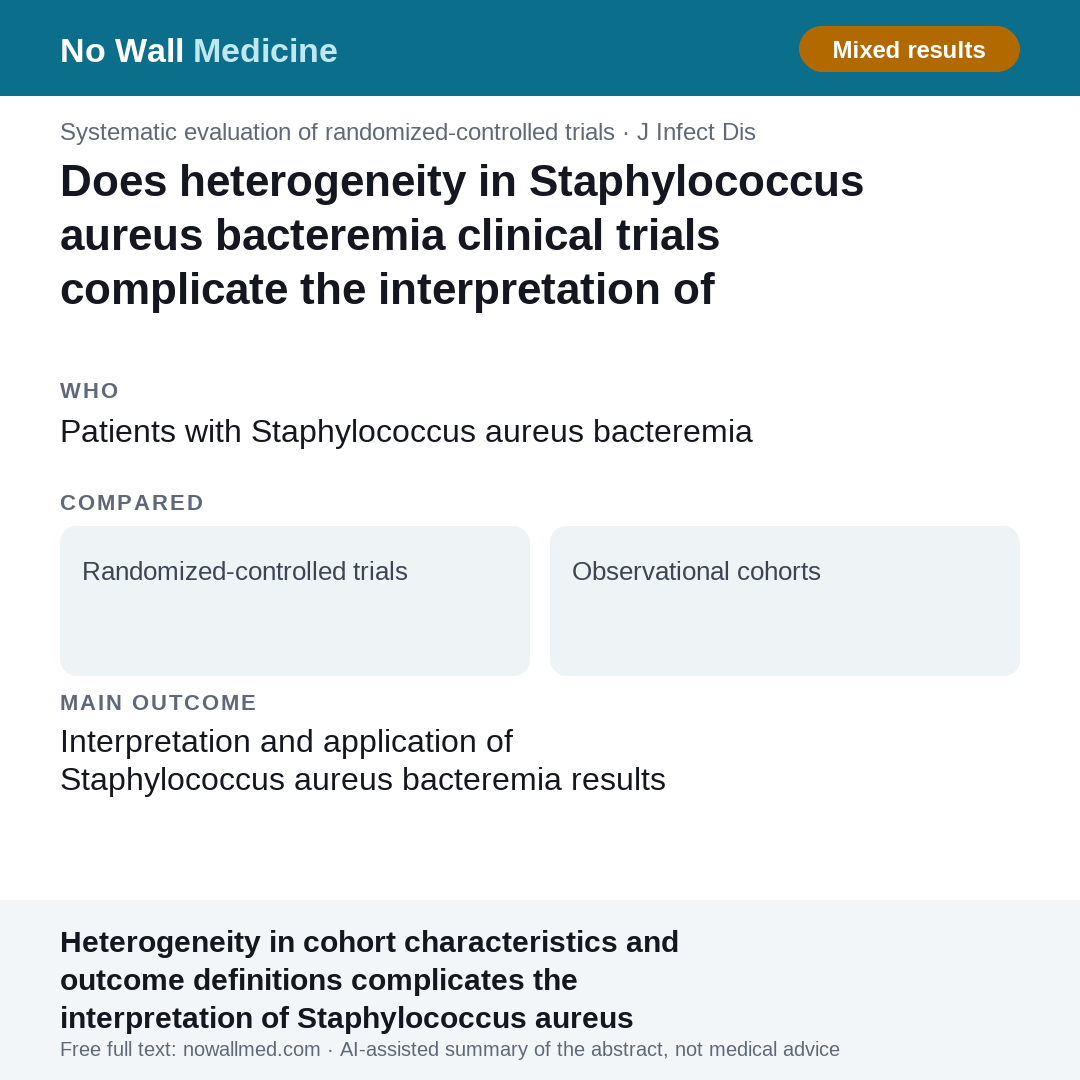
Clinical question: Does heterogeneity in Staphylococcus aureus bacteremia clinical trials complicate the interpretation of findings?
Why it matters: It is unclear how to apply results from clinical trials to real-world patients due to inconsistencies in how trials are designed and reported.
Key points
- Researchers systematically evaluated randomized-controlled trials involving Staphylococcus aureus bacteremia, which is a serious blood infection caused by the bacteria Staphylococcus aureus.
- The analysis found differences in patient characteristics, such as infection source and illness severity, and noted that mortality was lower in trial control groups than in observational groups.
- Inconsistent definitions of outcomes and variable reporting of patient details were found to make combining results through meta-analysis difficult.
Headline and key points written with AI from the paper’s abstract, with every number checked against it. Read the paper before relying on them.
Was this summary helpful?
Subject terms
Cite this article
Dolby HW, Clifford SA, Laurenson IF, Fowler VG, Russell CD. Heterogeneity in Staphylococcus aureus Bacteraemia Clinical Trials Complicates Interpretation of Findings. J Infect Dis. 2022. doi:10.1093/infdis/jiac219
Spotted a mistake? Suggest a correction
Top studies every Monday
The week’s key trials and guidelines in your specialties, plus any topics you follow. By email, free.
Get the weekly digest