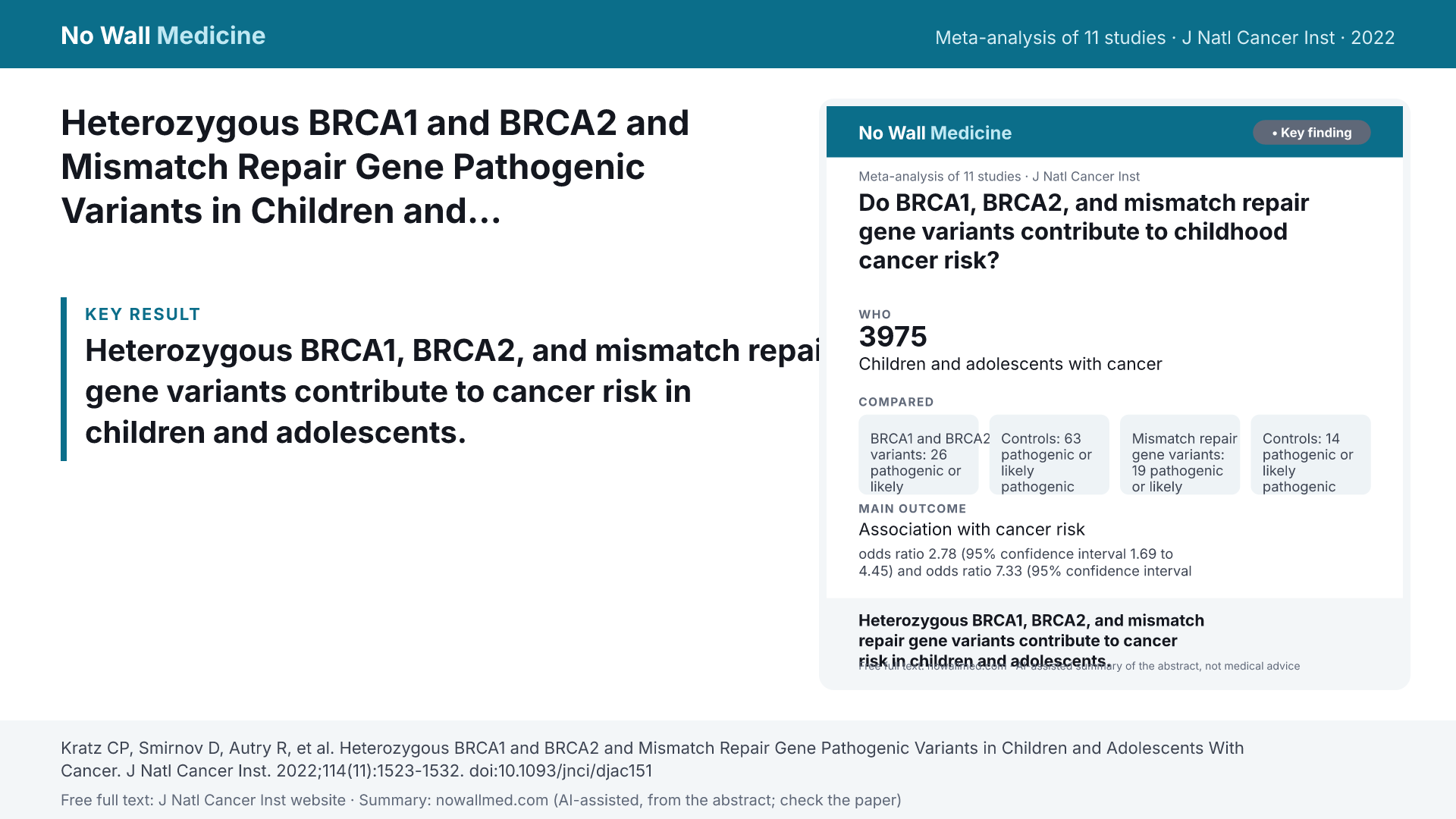
Heterozygous BRCA1 and BRCA2 and Mismatch Repair Gene Pathogenic Variants in Children and Adolescents With Cancer
Meta-analysis of 11 studiesBenefit found
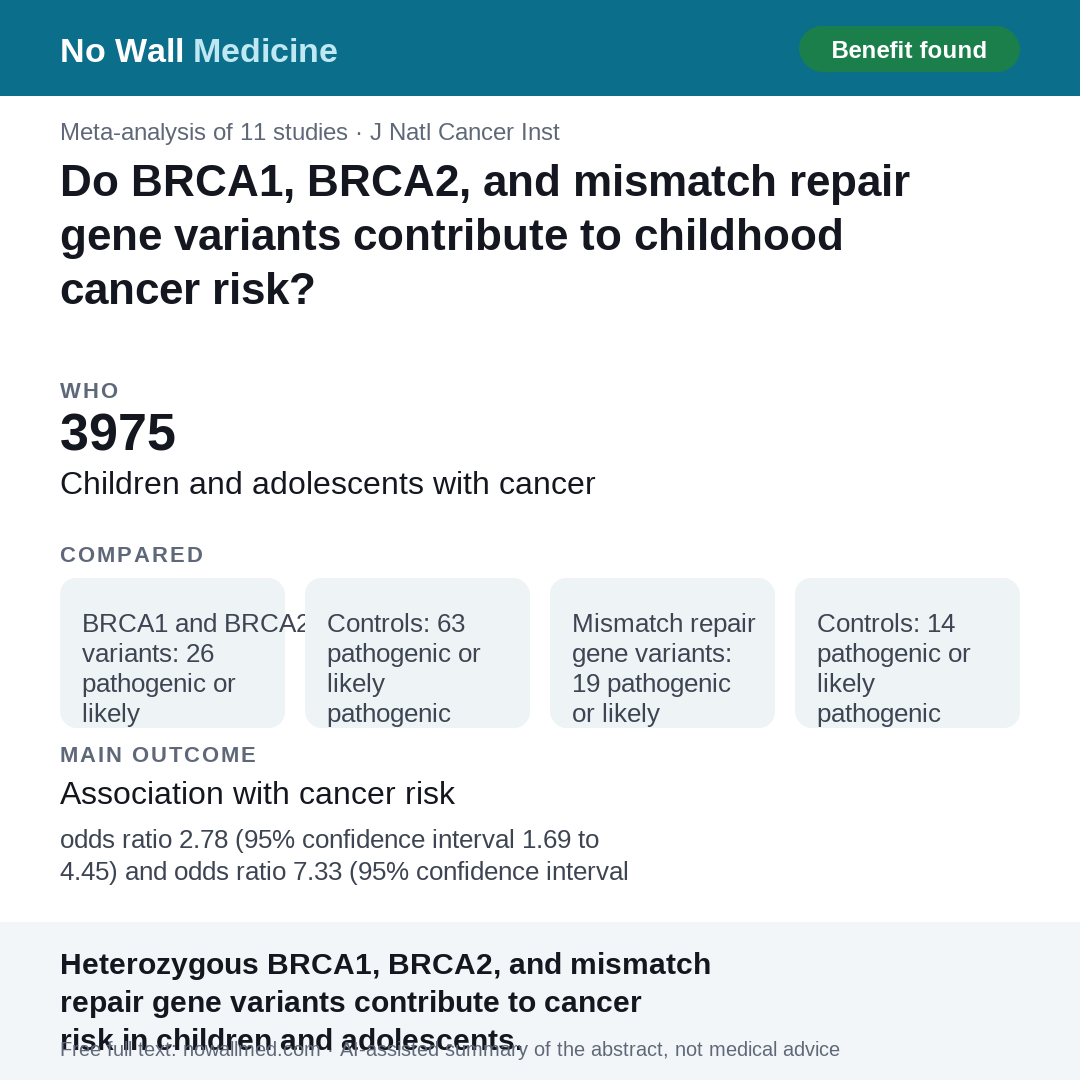
Do BRCA1, BRCA2, and mismatch repair gene variants contribute to childhood cancer risk?
Who
3975
Children and adolescents with cancer
Compared
BRCA1 and BRCA2 variants: 26 pathogenic or likely pathogenic variants
Controls: 63 pathogenic or likely pathogenic variants
Mismatch repair gene variants: 19 pathogenic or likely pathogenic variants
Controls: 14 pathogenic or likely pathogenic variants
Main outcome
Association with cancer risk
Result: odds ratio 2.78 (95% confidence interval 1.69 to 4.45) and odds ratio 7.33 (95% confidence interval 3.64 to 14.82)
Bottom line: Heterozygous BRCA1, BRCA2, and mismatch repair gene variants contribute to cancer risk in children and adolescents.
J Natl Cancer Inst · 2022-08-19Download image
Clinical question: Do BRCA1, BRCA2, and mismatch repair gene variants contribute to childhood cancer risk?
Abstract
Background
Genetic predisposition is has been identified as a cause of cancer, yet little is known about the role of adult cancer predisposition syndromes in childhood cancer. We examined the extent to which heterozygous pathogenic germline variants in BRCA1, BRCA2, PALB2, ATM, CHEK2, MSH2, MSH6, MLH1, and PMS2 contribute to cancer risk in children and adolescents. Methods
We conducted a meta-analysis of 11 studies that incorporated comprehensive germline testing for children and adolescents with cancer. ClinVar pathogenic or likely pathogenic variants (PVs) in genes of interest were compared with 2 control groups. Results were validated in a cohort of mainly European patients and controls. We employed the Proxy External Controls Association Test to account for different pipelines. Results
Among 3975 children and adolescents with cancer, statistically significant associations with cancer risk were observed for PVs in BRCA1 and 2 (26 PVs vs 63 PVs among 27 501 controls, odds ratio = 2.78, 95% confidence interval = 1.69 to 4.45; P < .001) and mismatch repair genes (19 PVs vs 14 PVs among 27 501 controls, odds ratio = 7.33, 95% confidence interval = 3.64 to 14.82; P <.001). Associations were seen in brain and other solid tumors but not in hematologic neoplasms. We confirmed similar findings in 1664 pediatric cancer patients primarily of European descent. Conclusion
These data suggest that heterozygous PVs in BRCA1 and 2 and mismatch repair genes contribute with reduced penetrance to cancer risk in children and adolescents. No changes to predictive genetic testing and surveillance recommendations are required.
Subject terms
Cite this article
Kratz CP, Smirnov D, Autry R, Jäger N, Waszak SM, Großhennig A. Heterozygous BRCA1 and BRCA2 and Mismatch Repair Gene Pathogenic Variants in Children and Adolescents With Cancer. J Natl Cancer Inst. 2022. doi:10.1093/jnci/djac151
Spotted a mistake? Suggest a correction